Work Jacket & Barn Jacket Manufacturing: Fabrics, Fit & Custom Details for Brands
Ask five brands what a "work jacket" is and you will get five different garments. One buyer means a French-style chore coat. Another means a corduroy-collared barn jacket. A third is picturing the hip-length, zip-front silhouette that mechanics and ranchers have worn for seventy years. Every one of them is technically right — and that is precisely why so many workwear programs go sideways.
These jackets belong to the same family, but they are cut from different blocks, run on different fabric weights, and land in completely different retail price bands. The decisions you lock in during the first three weeks decide almost everything that follows: fabric weight, collar type, pocket layout, wash level, and where the branding goes.
This guide walks through those decisions in the order a factory actually needs them — not in the order a mood board presents them.
Why Workwear Stopped Being a Niche Category
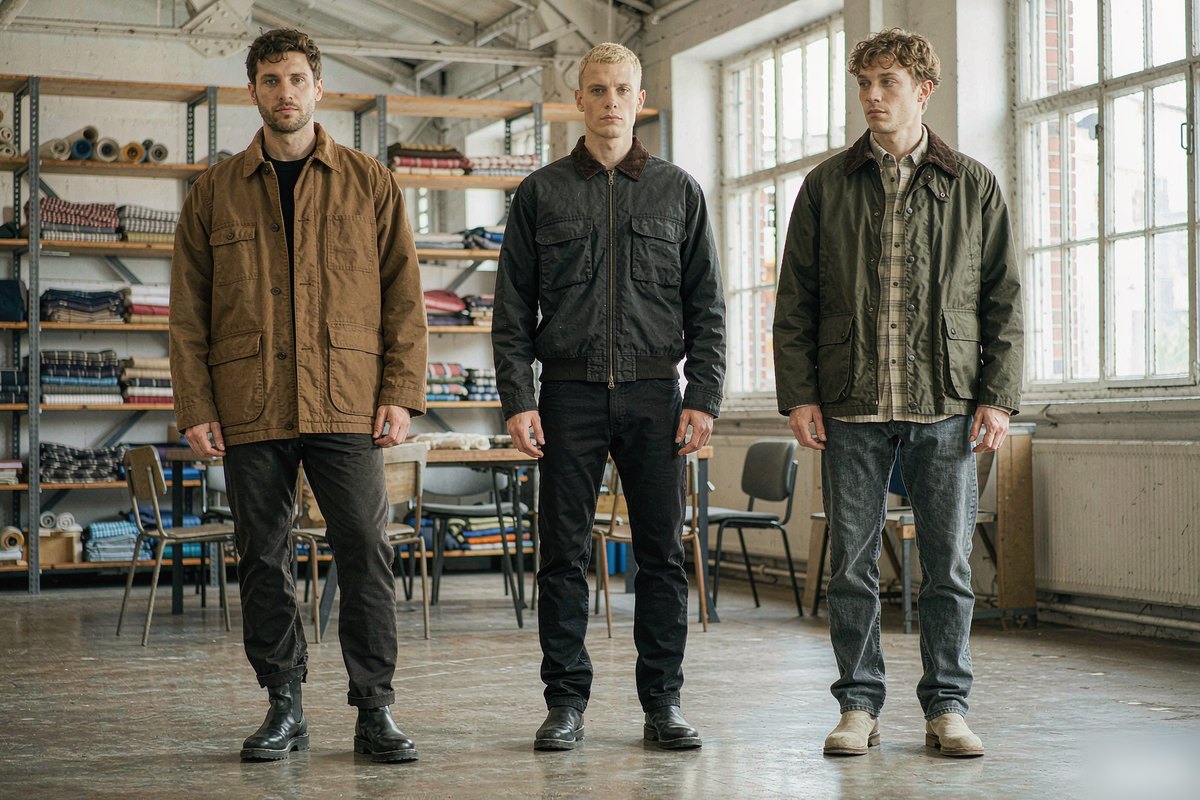
For most of the last decade, workwear was something a streetwear brand borrowed for one or two hero pieces per season. That is no longer how it works. Utility silhouettes have moved from "trend" to "baseline" — the same thing that happened to the hoodie in the 2010s and to denim in the 1990s. When a category becomes baseline, buyers stop asking whether they need it and start asking how to execute it better than the brand next to them.
That shift changes the manufacturing conversation completely. A trend piece can survive sloppy construction because nobody is going to wear it four days a week. A workwear program cannot. If your barn jacket loses its shape after six washes, or the corduroy collar pills at the fold, the customer does not blame the fabric mill — they blame your brand and never come back.
Utility Moved From Statement to Staple
Look at what racks actually move in fall and winter: chore coats, barn jackets, utility vests, cargo pants, technical shells. There is a reason. These garments photograph well, they layer over everything, and they carry a story — real workwear heritage — without needing a marketing team to explain it. Our 2026 utility streetwear breakdown covers the wider capsule, but the jacket is almost always where a brand starts, because it carries the highest perceived value per unit.
What Brands Get Wrong Before They Even Request a Quote
The most expensive mistake in workwear development is not choosing the wrong fabric. It is choosing no fabric at all — arriving at a factory with a Pinterest board and a price target and expecting the supplier to reverse-engineer a specification. Good factories can absolutely work from references. But a reference image tells us nothing about the four things that actually drive cost and lead time:
- Shell weight in ounces per square yard — an 8 oz canvas and a 14 oz duck are different products, not different grades of the same product.
- Lining architecture — unlined, quilted taffeta, flannel, or sherpa. Each one changes the pattern, the seam allowance, and the finishing sequence.
- Wash direction — raw, garment-washed, or heavily distressed. This single decision can move your sampling timeline more than any other variable.
- Target use case — a fashion layering piece and a genuine field jacket are engineered differently at the armhole, the gusset, and the hem.
Sort those four out early and you will save yourself at least one full sample round. Ignore them and you will pay for the round anyway, just later and with more freight attached. If you want a structured version of this conversation, our pre-sampling checklist for custom work jackets is a good place to start.
Work Jacket vs Barn Jacket vs Chore Jacket: Where the Construction Actually Diverges
Here is the part that trips up nearly every first-time buyer. These three categories look interchangeable on a screen and behave nothing alike on a pattern table. The differences sit in length, closure, collar, and pocket engineering — and each one ripples through fabric consumption, labor minutes, and retail positioning.
The Chore Coat: The Blank Canvas
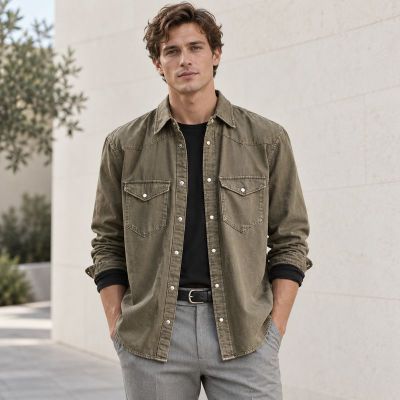
The chore coat — or chore jacket, or bleu de travail if you want the French heritage angle — is the simplest and oldest of the family. Think straight, boxy body, button front, three or four patch pockets, no contrast collar, usually unlined or lightly lined. It came out of nineteenth-century European labor wear and it has barely changed, which is exactly its commercial appeal: it is a clean canvas for your brand's fabric and wash decisions.
Because there is so little hardware and no lining structure, the chore coat is also the cheapest of the three to develop. That makes it the natural entry point for a brand testing the category, and the natural volume driver once the silhouette is proven. If you want to see how a finished one reads, our crinkle-wash chore coat shows what a simple block plus an interesting finish can do.
The Barn Jacket: The Weather-Proofed Cousin
Take the chore coat, add a corduroy collar, lengthen the body slightly, deepen the pockets so they hold gloves, and give it a warmer lining — flannel plaid, quilted taffeta, or sherpa — and you have a barn jacket. The American variant grew out of exactly the environment the name suggests: farm work in cold, wet, dirty conditions, which is why it is heavier, more structured, and more protective than its French ancestor.
Two features do most of the identification work: the contrast collar, and the warmer lining. Remove both and you are back to a chore coat. That matters commercially, because the barn jacket sits one price tier above the chore coat and customers expect to feel the difference — a heavier hand, a sturdier closure, a collar that stands up.
The Detroit-Style Work Jacket: The Mobility Play
The third silhouette is the shortest and the most technical. Hip-length, zip-front, ribbed knit hem and cuffs, corduroy collar, slash hand pockets plus a zippered chest pocket. It exists because a longer jacket bunches up when you sit, bend, or reach over a fender — so it was cut short and given elastic at the hem to stay put. The result is a jacket that reads as clothing rather than costume, which is why it has crossed over so successfully into streetwear.
Note the construction consequence: a rib hem means a knit trim component, which means a separate supplier, a separate color match, and a separate shrinkage test. That is more moving parts than either of the other two silhouettes. Our jacket manufacturing overview covers how those trims get specified and matched.
Side by Side: What Actually Changes
| Specification | Chore Coat | Barn Jacket | Detroit-Style Work Jacket |
|---|---|---|---|
| Typical length | Hip, straight and boxy | Hip to just below, slightly longer | Short hip, cropped feel |
| Collar | Self-fabric, flat | Contrast corduroy or leather | Contrast corduroy |
| Closure | Button front | Buttons or snaps, often over a zip | Heavy-duty zip |
| Pockets | Three to four patch pockets | Large flap patch plus hand-warmer openings | Slash hand pockets plus zip chest pocket |
| Lining | Unlined or light | Flannel plaid, quilted, or sherpa | Quilted taffeta or mesh |
| Hem and cuffs | Self-fabric, straight | Self-fabric, straight | Ribbed knit hem and cuffs |
| Best for | Layering, three-season retail volume | Cold-weather heritage positioning | Mobility, streetwear crossover |
One practical note: nothing stops you from blurring these lines. Plenty of successful programs build a barn jacket with a zip front, or a Detroit block with patch pockets. Blurring is fine — just make sure you blur deliberately and write it into the tech pack, because pattern makers will otherwise default to the convention and hand you something you did not ask for.
Canvas, Duck, Twill, Denim or Corduroy? Reading Fabric Like a Pattern Maker
Fabric is where workwear programs are won or lost, and it is almost never decided on the basis of feel alone. A shell choice sets your abrasion resistance, your drape, your wash possibilities, your colorfastness risk, and your per-unit fabric consumption. Let's go through the real options.
Duck Canvas: Still the Undisputed King
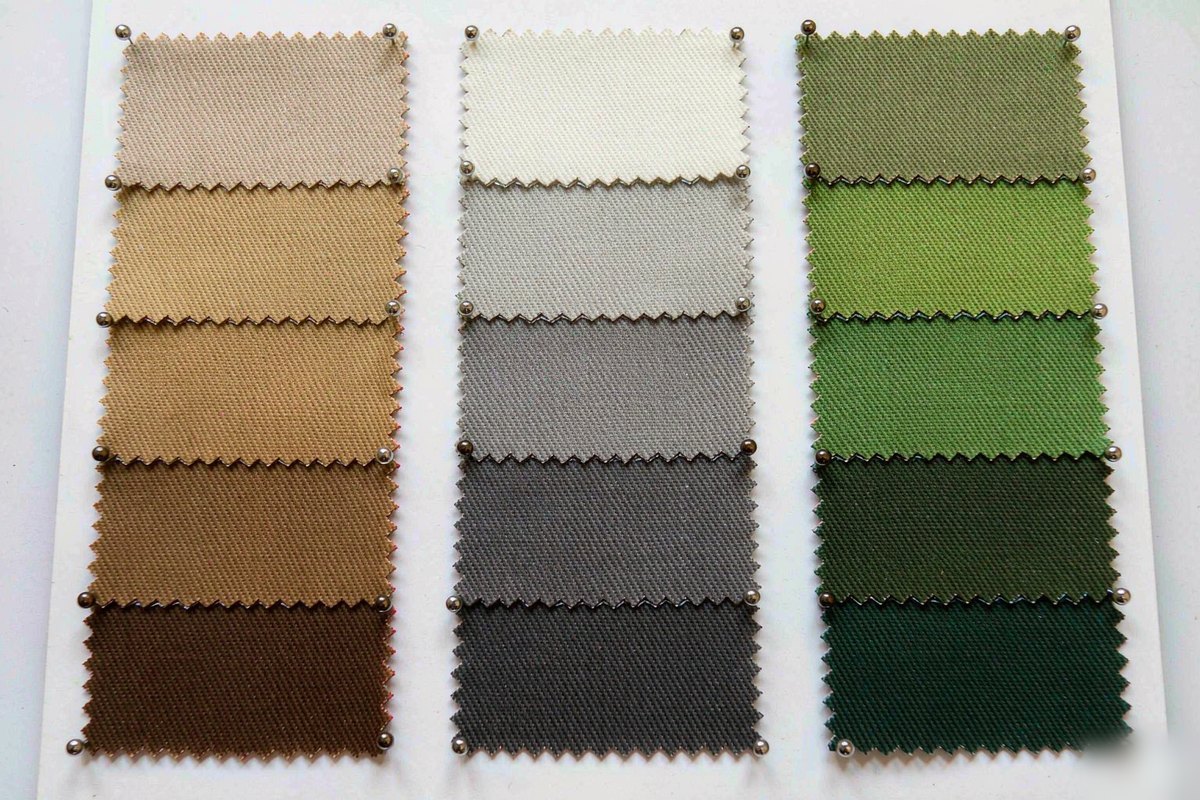
Cotton duck is a tightly woven, plain-weave fabric that resists tearing and abrasion without being stiff enough to fight the wearer. It is the default shell for a reason, and the specification that matters most is weight, measured in ounces per square yard. As a working rule, 10–12 oz handles temperate climates and retail layering, while 12–14 oz delivers the rugged, armor-like hand that heritage customers are paying for.
Heavier is not automatically better, though. Every extra ounce adds cost, reduces drape, and demands a stronger needle, a longer stitch length, and more machine time. If your customer is a commuter rather than a carpenter, a 14 oz shell is a liability dressed up as a virtue.
Heavy Twill and Poly-Cotton Twill: The Colorfastness Play
Cotton twill gives you a softer break-in and a cleaner surface for print and embroidery. Blending in polyester — typically a 65/35 split — noticeably improves color retention and shrinkage control, which matters enormously if your program runs in bright or saturated colors, or if you need a long repeat life across seasons.
The trade-off is character. Poly-cotton reads slightly more uniform and slightly less "heritage" than pure cotton duck. There is no universally right answer here; it depends on whether your customer buys the story or the durability. Our fabrics and techniques reference breaks down which shells pair best with which finishing routes.
Denim: When You Actually Want the Fades
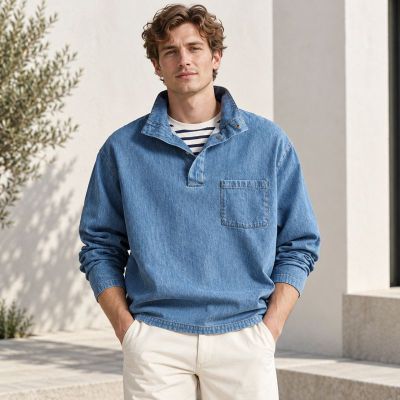
Denim as a workwear shell is a deliberate aesthetic choice. Raw or rigid denim at 12 oz and above gives you the abrasion resistance of canvas with the promise of personal fading — the jacket molds to the wearer and records where they've been. That is a genuinely powerful retail story, and it is the reason denim work jackets keep selling.
But be honest about the cost: denim adds wash complexity, indigo crocking risk, and a longer development cycle. If you are already building a denim capsule, the economics improve because you are sharing fabric and wash development. Our denim jacket manufacturing page and the denim jacket development guide cover that route in detail, and our custom denim range shows how a workwear silhouette sits inside a broader denim line.
Corduroy: The Detail That Says "Barn Jacket" Without a Label
Corduroy rarely appears as a full body fabric in production workwear — it is too soft and too directional. Where it earns its place is the collar, and sometimes the cuff facing. A wide-wale corduroy collar in a contrasting tone is the single most efficient piece of category signaling available to you. It adds maybe a dollar or two of material and instantly moves the garment from "canvas jacket" to "barn jacket" in the customer's mind.
Specify the wale count (wales per inch), the fiber content, and the color explicitly. "Brown corduroy collar" is not a specification; it is a wish.
What Weight Should You Specify?
| Positioning | Shell weight | What it delivers |
|---|---|---|
| Lightweight fashion layering | 8–10 oz | Soft drape, easy break-in, lowest fabric cost |
| Mainstream retail, temperate | 10–12 oz | Balanced structure and comfort, works over a hoodie |
| Heritage and rugged outdoor | 12–14 oz | Maximum abrasion resistance, stiff hand that softens with wear |
| Waxed or coated finishes | 10–14 oz | Weather resistance, develops a patina, needs care instructions |
Fit, Cropped Proportions and the Layering Allowance Nobody Plans For
Fit is the most argued-about and least well-specified part of workwear development. Two brands can approve the same fabric and the same trim and end up with garments that sell to completely different customers, purely because of block decisions. So let's make those decisions concrete.
Boxy, Oversized or Cropped? Three Blocks, Three Buyers
Classic boxy keeps the shoulder close to natural, the body straight, and the rib or hem balanced. It sells to a customer who wants a workwear jacket to look like workwear — a clothing purchase, not a fashion statement.
Oversized drops the shoulder, lengthens the sleeve, and broadens the chest and armhole. It reads as streetwear and it photographs beautifully on a model, but it demands more fabric, and it creates a fit-consistency risk in grading because the extra ease amplifies any pattern error.
Cropped shortens the body, raises the hem, and usually shortens the sleeve slightly. It is a strong seasonal drop piece and a weaker core stock piece, because cropped proportions date faster than boxy ones.
There is no wrong answer. There is only a mismatch between block and buyer — and that mismatch usually shows up as returns rather than slow sales, which makes it much harder to diagnose.
The Layering Allowance Is a Number, Not a Feeling
Every workwear buyer eventually says the same sentence: "It needs to fit over a hoodie." Respectfully, that is not a measurement. The layering allowance is a specific amount of ease at the chest, the armhole, and the upper sleeve, and it has to be written into the spec sheet before the pattern is cut.
Here is the practical version. Take the exact garment the customer will layer underneath — not a generic assumption, the actual hoodie — measure its chest width across the front, and add the ease you want. If the jacket is meant to work over a hoodie and a light flannel, that is a bigger number than if it only layers over a tee. Pattern makers can hit any of those targets; they just cannot hit a target that was never stated.
Grading: Where Otherwise-Good Work Jackets Fall Apart
Grading is the quiet killer. A jacket can be flawless in a size medium and wrong in an XL — armhole too tight, sleeve too short, hem riding up, pocket placement drifting toward the panel edge. This is the point where cheap development becomes expensive, because the consumer who wears an XL is often the one who complains loudest.
Ask your factory how they verify grading before bulk cutting. At minimum, there should be master patterns locking fit and grading so the silhouette stays consistent from sample through replenishment, and there should be a wash test on the graded sizes, not just the base. Washed garments shrink differently at different sizes, which is why a barn jacket that measures perfectly raw can come back from the wash a full size off in the largest grade.
Corduroy Collars, Snap Closures and Pocket Logic
Details are where a work jacket stops being a commodity and starts being a product. They are also, conveniently, the cheapest place to add perceived value — a few dollars of trim can shift how a jacket is read at retail more than a fabric upgrade will.
The Collar Is the Category Signature
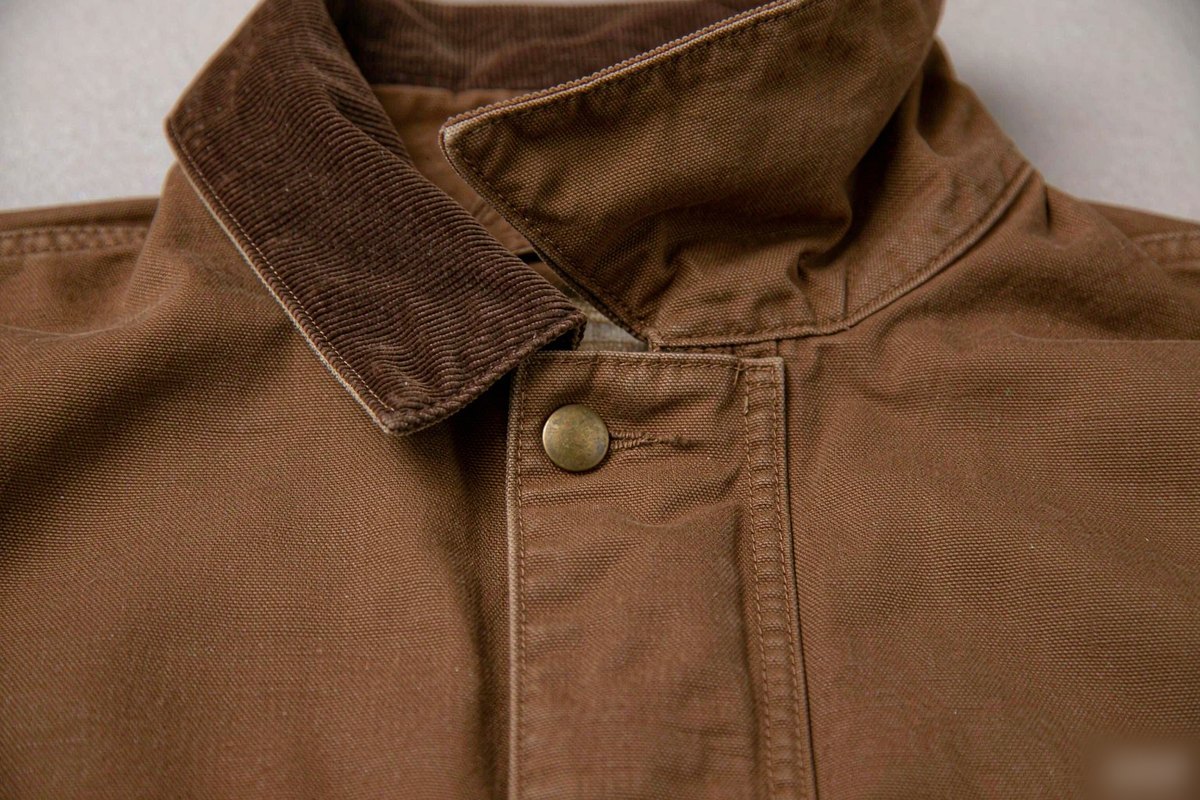
A barn jacket without a corduroy collar is just a canvas jacket. This is worth stating plainly because we see programs cut corners here and then wonder why the garment feels anonymous.
Three things to specify: the wale count (wider wales read more traditional and more rugged), the contrast tone (a darker brown or a deep rust against an olive or stone shell is the classic pairing), and how the collar is constructed. A collar that is simply sewn in will pucker at the fold over time. A collar with proper interlining, edge binding, and controlled topstitching will hold its line through years of abuse — which is exactly the standard a workwear customer applies.
Closures: Buttons, Snaps and Zips Are Not Interchangeable
The closure determines how the jacket feels in the hand and how it survives the first winter. Here is how to think about it:
- Buttons read heritage and are the most repairable. A lost button is a five-second fix for the customer, which is a genuine long-term retention advantage for a workwear program.
- Metal snaps read utilitarian and are faster to close with cold hands. Specify snap pull strength and check plating for corrosion resistance, because cheap snaps tarnish and that tarnish shows up in photos and reviews.
- Heavy-duty zips are the Detroit-style signature. Specify the gauge, the tape width, and the slider type — a lightweight zip on a heavy canvas shell is the most common mismatch we see in incoming samples.
- Zip plus snap storm flap is the cold-weather combination. It adds labor and a hardware set, but it changes the garment from three-season to genuinely winter-capable.
Whichever you choose, put it in the tech pack with a part number. "Metal snaps" is not a specification, and unspecified hardware is where factories quietly substitute.
Pocket Design Is a Use-Case Decision, Not a Decorative One
Count the pockets on a well-designed work jacket and you will usually find four to six, each with a job. Patch pockets at the lower front for bulk carry. Hand-warmer openings at the sides for cold hands. A chest pocket sized to a phone, a notebook, or a tool. Sometimes a sleeve pocket or an interior security pocket.
The engineering constraint is that pockets must not fight the silhouette. Oversize a patch pocket and the jacket looks like a vest. Place a chest pocket too high and it collides with the collar and the topstitching. Put it too low and it disappears under a layer. Pocket height, width, depth, flap angle, and corner reinforcement all have to be specified — and pocket corners are precisely where bar-tacks earn their keep.
Ask yourself what the wearer is actually carrying. Then size the pocket to that answer. Our cotton canvas work jacket with utility pockets is a good reference for how a practical pocket layout reads in production, and our color-block work jacket shows how a single well-placed chest pocket can carry a whole design.
Washed, Faded, Distressed and Vintage Finishes
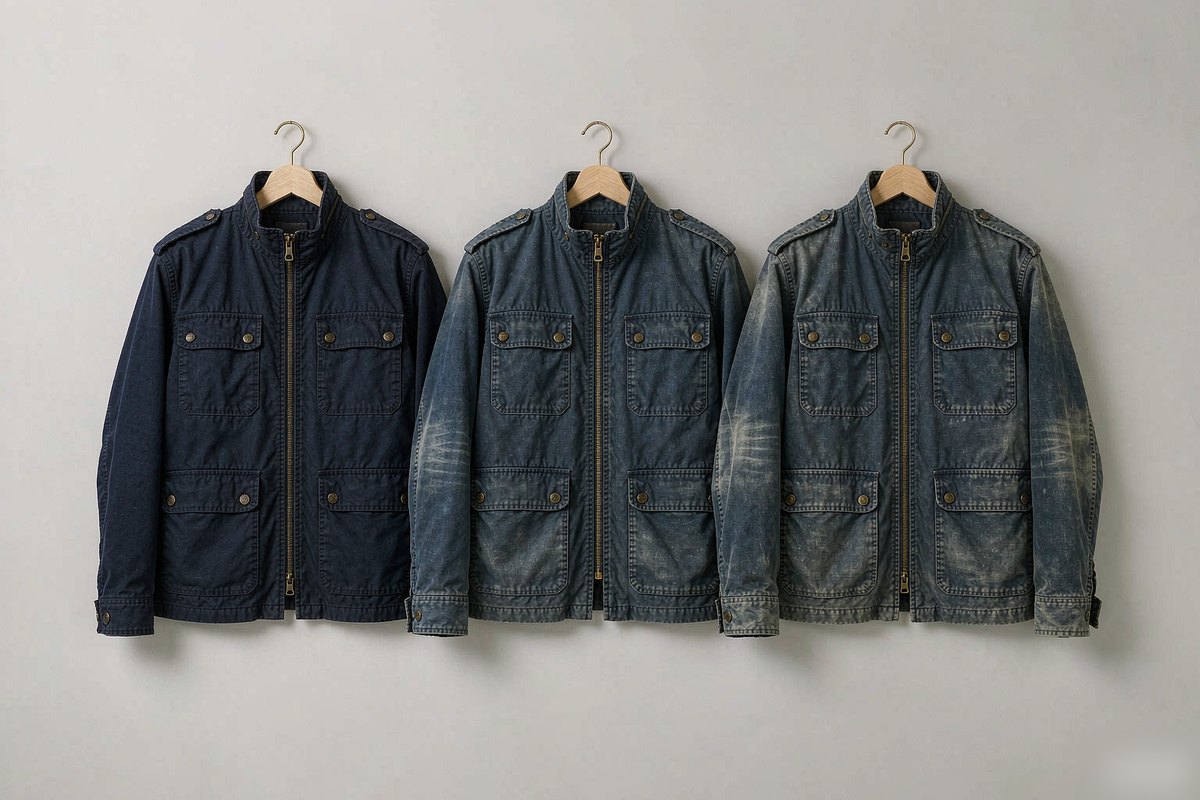
Washing is the most misunderstood step in the whole workflow, largely because it is the step that behaves least like a manufacturing process and most like a recipe. You cannot simply "add washing" to a jacket at the end. Wash has to be designed in from the first sample, because it changes the pattern, the measurements, the trim choices, and the care label.
How Wash Development Actually Works
Wash effects come from three broad families of process, and they are usually combined:
Enzyme Wash
Enzyme washing softens the fabric and creates gentle color variation along seams and high-wear areas. It is the workhorse finish for "broken-in but not destroyed" — controlled, repeatable, and comparatively gentle on trims and hardware.
Stone Wash
Stone washing uses abrasive pumice to produce stronger, more visible fading and a genuinely worn hand. It is harder on the garment and harder on the machine, which is why it costs more and why it accelerates wear on the wash drum itself.
Garment Dye and Pigment Dye
These processes work in the other direction: you build the garment first and add color afterward, producing the muted, slightly uneven workwear tones that machinery and hand-sanding can then highlight. The result is a depth that a piece-dyed fabric simply cannot produce.
Hand-Sanding, Whiskering and Spot Distressing
These are applied as targeted finishing operations, and they are the least repeatable part of the process. That is the honest trade-off: the more "handmade vintage" a finish looks, the harder it is to reproduce exactly. If your program needs tight consistency across repeat orders, choose an enzymatic route over a heavily distressed one and let the fabric do the aging on the customer's back.
Repeatability Is the Hardest Part of a Washed Program
Here is the question to ask every factory you evaluate: how do you guarantee that next season's batch matches this season's approved sample? Anyone can wash a jacket. Matching a wash across a reorder, twelve months later, in a different humidity, requires retained standards and controlled process parameters.
The answer you want involves retained reference samples, fixed wash recipes with recorded liquor ratios and cycle times, controlled temperature, and an inspection step that compares the finished garment against the original standard under consistent lighting. Without those, your "vintage black" quietly becomes "medium gray" in season three and your reviews start mentioning inconsistency.
Washed Garments Change the Care Label You Have to Write
Every wash decision has a downstream consequence: what you tell the customer to do with the jacket afterward. Waxed and coated shells should never be machine washed, and they need re-waxing guidance if the finish is to survive. Garment-dyed pieces bleed if washed hot. Heavy canvas softens dramatically in the first wash, which means your size chart should account for it or your returns will.
In the United States, permanent care instructions are not optional — the FTC's Care Labeling Rule requires manufacturers and importers to attach them, and it also requires a reasonable basis for whatever you print. In practice that means the care content has to come out of actual testing, not out of a template. Wash testing protocols, including colorfastness and dimensional stability methods, are standardized by bodies such as AATCC, and your factory should be able to tell you which methods they run and what the results were.
Branding Details Built to Survive a Washing Machine
Workwear branding occupies an awkward spot. It needs to be visible enough to build recognition, durable enough to survive industrial washing, and subtle enough that it does not turn a heritage jacket into a billboard. Getting all three right is a decoration-specification problem, not a design problem.
Embroidery, Patches, Woven Labels and Custom Hardware
Each decoration route has a natural home on a workwear jacket:
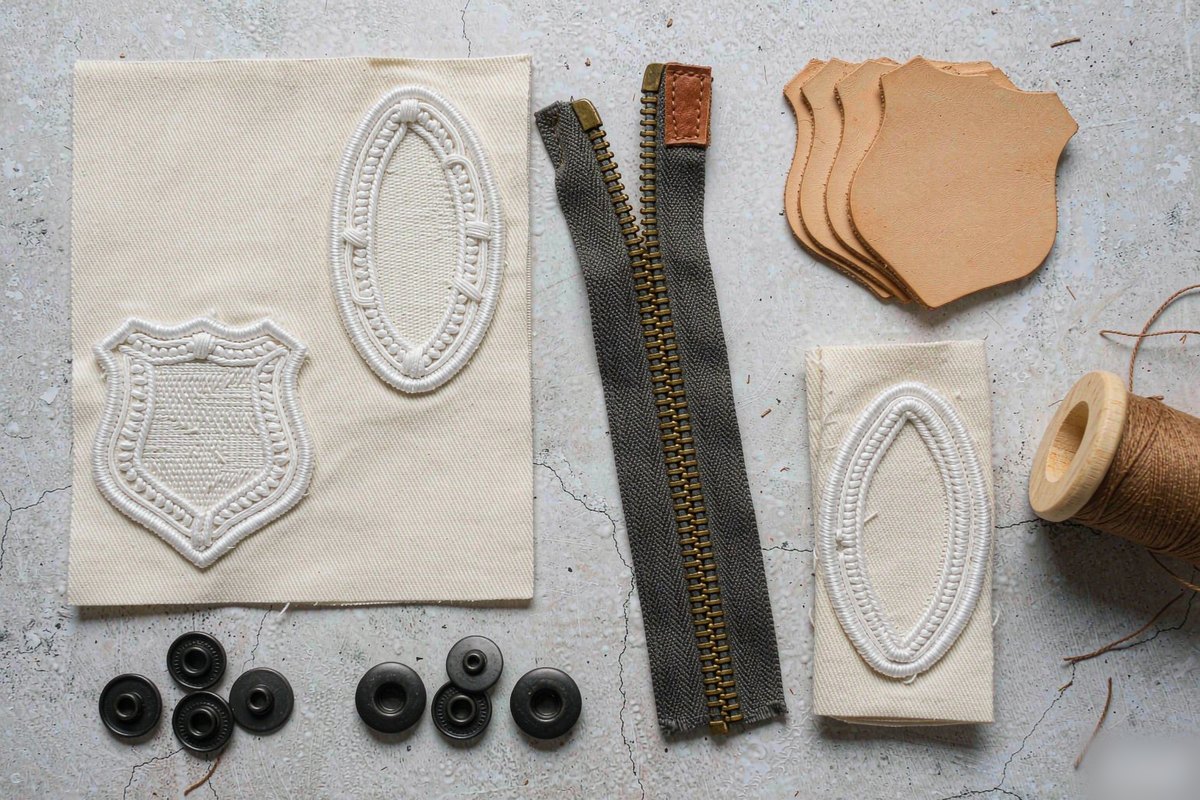
- Embroidery is the default for a chest hit or a sleeve mark. It reads premium, it survives washing better than almost anything else, and it works on rigid canvas where print struggles. Watch the stitch count on heavy fabric — dense artwork on a stiff shell can pucker the panel unless the backing is specified correctly.
- Appliqué and woven patches give you a larger graphic without the stiffness of a heavy embroidery block. A leather patch at the back neck or a woven label at the hem is a cost-efficient way to add perceived quality.
- Screen print, DTF, and heat transfer belong on softer twills and washed surfaces. On coated or waxed shells they are the wrong choice — you need low-temperature ink systems, and even then adhesion is less reliable than stitching.
- Custom hardware — branded snaps, zipper pulls, buttons, rivets — is the detail that experienced buyers notice first. A debossed leather zipper pull or a custom snap face is a small spend that signals a serious program.
- Interior labeling matters more than most brands expect. A printed neck label, a content and care label, and a size label all have to survive repeated washing while staying legible, which is a materials question as much as a printing one.
Where Branding Should and Should Not Go
Two rules will keep you out of trouble. First, never place a decoration across a seam or a stress point — embroidery on a shoulder seam will pull, and a print over the armhole will crack. Second, do not print onto waxed or heavily coated surfaces. These substrates shed ink rather than bonding to it, so put your mark there in embroidery or a stitched patch instead.
There is also a legal line worth respecting: we do not reproduce protected insignia, military markings, or third-party trademarks without authorization. That applies to reference-based development too. If you send us a jacket you own and ask us to match its construction, we will match the weight, the fit, and the build — under your brand, not someone else's.
Reinforced Seams and Durability-Focused Quality Control
Workwear fails at its stress points, in a predictable order. Knowing that order lets you spend money exactly where it prevents a return.
The Construction Details That Decide Whether a Jacket Lasts
- Triple-stitched main seams. Shoulders, side seams, and sleeve seams should carry three parallel rows of stitching. This is the single clearest visible marker of a serious workwear build.
- Bar-tacks at every high-tension point. Pocket corners, zipper bases, and any point where a closure is pulled rather than fastened.
- Rivets or reinforced stitching at pocket mouths. The pocket corner is where a jacket tears first.
- Gussets or a bi-swing back. These are what let a wearer raise both arms without dragging the whole hem upward — a mobility detail that separates a real work jacket from a workwear-inspired one.
- Interlined, bound collars. A structured collar that keeps its shape instead of collapsing into a fold.
- Rib and cuff recovery. Knit trims that stay elastic past the fiftieth wear, verified by a recovery test rather than by eye.
What a Real Workwear QC Plan Actually Looks Like
Inspection is not a final step. It is a sequence, and the difference between a good and a mediocre supplier is usually how early in that sequence they start checking.
A workable plan runs like this. Fabric inspection on receipt — weight, shade, and defect mapping before anything is cut. Inline checks during sewing, so a problem in the first fifty pieces is caught before the next five hundred are made. Measurement verification against the graded spec sheet at multiple sizes, not just the base. Functional testing for zipper cycle, snap pull, seam slippage, pilling, and colorfastness. And finally a final inspection on a defined sampling plan, with a documented pass threshold.
Our own production runs inline quality control plus a final audit at AQL 2.5 / 4.0, with on-time delivery holding above 98%. What matters more than the number is that it is stable from first sample through replenishment — because a program that ships perfectly in month two and inconsistently in month eight is worse than one that ships averagely throughout. The quality control process page lays out how that sequence is structured, and the jacket development risk checklist is worth running against your own spec before you approve anything.
Sampling Considerations for Washed Workwear
Sampling is where most of a brand's money is quietly spent, and it is the stage where clear specifications pay off fastest. A well-briefed sample comes back close to final. A vague brief comes back as a starting point for a conversation you could have had for free.
The Sample You Approve Is Not Automatically the Sample You Receive
There is a subtle trap in washed workwear development. A sample is often produced before the final wash recipe is locked, which means the sample the buyer approves and the bulk garment that ships can differ by one wash cycle — and one wash cycle is visible. Half an inch of shrink, a shade deeper in tone, a slightly softer hand.
The fix is procedural, not technical: the sample that gets signed off should represent the final wash specification, and both the wash recipe and the approved physical sample should be retained as the standard that bulk is measured against. If your factory cannot describe how they retain that standard, treat it as a warning sign.
What to Send Before You Request a Sample
The Non-Negotiables
A complete brief saves weeks. Here is the short version:
- A tech pack, or at minimum a flat sketch with measurements
- Fabric preference — shell weight in oz, and whether you want duck, twill, denim, or a blend
- Reference images of the silhouette, the finish, and the branding you have in mind
- Target quantity and how you expect to break it across colors and sizes
- Destination country, so packing and labeling requirements are right the first time
- Timing — when you need the sample, and when you need goods on the shelf
What Can Be Worked Out Together
Missing pieces here can usually be filled in collaboratively — trim sourcing, lining options, decoration placement, and even fabric direction are all conversations worth having with a factory that builds this category weekly. What cannot be filled in retroactively is direction. If you have not decided whether you are building a barn jacket or a chore coat, no amount of factory expertise will decide it for you. Our service process overview and the OEM and ODM services page walk through how a brief becomes a sample, and our end-to-end jacket development guide covers the full arc.
Timeline and Minimum Order Quantity: The Numbers to Plan Around
Workwear is heavier and more involved than knitwear, so plan accordingly. Standard sampling runs about 7–10 days, though a program with a custom shell, a complex lining, or several rounds of revision can extend development to 15–25 days. Bulk production runs about 25–35 days after confirmation — and that clock starts when the final sample and specification are approved, not when the conversation starts.
On quantity, our minimum is 100 pieces per color per style. That is a per-color figure, and it catches people out, so let's be explicit: two colors is a 200-piece minimum, and four colors is 400 pieces. If your palette is wide, consolidating colors into a single order is almost always cheaper than splitting it, because dyelots, cut planning, and setup costs are shared across the run rather than repeated. Our private label programs and programs for established brands both work this way, and the brand-type FAQ answers the common quantity questions directly.
One more scheduling note: if your launch is seasonal, work backward from the date goods must land, not from the date you want to see a sample. Freight, customs, and the gap between sample approval and bulk cutting are all real calendar time, and they are the three items brands most often forget to budget.
Common Mistakes That Sink Work Jacket Programs
After enough of these projects you start to see the same failure modes repeat. None of them are exotic. All of them are avoidable.
- Specifying fabric by adjective instead of weight. "Heavy canvas" means something different to every person in the room. Write 12 oz and be done with it.
- Treating the barn jacket, chore coat, and Detroit jacket as one product. Different blocks, different trims, different costs. Decide which one you are building before you ask for pricing.
- Designing the wash last. Wash changes measurements, trims, and care content. It belongs in the first sample, not the last revision.
- Leaving the layering allowance unstated. The customer will layer. You either specify the ease now or discover it in returns later.
- Printing onto waxed or coated shells. It will not hold. Use stitching.
- Putting decoration across seams and stress points. It will pull. Every time.
- Approving a sample that does not represent the final finish. You are then measuring bulk against the wrong standard.
- Forgetting that MOQ is per color. A three-color drop is a 300-piece commitment at minimum, not 100.
If you want to pressure-test a specification before committing to it, our custom clothing quality control FAQ and the jacket manufacturing FAQ cover the questions buyers ask most often at exactly that stage.
Where Work Jackets Sit Inside a Wider Line
A work jacket rarely lives alone. The strongest workwear programs treat it as the anchor of a small system: a chore coat or barn jacket on top, a cargo pant or heavy sweatpant below, and a layering piece in between. That is how a brand builds a recognizable product family instead of a rack of unrelated items — and it is how fabric and trim purchases get shared across styles instead of repeated.
If you are mapping out that system, our work jacket range sits inside the broader custom jacket collection, which also includes bomber jackets, varsity and letterman styles, windbreakers, and puffer jackets for the colder end of the season. Below the waist, cargo pants and sweatpants carry the same durability logic. Two guides worth reading alongside this one are our outerwear category comparison and, for the other main construction family, the puffer jacket manufacturing guide.
Wherever the work jacket sits in your line, the same principle applies: lock the specification before you lock the calendar.
Conclusion: A Work Jacket Is a Specification, Not a Vibe
Here is the thing about workwear. It looks effortless — a canvas jacket, a corduroy collar, four pockets — and that effortlessness is entirely manufactured. Every one of those decisions was made deliberately by somebody: the 12 oz shell, the wale of the corduroy, the height of the chest pocket, the bar-tacks at the pocket corners, the wash recipe that turned an even indigo into a jacket that looks like it has been worn for a decade.
Brands that treat workwear as a vibe get a garment that photographs well and returns badly. Brands that treat it as a specification get a product that does the thing workwear has always done: it gets worn, it holds up, and it makes the customer come back for the next one.
So decide the silhouette. Decide the fabric weight. Decide the finish and the branding placement. Then bring all of it to a factory that builds this category every week and can tell you, honestly, where your spec is going to cost you money. That conversation costs you an afternoon. Skipping it costs you a season.
Send Us Your Reference and Fabric Preference
Send your workwear reference and fabric preference to discuss sampling and finish options. Share your tech pack, reference images, quantity, destination country, and target budget — our team will come back with a suitable factory quote.
We build work jackets, barn jackets, chore coats, and Detroit-style silhouettes at 100 pieces per color per style, with sampling in 7–10 days and bulk production in 25–35 days after confirmation.
FAQ: Custom Workwear Jacket Manufacturing
What is the actual difference between a work jacket, a barn jacket, and a chore jacket?
They share a workwear vocabulary but run on different blocks. A chore coat is the simplest — boxy, button front, patch pockets, no contrast collar, usually unlined. A barn jacket adds a contrast corduroy collar, a slightly longer body, larger pockets, and a warmer lining such as flannel plaid, quilted taffeta, or sherpa. A Detroit-style work jacket is cut shorter, closes with a heavy-duty zip, and finishes with ribbed knit hem and cuffs for mobility. The collar and the lining are the two features that most reliably identify a barn jacket. All three sit inside our work jacket manufacturing range.
What fabric weight should I choose for a custom work jacket?
It depends on positioning rather than preference. Lightweight fashion layering works at 8–10 oz. Mainstream retail in a temperate climate is well served by 10–12 oz, which gives structure without stiffness. Heritage and rugged outdoor programs usually want 12–14 oz duck for maximum abrasion resistance and a hand that visibly softens with wear. Waxed and coated shells typically start from 10 oz upward. Keep in mind that heavier fabric increases unit cost, reduces drape, and demands a stronger needle and longer stitch length, so heavier is not automatically better — it is only better if your customer actually needs it.
How long does sampling and bulk production take?
Standard sampling runs about 7–10 days. Programs with a custom shell, complex lining architecture, or multiple revision rounds can extend development to 15–25 days. Bulk production runs about 25–35 days after the final sample and specification are approved. When planning a seasonal launch, work backward from the in-store date and budget freight and customs time rather than counting forward from your sample request.
What is the minimum order quantity, and is it per color?
Our minimum is 100 pieces per color per style. That is a per-color figure, so two colors means a 200-piece minimum and four colors means 400 pieces. If your palette is broad, consolidating colors into a single order is usually more economical than splitting the run, because dyelot planning, cut setup, and machine changeover are shared rather than repeated. The brand-type FAQ covers how different buyer profiles plan their first order.
Can you match a specific washed or vintage finish, and will it repeat next season?
Yes, with one honest caveat: the more heavily distressed the finish, the harder it is to reproduce exactly. Enzyme and stone washes, garment dye, and pigment dye are all controllable and repeatable when the recipe is locked, and we retain approved reference samples so bulk is measured against the same standard across reorders. Hand-sanding and spot distressing are applied by hand and carry more natural variation. If repeatability matters more to you than maximum character, choose an enzymatic route and let the fabric age on the customer's back instead. Our quality control process explains how finished garments are verified against the retained standard.
Which branding methods hold up best on heavy canvas work jackets?
Embroidery is the most durable option on rigid canvas, followed by appliqué and stitched woven or leather patches. Screen print, DTF, and heat transfer work well on softer twills and washed surfaces, but they are the wrong choice for waxed or coated shells, which shed ink rather than bonding to it. Branded hardware — custom snaps, buttons, and debossed leather zipper pulls — is a small spend that reads as a serious program. Two placement rules matter: never run decoration across a seam or stress point, because it will pull, and never print onto a waxed surface, because it will not hold.
What should I prepare before requesting a work jacket sample?
A tech pack or a flat sketch with measurements, your shell preference in ounces, reference images of the silhouette and finish, target quantity broken down by color and size, destination country, and your timing. If some of that is still open, we can work through it together — but direction is the one thing that cannot be added retroactively. Deciding whether you are building a barn jacket or a chore coat is your call, and it changes the pattern, the trims, and the cost. Once that is settled, the service process moves quickly.
Related pages and guides on this topic
- Work Jacket Manufacturer for Private Label — chore, barn, utility, and Detroit-style silhouettes in duck canvas, heavy twill, and corduroy trims.
- Fabrics & Techniques — shell options, finishes, and outlining the decoration routes that suit each substrate.
- Factory Strength — in-house pattern development, cutting, washing, decoration, and inspection capability.
- Quality Control — the inline and final audit sequence used across sample and bulk production.
- How to Develop a Custom Sherpa Jacket — lining, trims, and sampling decisions for warmer outerwear builds.
- Streetwear Sampling & Lead Times — a realistic timeline for custom outerwear programs.
- Custom Product Guides — the full library of development guides for apparel brands.