Custom Jacket Manufacturing Guide: From Design Concept to Bulk Production
Custom Jacket Manufacturing Guide: From Design Concept to Bulk Production
A great jacket may begin with a sketch, a vintage reference, a mood board, or even a rough idea in your head. But turning that idea into 100, 500, or 5,000 consistent garments is a very different challenge. That is where professional custom jacket manufacturing begins.
For apparel brands, working with the right custom jacket manufacturer is not simply about finding someone who can sew a garment. You need a manufacturing partner capable of translating design intent into patterns, materials, trims, samples, production specifications, quality standards, and finally repeatable bulk products.
This guide walks you through that entire journey—from the first design concept to final bulk production. Whether you are developing a varsity jacket, bomber jacket, denim jacket, work jacket, puffer jacket, or windbreaker, the same principle applies: the earlier you control the details, the fewer surprises you face later.
Quick Answer: How Does Custom Jacket Manufacturing Work?
Custom jacket manufacturing normally moves through a structured sequence: design brief, tech pack review, material selection, pattern development, prototype sampling, fit and construction revisions, final sample approval, material preparation, cutting, decoration, sewing, finishing, quality control, packaging, and shipment.
Unlike basic garments, jackets often combine shell fabrics, linings, ribs, zippers, snaps, pockets, padding, patches, embroidery, labels, and multiple construction layers. That makes the approved sample and technical specifications especially important. The goal is not simply to make one good sample—it is to create a standard that can be reproduced consistently during bulk production.
Why Jacket Manufacturing Is More Complex Than Basic Apparel
At first glance, a jacket is simply another garment. In production, however, it behaves more like a small mechanical system. Change one component and several others may need to change with it.
Imagine replacing a bomber jacket's lightweight nylon shell with a heavy cotton canvas. The visual design may stay identical, but the garment will not behave the same way. The sleeve hangs differently. The collar may need more support. Pocket construction may become bulkier. The zipper may need a heavier gauge. Seam allowances and sewing methods may also need adjustment.
That interconnected structure is what makes a specialized jacket manufacturer different from a factory that mainly handles basic T-shirts.
A custom jacket may contain:
- Outer shell fabric
- Body and sleeve lining
- Interlining or reinforcement
- Insulation or padding
- Collar, cuff, and hem rib
- Main and pocket zippers
- Snap buttons or metal hardware
- Pocket bags
- Drawcords and elastic
- Embroidery, appliqué, prints, or patches
- Woven labels and care labels
- Multiple shaped panels and seam constructions
This is why a jacket project should be developed as a complete system rather than a collection of isolated design choices.
Step 1: Turn Your Jacket Idea Into a Clear Product Brief
The manufacturing process should begin before anyone cuts fabric. Your first task is defining what the jacket is supposed to become.
A phrase such as “I want a premium vintage jacket” may sound clear creatively, but it leaves dozens of manufacturing questions unanswered. What kind of vintage jacket? Boxy or regular fit? Washed denim or cotton twill? Lightweight or insulated? Metal zipper or snaps? Embroidery or chenille appliqué?
A stronger product brief connects creative direction with production reality.
Your Initial Jacket Brief Should Define:
- Jacket category: varsity, bomber, denim, work, puffer, windbreaker, coach, racing, or another structure.
- Target customer: streetwear, fashion, workwear, outdoor, teamwear, lifestyle, or another market.
- Fit direction: oversized, boxy, cropped, relaxed, regular, or fitted.
- Season: lightweight transitional outerwear or insulated cold-weather product.
- Material direction: denim, nylon, polyester, wool blend, canvas, twill, satin, PU, or another fabric.
- Branding: embroidery, screen print, appliqué, chenille, patches, woven labels, or custom hardware.
- Target quantity: expected pieces per style and color.
- Launch timeline: when the finished products need to reach your market.
- Target price position: entry, mid-market, premium, or luxury.
Why think about target price this early? Because product development is a chain of trade-offs. A premium metal zipper, custom-dyed rib, multiple chenille patches, quilted lining, and complicated panel construction may all look fantastic individually, but together they affect cost, MOQ, and production complexity.
The manufacturer needs to understand the destination before choosing the road.
Step 2: Build a Production-Ready Jacket Tech Pack
Once the concept is clear, it needs to become manufacturing information. That usually happens through a tech pack.
Think of your tech pack as the blueprint of a building. A beautiful architectural rendering shows what a building should look like, but contractors still need dimensions, materials, specifications, and construction details. Jacket production works the same way.
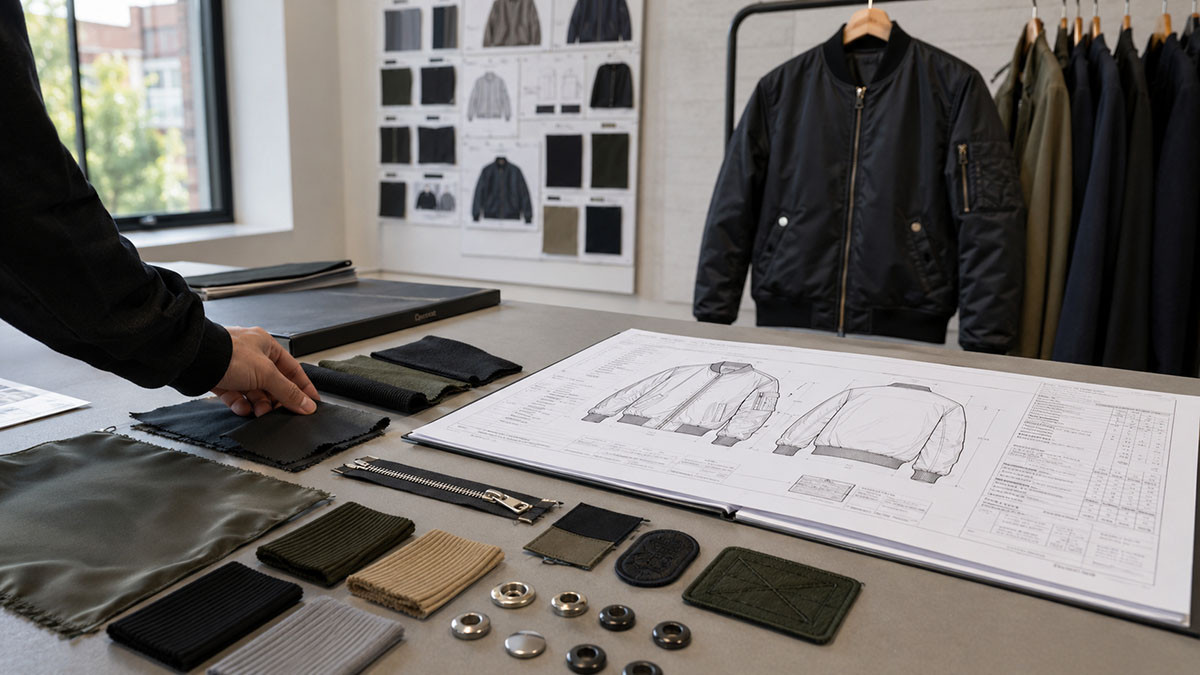
A strong jacket tech pack should normally include technical flats, measurements, materials, construction notes, color information, artwork details, trims, labels, and packaging requirements.
If you are still developing yours, review VANRD's clothing tech pack guide before beginning sampling.
Technical Flats and Construction Details
Front and back technical drawings are the minimum. More complicated jackets may also require inside views, hood construction, pocket sections, collar details, lining views, or close-ups of unusual seams.
Do not assume that a supplier will automatically interpret the construction exactly as you imagined it. If a specific detail matters to your brand, document it.
Measurements and Points of Measure
A jacket size chart should define not only numbers but also how those numbers are measured. Chest width, shoulder width, body length, sleeve length, cuff opening, hem width, collar height, pocket position, and other measurements can all influence the silhouette.
Words such as “oversized” are useful for discussing style, but they are not measurable production standards.
Bill of Materials
The bill of materials, often called the BOM, connects each component with its specification. A typical jacket BOM may include shell fabric, lining, rib, zipper, snaps, thread, labels, patches, drawcords, elastic, padding, and packaging.
This becomes increasingly important as jacket complexity increases. A puffer jacket, for example, cannot be controlled by specifying the shell fabric alone. Insulation, lining, quilting construction, zipper, cuff design, and fill distribution all contribute to the finished product.
Step 3: Choose the Right Jacket Construction for Your Collection
Not all jackets travel through the factory in exactly the same way. Your category determines where the technical risks are likely to appear.
Varsity Jackets
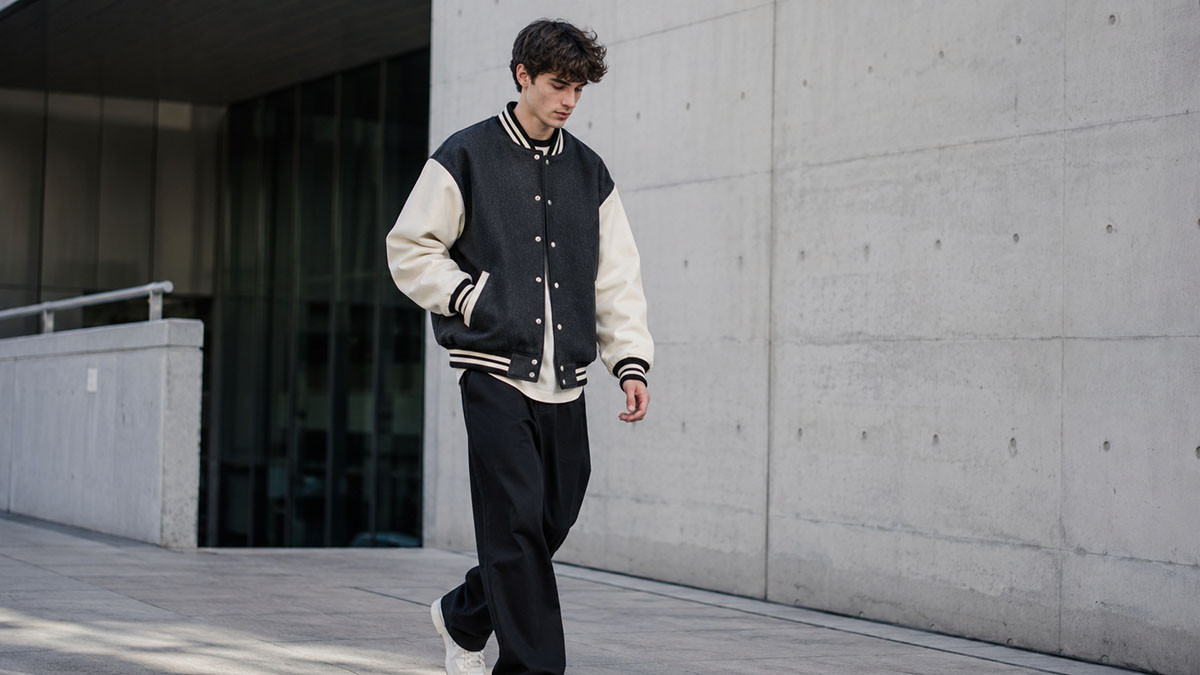
A custom varsity jacket often combines a wool-blend or woven body with contrasting sleeves, striped rib, snap buttons, lining, embroidery, chenille patches, or appliqué.
The challenge is coordination. Rib colors must work with the shell. Sleeve materials need to sew cleanly to the body. Large patches must sit correctly on curved garment areas. Snap placement needs to remain even down the center front.
Bomber Jackets
A custom bomber jacket may look visually clean, but its fit depends heavily on the relationship between the shell, lining, zipper, rib collar, cuff, and waistband.
If the waistband rib is too tight, the body can balloon excessively. If it is too loose, the silhouette loses the classic bomber shape. Small trim choices can change the entire garment.
Denim Jackets
For a custom denim jacket, the story does not end when sewing finishes. Wash treatments can affect color, dimensions, hand feel, seam appearance, and overall character.
That means the brand should evaluate the jacket after its intended wash process, not just before washing. A pattern that appears correct in raw denim may behave differently after shrinkage and finishing.
Work Jackets
A custom work jacket may use canvas, twill, reinforced seams, utility pockets, heavy zippers, or structured collars.
Here, durability and visual balance must work together. A streetwear-inspired work jacket still needs the utility character buyers expect, but it also has to fit the brand's silhouette and design language.
Puffer Jackets
A custom puffer jacket adds another variable: volume. Shell fabric, insulation, quilting pattern, baffle dimensions, lining, hood construction, and fill distribution interact with the final shape.
A flat technical sketch cannot completely communicate this three-dimensional volume. Sampling becomes especially important.
Windbreaker Jackets
A custom windbreaker jacket is usually lighter, so fabric behavior becomes more visible. Lightweight nylon and polyester fabrics can show puckering, uneven topstitching, or poor print compatibility more easily than heavier materials.
Logo technique, lining, zipper weight, elastic, drawcords, and hood construction should therefore be developed together rather than independently.
| Jacket Type | Typical Material Direction | Key Components | Main Development Risk |
|---|---|---|---|
| Varsity | Wool blend, PU, leather, satin | Rib, snaps, lining, chenille, appliqué | Color matching and patch placement |
| Bomber | Nylon, polyester, cotton, satin | Zipper, rib, lining, sleeve pocket | Fit balance and rib recovery |
| Denim | Cotton denim | Metal hardware, labels, wash | Shrinkage and wash consistency |
| Work Jacket | Canvas, twill, duck fabric | Heavy zipper, pockets, reinforcement | Bulk at seams and construction durability |
| Puffer | Nylon or polyester shell | Insulation, lining, quilting, zipper | Fill distribution and finished volume |
| Windbreaker | Lightweight nylon or polyester | Lining, elastic, drawcord, zipper | Puckering and logo compatibility |
Step 4: Select Shell Fabrics, Linings, Trims, and Hardware
Fabric selection is one of the most influential decisions in custom jacket manufacturing, yet brands often treat it as a visual choice: “I want black nylon,” “I want heavyweight denim,” or “I want canvas.”
A professional jacket manufacturer should go further. How does the fabric drape? How stiff is it? Does it shrink? Does it work with embroidery? Will the wash change its color? Does it require backing behind a large patch? Does the lining move comfortably against it?
You can explore VANRD's fabrics and customization techniques to understand how fabric choice connects with printing, embroidery, patches, washing, and other branding methods.
Do Not Forget the Lining
Buyers understandably focus on the exterior, because that is what customers see first. Yet the lining affects comfort, movement, warmth, structure, perceived quality, and sometimes even the way the outer shell hangs.
A slippery lining may make layering easier. A quilted lining changes warmth and volume. A mesh lining can improve comfort in lightweight shells. There is no universally “best” lining—the right choice depends on what the jacket is supposed to do.
Hardware Can Change the Perceived Value of the Jacket
Put a weak zipper on an otherwise premium jacket and the customer notices immediately. Hardware is touched every time the garment is worn, which makes it one of the most tangible signals of product quality.
Before approving bulk production, review zipper function, puller design, snap strength, button finish, drawcord hardware, and color consistency alongside the garment—not as separate accessories.
Step 5: Pattern Making Turns the Drawing Into a Three-Dimensional Garment
Now the design begins to acquire shape.
Pattern makers translate the approved measurements and construction into individual pattern pieces. For jackets, this may include front and back body panels, sleeves, collar, cuffs, waistband, pocket components, facings, lining sections, hood pieces, insulation pieces, and reinforcement areas.
Good pattern development is not just mathematical. It requires understanding how materials behave once sewn together.
For example, a dropped-shoulder work jacket made from rigid canvas cannot simply use the same proportions as a soft nylon bomber. The design language may be equally oversized, but the fabrics create different volume.
This is where manufacturer experience in the actual jacket category matters.
Step 6: Develop and Review the Jacket Sample
Sampling is where assumptions become visible.
A technical file can look perfect on screen, yet once the jacket is physically made you may discover that the collar feels too tall, the body is too long, the sleeve opening is too narrow, the embroidery feels too heavy, or the zipper changes the way the front hangs.
That does not automatically mean the sample process failed. Finding those issues is one of the reasons sampling exists.
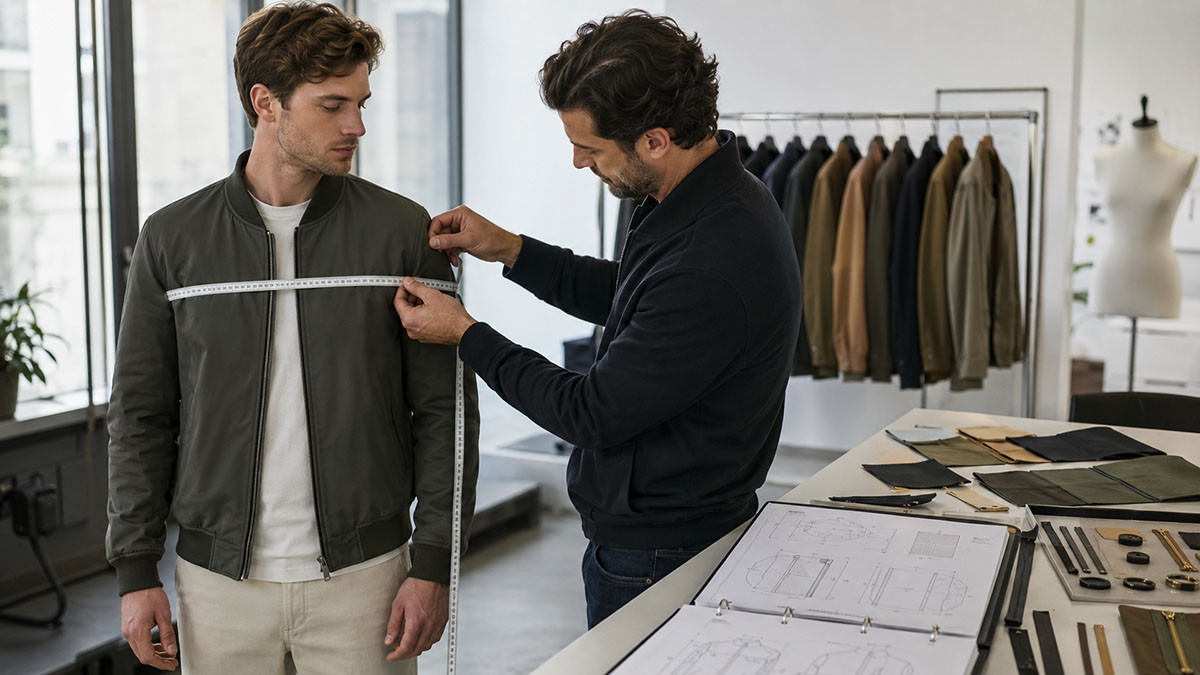
Whenever possible, review the sample on a fit model rather than evaluating it only on a hanger or flat surface. A fitting makes it easier to judge shoulder balance, sleeve pitch, body volume, movement, hem position, and how the shell, lining, and trims behave together when the jacket is actually worn.
What Should You Check on a Jacket Sample?
- Overall silhouette and fit
- Chest, shoulder, sleeve, body length, and hem measurements
- Collar and hood shape
- Sleeve pitch and arm movement
- Pocket size and placement
- Shell fabric hand feel
- Lining comfort and attachment
- Rib stretch and recovery
- Zipper and snap performance
- Embroidery or print quality
- Patch dimensions and placement
- Thread and topstitching
- Labels and branding
- Wash or finishing effect
- Inside construction and seam finishing
Do not send feedback such as “make it more oversized” if the change can be expressed numerically. Good sample comments convert visual reactions into measurable instructions.
For example, instead of saying “make the sleeves longer,” specify which sleeve measurement should change and by how much. Precise feedback reduces interpretation.
Step 7: Confirm Jacket Cost, MOQ, and Production Timeline
Brands often ask for a price before the product has been fully defined. That is understandable—you need to plan a budget. But an early price should be treated as an estimate, not an immutable final number.
The true production cost depends on what is actually being manufactured.
What Affects Custom Jacket Pricing?
- Shell fabric type, composition, weight, and finish
- Lining and insulation
- Pattern complexity
- Number of panels and pockets
- Zippers, snaps, buttons, and custom hardware
- Embroidery coverage
- Chenille, appliqué, or other patches
- Printing technique
- Garment washing or finishing
- Custom labels and packaging
- Order quantity and number of colors
- Size range
- Testing or special quality requirements
How Design Choices Can Affect Cost and MOQ
| Design Choice | Typical Production Impact |
|---|---|
| More colorways | More fabric and trim coordination, which may increase material minimums and production complexity. |
| Custom-dyed rib | May require additional color development and minimum quantities for rib production. |
| Large embroidery or appliqué | Adds decoration time, setup requirements, and production cost. |
| Custom zipper pullers or hardware | May require mold development, sampling, or accessory minimums. |
| Garment washing | Adds development steps and requires tighter control of shrinkage, shade, and finishing consistency. |
This is why comparing quotations without comparing specifications can be misleading. Two factories may quote the “same” bomber jacket using different shell quality, zipper grade, lining construction, rib quality, or workmanship standards.
You are not really comparing two prices unless you are comparing two equivalent products.
What Determines Jacket MOQ?
MOQ is not simply a random number chosen by a factory. Fabrics, dyeing, custom colors, ribs, zippers, patches, labels, and other materials can each have their own minimum purchasing or production requirements.
For brands planning custom jacket programs, VANRD's current jacket manufacturing page provides the latest project-level MOQ and sampling information. Exact requirements should still be confirmed against the jacket type, materials, color count, trims, branding, and order structure.
Step 8: Lock the Pre-Production Standard Before Bulk Manufacturing
This may be the most important transition in the entire process.
A sample can keep evolving while you are developing the product. Bulk production cannot. At some point, every important variable needs to stop moving.
Before bulk production begins, your brand and manufacturer should clearly establish what the production team is expected to reproduce.
Pre-Production Approval Checklist
- Final approved sample
- Approved measurement chart
- Measurement tolerances
- Final shell fabric
- Approved color standard
- Final lining
- Approved zipper and hardware
- Rib or elastic standard
- Final artwork files
- Logo dimensions and placement
- Embroidery or patch references
- Label and hangtag details
- Wash or finishing reference
- Packaging requirements
- Carton and shipping information
You can also review VANRD's custom apparel service process to see how development, sampling, approval, production, QC, and shipment connect.
Step 9: Bulk Jacket Manufacturing Begins
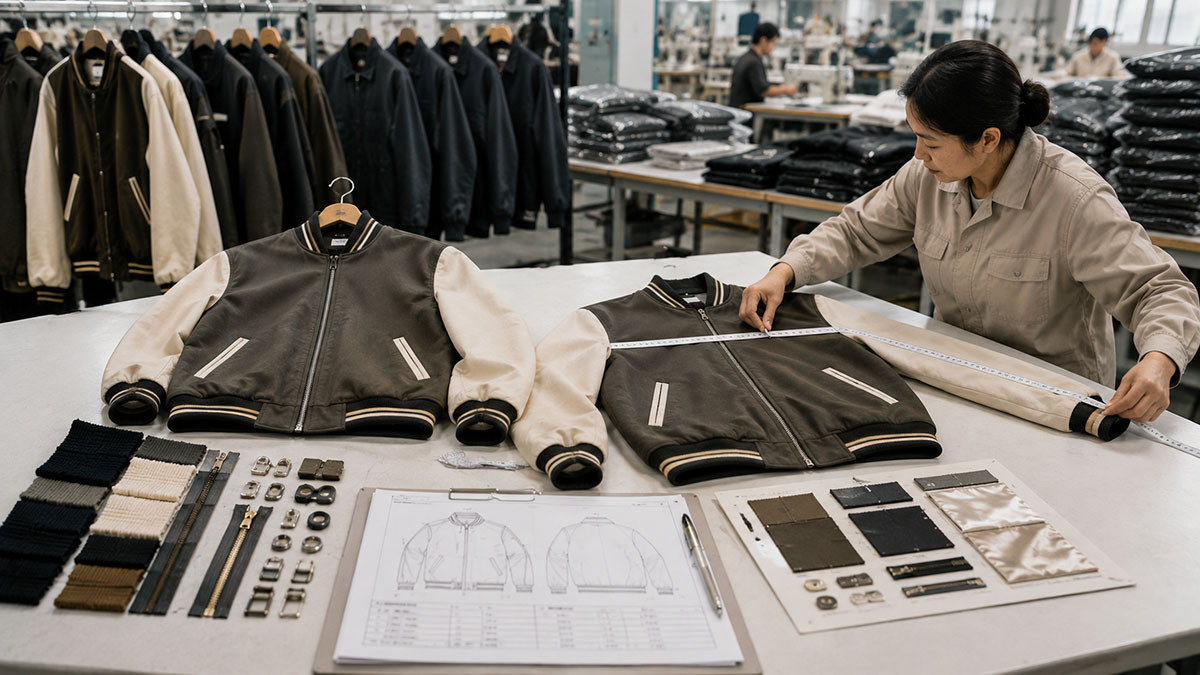
Once the production standard is locked and materials are ready, the factory moves into bulk manufacturing.
Why the Production Sequence Matters
Certain decoration techniques need to happen before major garment assembly, while others may be completed after sewing. Washing can also affect embroidery, labels, hardware, and garment measurements.
This is another reason the manufacturer should review the entire construction before production. A jacket is not assembled by completing every component independently and hoping they fit together at the end.
Step 10: Control Quality During Bulk Jacket Production
Quality control should not begin when 500 finished jackets are already sitting in cartons.
By then, a repeated production problem may already exist across the whole order.
A better system builds control into several stages. Materials can be reviewed before cutting. Early production units can be compared against the approved standard. Measurements and workmanship can be monitored during sewing and finishing. Finished goods can then receive final checks before packing and shipment.
VANRD's quality control process explains the types of checks brands should consider when moving from an approved sample into bulk apparel production.
Key Jacket Quality-Control Points
| QC Area | What to Check | Why It Matters |
|---|---|---|
| Fabric | Shade, defects, hand feel, wash effect | Controls visual consistency across the order |
| Measurements | Chest, shoulder, sleeve, length, hem, tolerance | Protects the approved fit |
| Panels | Alignment, symmetry, seam position | Prevents distorted jacket appearance |
| Stitching | Seam quality, topstitching, loose threads | Affects appearance and durability |
| Hardware | Zipper, snaps, buttons, pullers | Functional defects are immediately visible to customers |
| Branding | Logo size, placement, color, embroidery, patches | Protects brand presentation |
| Lining | Attachment, twisting, excess fabric, seam finish | Affects comfort and garment structure |
| Packing | Labels, size, polybag, folding, cartons | Prevents fulfillment and retail problems |
Step 11: Packaging, Shipment, and Repeat-Order Preparation
The manufacturing process does not finish at the sewing line.
For a private label brand, the product should arrive ready for the next stage of the business. That may mean warehouse receiving, retail distribution, ecommerce fulfillment, wholesale delivery, or launch-day inventory preparation.
Confirm folding method, polybags, barcode labels, size stickers, hangtags, carton quantity, size ratios, carton marks, and other packaging details before the order is packed.
And if the jacket performs well? Save the production information.
Repeat orders become easier when both parties retain the approved size chart, fabric reference, trim specifications, artwork files, packaging standard, and production comments. You should not have to reinvent the same jacket every season.
Common Custom Jacket Manufacturing Mistakes Brands Should Avoid
1. Starting With Reference Images Only
Reference images communicate direction, but they rarely define measurements, fabric specifications, construction, trims, branding dimensions, or finishing standards.
Use references as visual language—not as the entire manufacturing specification.
2. Choosing a Manufacturer Only by Unit Price
A lower quotation is attractive until you discover that the fabric, lining, zipper, embroidery quality, or QC standard is also lower.
Compare what is included before comparing numbers.
3. Treating the First Sample as a Formality
Sampling is not merely a box to tick before production. It is where you validate whether your design works as a physical product.
4. Changing Major Details After Bulk Materials Are Ordered
Late changes are expensive because they can affect already-purchased fabric, trims, patterns, artwork, production scheduling, and completed operations.
Creative flexibility is valuable during development. Production needs discipline.
5. Approving the Exterior but Ignoring the Inside
Turn the jacket inside out. Look at seam finishing, lining attachment, reinforcement, pocket bags, loose threads, labels, and internal construction.
Customers may not see those areas first, but they experience them every time they wear the garment.
6. Waiting Until Final Inspection to Discuss Quality
Quality standards should be established before bulk manufacturing. Final inspection should confirm that production followed the standard—not introduce the standard for the first time.
How to Choose the Right Custom Jacket Manufacturer
If your brand is comparing suppliers, ask a more useful question than “Who has the lowest price?”
Ask: Which jacket manufacturer is most capable of reproducing the product my brand actually wants to sell?
A factory experienced mainly in basic knitwear may be excellent at what it does, yet still be the wrong partner for a complicated varsity, insulated puffer, washed denim jacket, or multi-panel racing jacket.
A strong custom jacket manufacturer should be able to discuss not only sewing capacity but also jacket categories, fabric behavior, linings, trims, pattern development, sample revisions, branding techniques, bulk consistency, and inspection standards.
For a deeper supplier-evaluation framework, read How to Choose a Custom Jacket Manufacturer for Streetwear Brands.
Questions to Ask Before Choosing a Jacket Manufacturer
- Which jacket categories does the factory manufacture regularly?
- Can it develop patterns from tech packs or reference garments?
- Can it source both shell fabrics and linings?
- Can it coordinate custom zippers, snaps, ribs, labels, and patches?
- How does its sampling and revision process work?
- What information is required for an accurate quotation?
- How does it control sample-to-bulk consistency?
- What quality checks happen during production?
- Can it support custom labels and packaging?
- Can it retain production standards for repeat orders?
How VANRD Supports Custom Jacket Development From Concept to Production
VANRD works with streetwear brands, private label businesses, designers, wholesalers, and apparel teams that need more than a ready-made jacket with a logo added to it.
Based in Dongguan, Guangdong, China, VANRD supports jacket development through sample development, fabric sourcing, pattern development, custom trims, embroidery, printing, quality inspection, and bulk production management. This allows brands to coordinate the major stages of jacket development with one manufacturing partner.
The development process can include design and tech pack review, fabric and trim sourcing, pattern development, sample making, logo technique coordination, labels, packaging, bulk production, and quality control.
Jacket programs can cover categories such as varsity jackets, bomber jackets, denim jackets, work jackets, puffer jackets, windbreakers, coach jackets, racing jackets, and other custom outerwear.
The objective is simple: turn the creative idea into a specification that can be manufactured consistently.
Brands that want to see how similar development work is handled can also review VANRD's custom apparel development and customer case examples.
Ready to Develop Your Custom Jacket?
Send your jacket type, tech pack or reference images, target fabric, artwork, estimated quantity, size range, and expected launch timeline. VANRD can review the project and help identify the next step for sampling and bulk production.
Discuss Your Jacket ProjectConclusion: Good Jacket Manufacturing Is About Controlling the Handoffs
Custom jacket manufacturing is not one big production step. It is a chain of smaller decisions: design becomes specifications, specifications become materials and patterns, patterns become samples, approved samples become bulk standards, and bulk standards become finished products.
The weak point is usually not creativity. It is the handoff between stages.
A great drawing can fail when specifications are vague. A beautiful sample can fail when the production standard is not locked. Good materials can fail when trims or construction are incompatible. Even a capable factory can struggle if critical decisions keep changing after production begins.
The solution is not to make the process more complicated. It is to make it clearer.
Define the jacket before asking for final pricing. Build a useful tech pack. Choose materials as a complete system. Treat sampling as product development. Approve measurable standards. Control quality throughout production instead of only at the end.
Do those things well and your relationship with a jacket manufacturer changes. You are no longer asking a factory to guess what you want. You are building a repeatable manufacturing system around your brand's product.
Frequently Asked Questions About Custom Jacket Manufacturing
1. What information should I send to a custom jacket manufacturer?
Ideally, send a tech pack containing technical drawings, measurements, fabric direction, trims, artwork, logo placement, color requirements, labels, packaging details, target quantity, and timeline. If you do not yet have a full tech pack, clear reference images, measurements, fabric ideas, and branding files can help the manufacturer understand the initial direction before development begins.
2. How long does custom jacket sampling and production take?
The timeline depends on jacket complexity, material availability, custom trims, printing or embroidery, washing, pattern development, sample revisions, order quantity, and factory production schedule. A basic bomber using available materials may move faster than a custom puffer, washed denim jacket, or varsity jacket requiring special ribs, hardware, and multiple patches. Always request a project-specific timeline instead of relying on a universal lead-time promise.
3. What affects the MOQ for custom jacket manufacturing?
MOQ can be influenced by fabric minimums, custom dyeing, color quantity, zipper and hardware minimums, rib production, embroidery or patch setup, labels, packaging, and manufacturing complexity. Using available materials and concentrating volume into fewer colors can sometimes make a first production run easier to organize.
4. What should I approve before starting bulk jacket production?
Approve the final sample, measurements, tolerances, shell fabric, lining, trims, hardware, colors, branding, artwork dimensions, logo placement, labels, wash or finishing standard, packaging, and other details that could determine whether the final order is acceptable. The production team needs one clearly defined standard to follow.
5. How do I choose a reliable jacket manufacturer for my clothing brand?
Look beyond price. Evaluate whether the manufacturer has real experience with your jacket category, can source suitable fabrics and trims, provides structured sample development, understands custom branding, communicates clearly, controls measurements and workmanship, and has a defined bulk quality-control process. The right partner should reduce uncertainty as the project moves from concept to sample and from sample to production.