Custom Jacket Manufacturing Risk Checklist: Fabric, Fit, Hardware, and QC Before Bulk Production
A practical guide for apparel brands that want fewer surprises, cleaner bulk production, and better sample-to-shipment consistency when developing custom jackets.
Custom jacket manufacturing is not risky because jackets are difficult. It becomes risky when the wrong details are approved, the right details are not documented, and everyone assumes the bulk order will magically match the sample. Mature brands know better. They treat production like a system, not a gamble.
Why Jacket Production Risk Starts Before Bulk Production
A failed jacket order usually does not begin on the final inspection table. It often begins much earlier, when a fabric is approved without shrinkage testing, when a zipper is selected because it looks good but has not been stress-tested, or when the fit sample is accepted without checking how the jacket moves on a real body.
That is why a custom jacket manufacturing checklist should not be treated as a final QC document only. It should work more like a production map. Before the first bulk fabric is cut, the brand and manufacturer should already know what must be checked, what tolerance is acceptable, what evidence needs to be recorded, and what happens if something fails.
Think of jacket production like building a bridge. The final paint matters, but the structure underneath matters more. Fabric, trims, fit, hardware, stitching, labeling, and packaging all carry risk. If one part is weak, the whole order can feel unstable.
Use this guide to ask better questions before approving a jacket supplier, sample, or production schedule.
Use it to reduce returns, late corrections, inconsistent sizing, and unexpected quality disputes.
Use it to connect design intent with real manufacturing checkpoints before bulk production begins.
What Is a Jacket Manufacturing Risk Checklist?
A jacket manufacturing risk checklist is a structured production control tool that helps brands and factories confirm every critical detail before and during bulk production. It is not just a list of defects. It is a shared rulebook that explains what “approved quality” actually means.
For a custom jacket order, the checklist usually covers fabric approval, trim confirmation, fit and measurement control, hardware testing, decoration placement, sewing quality, inline inspection, final AQL inspection, labeling, packing, and shipment approval. In simple words, it answers one question: what could go wrong, and how do we catch it before it becomes expensive?
The Real Goal: Make Bulk Production Repeatable
Most brands do not want a beautiful sample and a disappointing bulk order. They want repeatability. If the approved sample has the right hand feel, sleeve shape, zipper function, wash effect, and brand trim placement, then bulk production should follow the same standard.
This is where mature brands separate themselves from beginners. A beginner asks, “Can you make this jacket?” A mature brand asks, “Can you repeat this jacket across 500, 2,000, or 10,000 units with stable quality?” That second question is the real production question.
Who Should Use This Checklist?
This checklist is useful for private label apparel brands, streetwear brands, outdoor-inspired fashion brands, uniform buyers, designers, sourcing managers, and production teams. It is especially useful for custom varsity jackets, bomber jackets, denim jackets, work jackets, windbreakers, coach jackets, racing jackets, and padded jackets.
Step 1: Lock the Tech Pack Before Production Starts
A weak tech pack is one of the fastest ways to create bulk production confusion. If the factory has to guess the fabric weight, pocket size, zipper length, rib quality, logo placement, seam construction, or tolerance, then the production line is already exposed to risk.
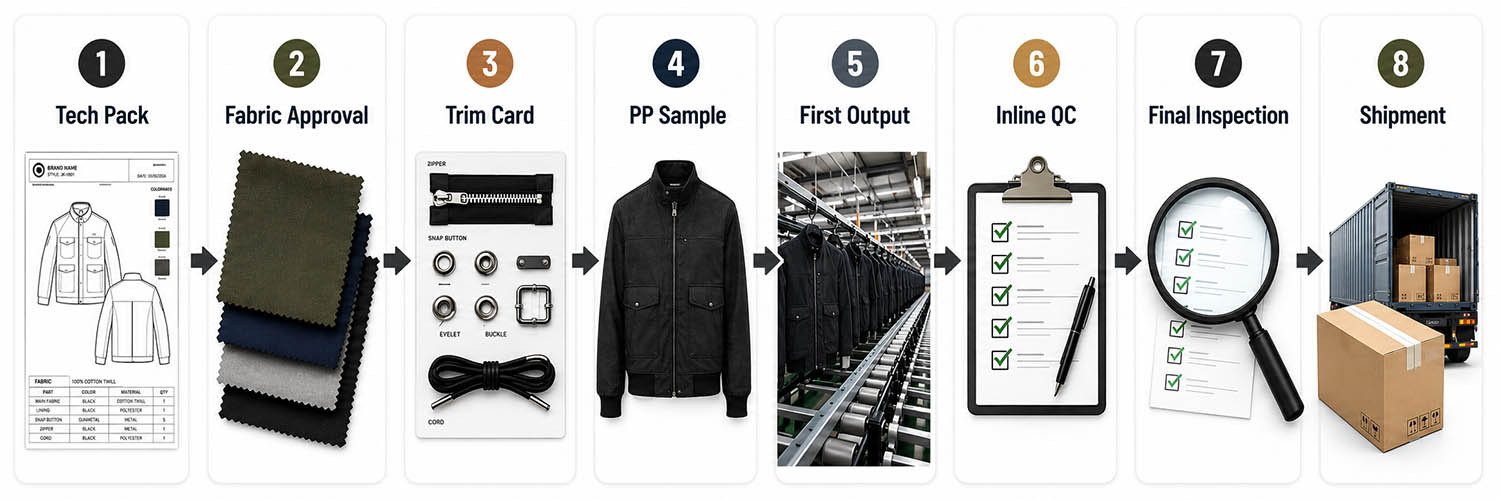
A reliable jacket tech pack should include the bill of materials, measurement chart, grading rules, construction details, stitch type, artwork files, color standards, label positions, packaging requirements, and inspection tolerance. It should also define the approved sample version. If there are three sample rounds, the final approved version must be clearly identified.
Confirm the Approved Sample as the Production Standard
The approved sample should become the physical reference for bulk production. Many brands call this the golden sample or pre-production sample. It should use the confirmed fabric, trims, hardware, decoration technique, label position, and construction method. If the factory changes any material after approval, the brand should review and approve the change again.
Never Let Verbal Changes Enter Bulk Production
Verbal changes are dangerous. A small sentence like “make the sleeves a little wider” can create a serious dispute later if no one records the new measurement. Every change should be written, dated, and linked to the latest spec sheet or sample approval record. In production, memory is not a system.
Pre-Production Documents to Confirm
- Final tech pack with updated measurements and tolerances
- Approved pre-production sample or golden sample
- Bill of materials for fabric, lining, trims, hardware, and packaging
- Artwork files for embroidery, print, patches, applique, or heat transfer
- Color references, lab dips, strike-offs, or approved swatches
- Label, hangtag, polybag, carton, barcode, and shipping mark requirements
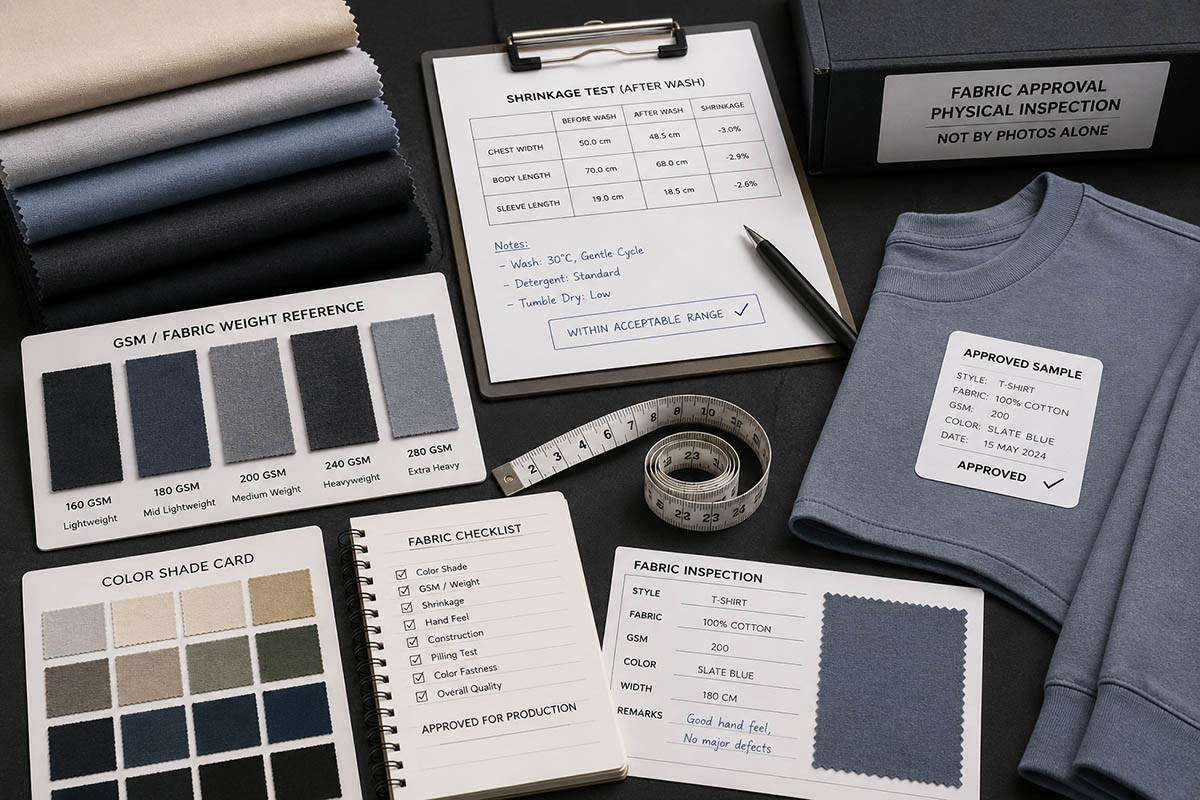
Before bulk cutting starts, apparel brands should confirm fabric hand feel, GSM, shrinkage, shade consistency, and lot quality. Early fabric review helps reduce sample-to-bulk differences and prevents avoidable production risk.
Step 2: Check Fabric Risks Before Cutting
Fabric is the largest surface of a jacket, so fabric risk is easy to see and expensive to fix. Once bulk fabric is cut, defects become much harder to control. A stain, shade issue, shrinkage problem, or wrong GSM can move from one roll to hundreds of finished jackets.
Before cutting, the fabric should be checked against the approved standard. The key points include composition, GSM, hand feel, width, shrinkage, color shade, surface defects, coating, print quality, wash performance, and lot consistency. For outerwear, the fabric may also need checks for water resistance, quilting stability, lining compatibility, or abrasion performance depending on the style.
Fabric Weight, Hand Feel, and Structure
Two fabrics can look similar in photos but feel completely different in real production. A 280 GSM twill and a 340 GSM canvas do not behave the same way. One may drape softly; the other may hold shape like armor. For jackets, this affects silhouette, comfort, seam bulk, needle selection, and even carton weight.
Brands should not approve fabric only from a product photo. They should review physical swatches, confirm GSM, check the hand feel, and test whether the material supports the intended fit. A structured work jacket needs different fabric behavior from a soft washed bomber jacket.
Shrinkage and Washing Risk
Shrinkage is one of those problems that stays quiet until it becomes loud. A jacket may pass the first measurement check, but after washing or finishing, the body length, sleeve length, chest width, and hem opening can shift. If the pattern is not adjusted for shrinkage, the bulk order may fail size expectations.
This matters even more for denim jackets, cotton canvas jackets, washed varsity jackets, and garment-dyed outerwear. When the fabric or finished garment has a wash process, the brand should confirm shrinkage data before final grading.
Shade Variation and Lot Control
Shade variation is a silent brand killer. If the sleeve looks slightly different from the body, customers may not know the technical reason, but they will feel the product looks wrong. For jackets with multiple panels, ribs, lining, contrast pockets, or patchwork details, shade control must happen before cutting.
Factories should separate fabric lots, check color continuity, and avoid mixing different dye lots in visible areas. For a mature brand, “close enough” is not enough when the product sits on a retail rack or appears in campaign photography.
Step 3: Review Trims Before They Touch the Sewing Line
Trims are small, but they carry a lot of brand perception. A cheap label, weak drawcord, poor rib, loose elastic, or off-color patch can make a jacket feel less premium even when the main fabric is correct.
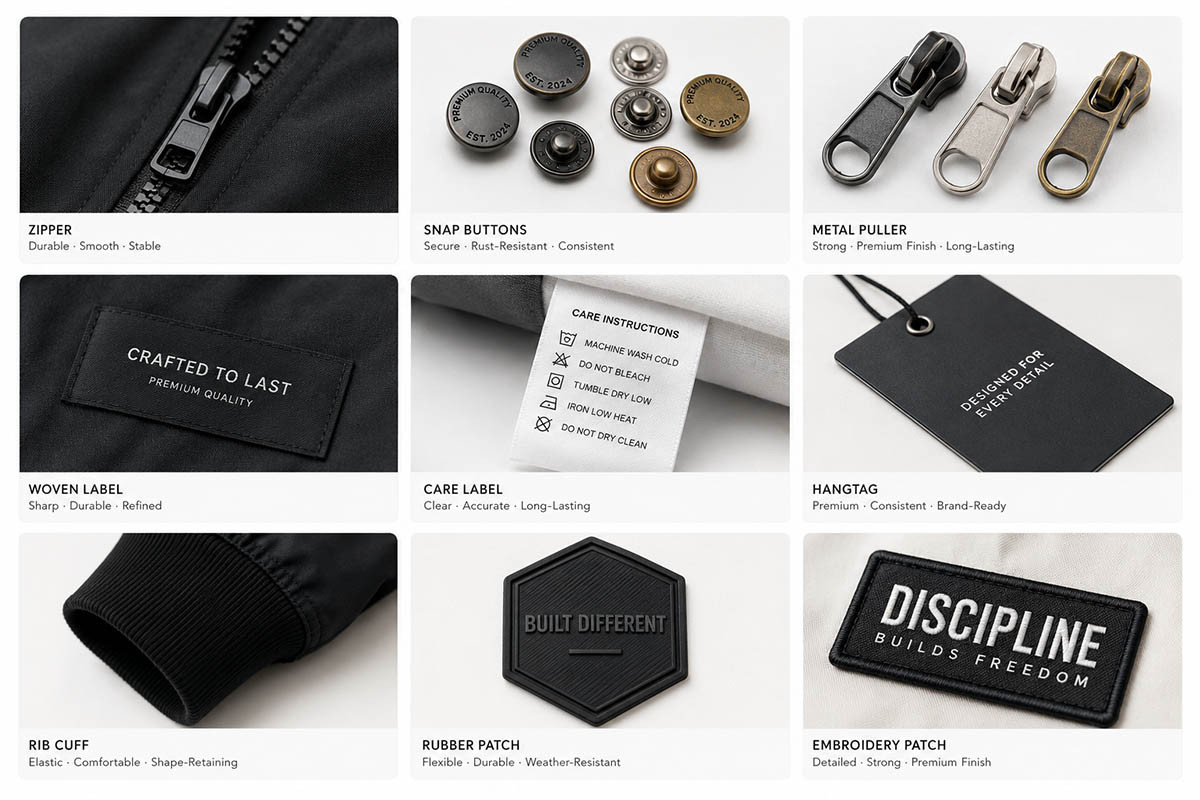
For custom jacket production, trims may include woven labels, care labels, size labels, hangtags, drawcords, elastic, rib cuffs, rib hems, lining, pocket bags, tapes, patches, zipper pullers, buttons, snaps, and packaging materials. Each trim should match the approved sample in color, size, material, placement, and function.
Branding Trims Must Match the Approved Standard
For apparel brands, branding details are not decoration only. They are part of product identity. A woven neck label that is 5 mm too low, a rubber patch with the wrong black tone, or an embroidery patch with weak edge finishing can damage the perceived value of the jacket.
Before bulk production, the factory should provide trim cards or physical trim approval sheets. The brand should confirm the exact trim version, not just a digital image. If trims are sourced from different suppliers, the production team should make sure all components arrive before bulk sewing starts.
Step 4: Test Hardware Function and Durability
Jacket hardware is where fashion meets engineering. Zippers, snaps, buttons, rivets, buckles, eyelets, pullers, and stoppers need to look right and work right. If they fail, the customer does not see a “minor production issue.” They see a jacket that cannot be worn.
Zipper Risk Is More Than Smooth Pulling
A zipper should glide smoothly, but smooth pulling is only the beginning. The zipper tape should match the garment color, the teeth should be aligned, the slider should not jam, the puller should feel stable, and the bottom stop should hold under normal use. For reversible jackets, padded jackets, or heavy work jackets, zipper strength becomes even more important.
Brands should also check zipper length, zipper placement, top alignment, pocket zipper function, and whether the zipper causes fabric waving. A beautiful jacket with a wavy front zipper can look cheap immediately.
Snap, Button, and Rivet Attachment
Snaps and buttons should be tested for attachment strength and function. They should close cleanly, open without damaging the fabric, and stay secure after repeated use. Rivets and metal eyelets should not have sharp edges, rust, or plating defects. If a jacket uses antique brass, gunmetal, matte black, or custom logo hardware, color consistency should be checked across the full batch.
| Hardware Area | Common Risk | What to Check Before Bulk |
|---|---|---|
| Zipper | Jamming, waving, wrong length, weak bottom stop | Test smooth pulling, alignment, tape color, puller strength, and front balance |
| Snaps | Weak attachment, fabric damage, poor closure | Check opening force, attachment position, repeated use, and backing stability |
| Buttons | Loose stitching, wrong size, poor color match | Confirm button size, color, logo, attachment method, and spare button requirement |
| Rivets and Eyelets | Sharp edges, rust, coating inconsistency | Inspect plating, edge finish, corrosion risk, and placement accuracy |
Step 5: Control Fit, Pattern, and Measurement Tolerance
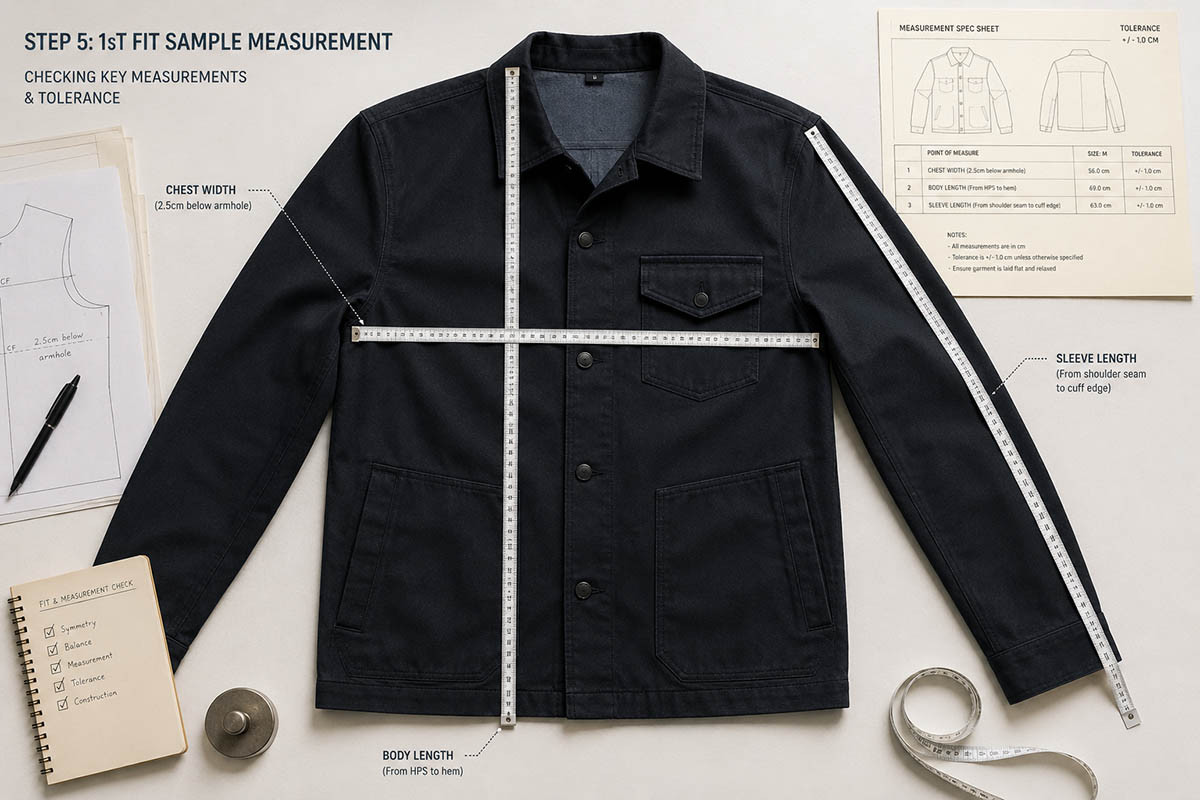
Fit is not just a number on a size chart. For jackets, fit is a three-dimensional experience. It includes shoulder balance, sleeve pitch, armhole comfort, body length, chest ease, collar shape, hem opening, and how the jacket feels when the wearer moves.
This is why mature brands should review the fit sample on a model or fit form, not only on a flat table. A jacket can measure correctly but still feel wrong if the sleeve rotation is uncomfortable or the shoulder seam sits awkwardly.
Jacket Fit Is a 3D Problem
A hoodie can forgive some fit problems because knit fabric stretches. A structured jacket is less forgiving. A bomber jacket needs the right balance between body volume and hem tension. A denim jacket needs sleeve comfort without losing shape. A work jacket needs enough room for layering. A racing jacket needs panel symmetry and a clean front line.
Before bulk production, the brand should approve base size fit, size set measurements, grading rules, and acceptable tolerance. The tolerance should be realistic. If the tolerance is too loose, quality becomes inconsistent. If it is too strict, production may become inefficient and expensive.
One Small Pattern Error Can Multiply Across Every Size
A pattern issue is dangerous because it repeats itself. If the pocket placement is wrong in the base pattern, every cut panel may carry that mistake. If the sleeve shape is off, every size may inherit the same comfort issue. That is why pattern checking and cutting inspection should happen before the sewing line scales up.
Step 6: Inspect Cutting and Sewing Before Defects Spread
Cutting is the point where fabric becomes commitment. After cutting, the factory has already invested material, labor, and time. If panels are off-grain, mismatched, stretched, or incorrectly bundled, sewing cannot fully save the order.
Before sewing begins, the production team should check marker layout, grain direction, panel shape, size bundling, color lot separation, notch accuracy, and panel count. For jackets with visible panels, pocket flaps, contrast parts, or symmetrical seams, cutting accuracy is essential.
The First 20 Pieces Tell You Where Bulk Production Is Going
The first output inspection is one of the most valuable checkpoints in jacket manufacturing. Once the first 20 or 30 pieces come off the line, the factory can see whether the sewing method, machine settings, seam allowance, pocket placement, zipper alignment, and pressing method are working correctly.
If the first output has the same defect repeatedly, the team should stop and correct the process. Continuing production while hoping the defect disappears is like driving faster when the steering wheel is already shaking.
Inline Sewing QC Points
- Seam allowance and seam strength at stress points
- Stitch density, skipped stitches, broken stitches, and puckering
- Pocket height, pocket angle, flap shape, and symmetry
- Zipper alignment, front opening balance, and hem matching
- Collar shape, cuff finish, sleeve rotation, and armhole comfort
- Thread trimming, pressing quality, and visible surface cleanliness
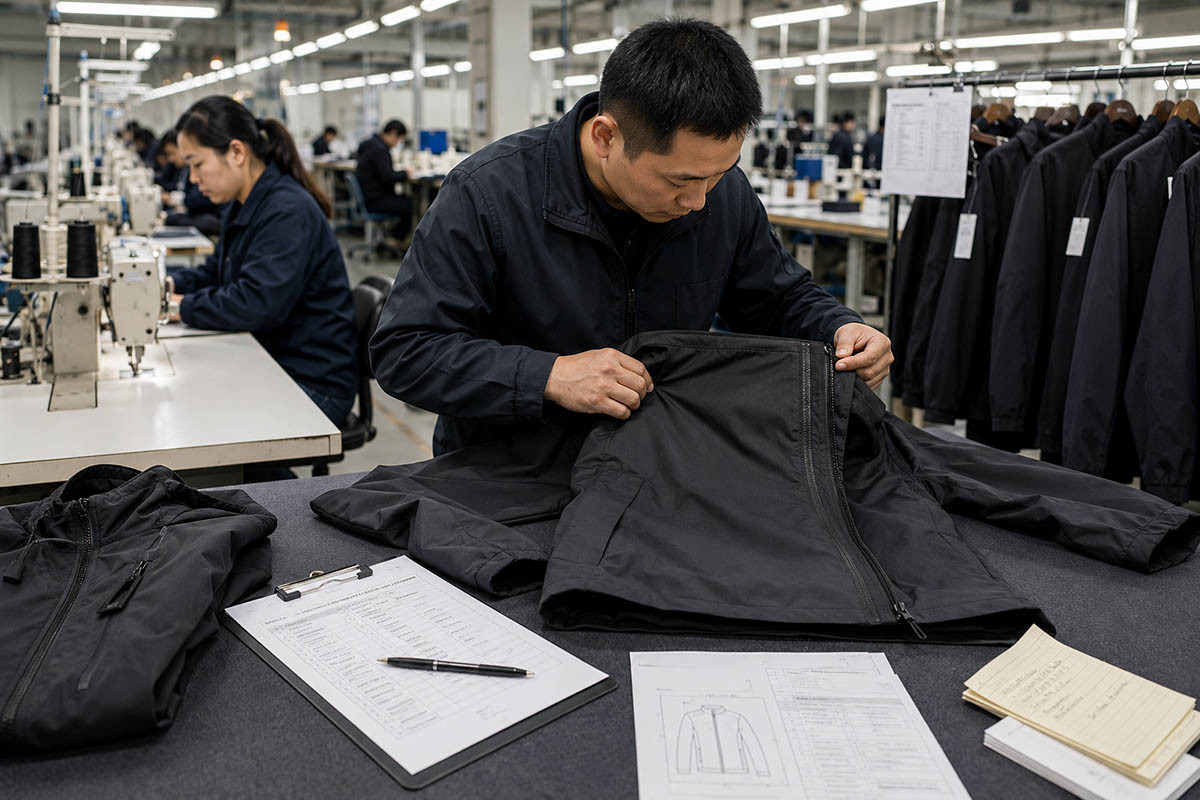
Inline QC helps production teams catch repeated sewing, fit, zipper, hardware, and surface issues early. Reviewing first output and in-line workmanship reduces rework, improves consistency, and keeps bulk jacket production on track.
Step 7: Check Decoration Quality
Decoration can turn a simple jacket into a brand product. It can also ruin the order if placement, color, scale, or durability is wrong. Custom jacket decoration may include embroidery, applique, chenille patches, screen printing, puff printing, heat transfer, reflective print, washing, distressing, laser effects, or custom badges.
Decoration Must Survive Wear, Wash, and Real Use
A logo that looks good on day one is not enough. It should stay clean after normal use, washing, rubbing, and packing. Embroidery should not distort the fabric. Applique edges should not lift. Heat transfer should not crack easily. Prints should not look dull, sticky, or misaligned.
Placement is equally important. If the chest logo is 1 cm too low, the wearer may not notice the number, but the whole jacket can feel visually unbalanced. For brands selling online, this matters because campaign photos, product pages, and customer reviews expose small design mistakes quickly.
Step 8: Build an Inline QC System Instead of Waiting for Final Inspection
Final inspection is important, but it should not be the first time anyone seriously checks the order. By final inspection, the jackets are already produced, trimmed, pressed, packed, and often close to the shipping deadline. If a systemic issue appears at that point, the brand may face rework, delay, discounting, or cancellation risk.
A stronger approach is to build QC into the production flow. That means checking materials before cutting, reviewing first output, inspecting during sewing, auditing finishing, and then running final inspection before shipment.
What to Check During Inline QC
Inline QC should focus on repeated defects and process drift. The inspector should not only find one bad piece. They should ask why the bad piece happened and whether more pieces are likely to have the same problem.
For jackets, inline QC should check seam construction, measurement stability, sleeve balance, pocket placement, zipper function, hardware attachment, lining quality, decoration placement, pressing, loose threads, stains, and shade consistency. If the same issue appears across multiple pieces, the factory should correct the production method immediately.
Step 9: Final AQL Inspection and Shipment Approval
Final inspection confirms whether the finished order is ready to ship. Many brands use AQL-based random inspection to evaluate bulk production without checking every single piece. The purpose is to classify defects, check measurements, verify packaging, and decide whether the shipment meets the agreed quality level.
Defects are usually grouped into critical, major, and minor categories. A critical defect may involve safety, sharp metal, broken needle risk, or illegal labeling. A major defect may affect fit, function, appearance, or sellability. A minor defect may be a small workmanship issue that does not seriously affect use.
What Mature Brands Should Ask Before Shipment
Before approving shipment, brands should ask direct questions. Do the measurements match tolerance? Do the colors match the approved standard? Are the zippers and snaps working? Are labels, barcodes, care instructions, and carton marks correct? Are there stains, holes, broken stitches, loose threads, or shade differences? Are the packing ratio and size assortment correct?
A shipment should not be approved because everyone is tired and the deadline is close. It should be approved because the inspection evidence supports the decision.
| Inspection Stage | Main Purpose | Key Jacket Checks |
|---|---|---|
| Pre-Production | Prevent wrong inputs | Fabric, trims, hardware, artwork, measurements, PP sample |
| First Output | Catch process issues early | Zipper alignment, sewing method, pocket placement, seam quality |
| Inline QC | Control production drift | Repeated defects, fit stability, decoration quality, construction consistency |
| Final Inspection | Approve shipment risk | AQL, measurements, appearance, packaging, labels, cartons |
Common Jacket Production Risks and How to Prevent Them
Every jacket style has its own risk points. A varsity jacket may need better rib control and chenille patch placement. A denim jacket may need wash consistency. A windbreaker may need coating, zipper, and seam quality checks. A work jacket may need stronger hardware and fabric durability.
Still, many production problems follow the same pattern. The risk was visible early, but nobody documented it, tested it, or stopped production in time.
| Risk | Why It Happens | Prevention Method |
|---|---|---|
| Bulk fabric feels different from sample | Fabric was changed, substituted, or approved only by photo | Approve physical swatch, GSM, composition, hand feel, and lot standard |
| Jacket shrinks after wash | Shrinkage was not tested before pattern confirmation | Test fabric or garment shrinkage before size grading and bulk cutting |
| Zipper front looks wavy | Wrong sewing tension, zipper mismatch, or fabric handling issue | Review first output and adjust machine settings before scaling |
| Sleeves feel uncomfortable | Sleeve pitch or armhole shape was not checked on body | Approve fit sample on model or fit form before bulk production |
| Logo placement is inconsistent | No placement template or weak decoration QC | Use artwork placement guide, measurement points, and inline decoration checks |
| Final cartons have wrong labels | Packing instructions were unclear or changed late | Confirm barcode, carton mark, size ratio, and packing list before packing |
How Apparel Brands Can Use This Checklist With a Jacket Manufacturer
The best way to use this checklist is before placing a bulk order. Share it with your manufacturer during sampling or pre-production. Ask which points are already included in their workflow and which points need to be added for your style.
You do not need to turn every order into a mountain of paperwork. The goal is not to slow down production. The goal is to make key decisions visible. For simple jackets, the checklist can be shorter. For complex jackets with custom fabric, multiple decorations, special hardware, lining, wash effects, or tight retail requirements, the checklist should be more detailed.
If you are comparing jacket manufacturers, ask how they handle fabric approval, trim cards, PP sample confirmation, inline QC, measurement reports, and final inspection. Their answers will tell you a lot. A serious manufacturer will not be afraid of these questions because good production depends on clear standards.
Conclusion: A Good Jacket Checklist Protects Margin, Timeline, and Brand Trust
Custom jacket manufacturing is full of moving parts. Fabric must perform correctly. Trims must match the approved standard. Hardware must function. Fit must feel right. Sewing must stay consistent. Decoration must survive real use. Final inspection must confirm shipment quality.
When these details are controlled early, production becomes smoother. When they are ignored, the factory and brand may spend the rest of the order solving problems that could have been prevented before cutting.
For mature apparel brands, the real value of a custom jacket manufacturing risk checklist is not the checklist itself. The value is the discipline behind it. It helps your team turn design intent into repeatable bulk production, protect your margin, reduce disputes, and deliver jackets your customers can trust.
FAQ
What should a custom jacket production checklist include?
A custom jacket production checklist should include tech pack confirmation, approved sample review, fabric inspection, trim approval, hardware testing, fit and measurement checks, cutting inspection, inline sewing QC, decoration inspection, final AQL inspection, labeling, packaging, and carton verification.
Why is fabric inspection important before bulk jacket production?
Fabric inspection helps catch GSM differences, shrinkage risk, shade variation, stains, weaving defects, coating issues, and hand-feel problems before the fabric is cut. Once defective fabric is cut and sewn, the cost of correction becomes much higher.
How can brands reduce sample-to-bulk inconsistency in jacket manufacturing?
Brands can reduce inconsistency by approving a clear pre-production sample, locking the tech pack, confirming fabric and trim standards, using measurement tolerances, checking first output, running inline QC, and documenting every change before bulk production starts.
What hardware should be checked on custom jackets?
Brands should check zippers, snaps, buttons, rivets, eyelets, buckles, pullers, sliders, and stoppers. The inspection should cover function, attachment strength, color consistency, corrosion risk, sharp edges, placement, and durability after repeated use.
Is final inspection enough for custom jacket production?
No. Final inspection is important, but it is not enough by itself. Many jacket defects should be prevented earlier through fabric checks, trim approval, fit review, first output inspection, and inline QC. Waiting until final inspection can make corrections slower, more expensive, and more stressful.
Control Jacket Production Risk Before Bulk Shipment
Vanrd helps apparel brands manage custom jacket development, sample review, fabric and trim coordination, inline production tracking, final inspection, and shipment quality control before bulk orders leave the factory.
```