Custom Puffer Jacket Manufacturing Guide: Fill, Shell Fabric, Construction & QC
A puffer jacket looks like the simplest garment in a winter range: shell, lining, insulation, zipper, a row of quilted channels. In production it is the least forgiving. A lighter shell packs smaller but leaks more down. Higher fill power cuts weight but does not automatically make the jacket warmer. A sample that looks perfect can still arrive in bulk looking flat.
This guide is for streetwear labels, outdoor brands, fashion houses and private label buyers preparing a puffer for production. It follows the order we actually work in: brief, insulation, shell, baffles, fit, branding, sampling, bulk and inspection.
The short version: before you request a quote, lock six things — target climate and use, silhouette and fit block, insulation type with fill power and total fill weight, shell construction and finish, quilting and baffle layout, and the branding plus packaging spec. A custom puffer jacket manufacturer should then turn those choices into a measurement sheet, a chamber-level filling chart and a repeatable inspection standard.
Why Puffer Jackets Are Hard to Manufacture in Bulk
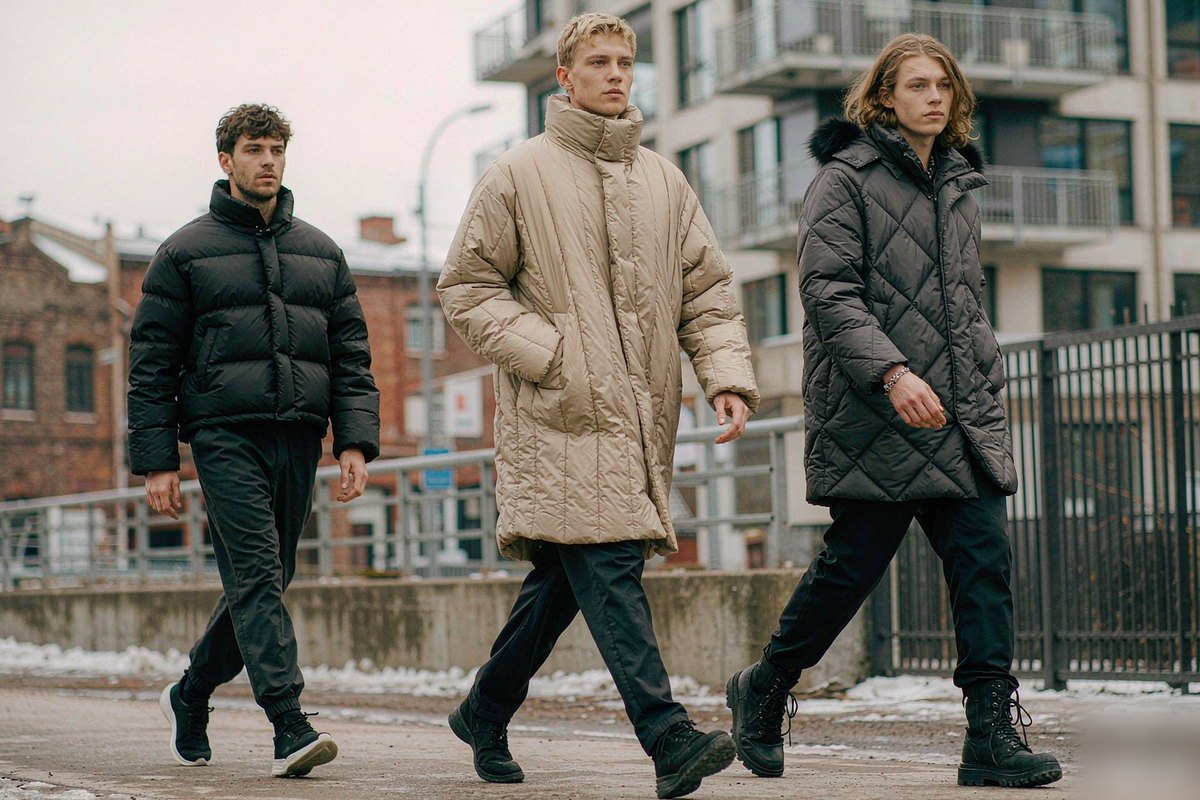
Think of a puffer as a set of small pillows that have to behave like one garment. Warmth comes from trapped air, and trapped air needs volume. Volume is unstable: it shifts, compresses and escapes, so every operation on the factory floor either protects that volume or destroys it.
A fleece hoodie arrives warm and the sewing line only has to hold its shape. A puffer gets insulation pushed into channels of a specific size, then has to survive folding, a sea container and a customer who unpacks it after three weeks of compression. Get the chamber width wrong and fill migrates downhill. Get the shell wrong and fibers find the needle holes. Neither fault shows up on a hanger photo.
The control point is never the finished jacket — it is the specification behind it. Buyers who understand that get fewer surprises and better pricing, because a factory can quote confidently instead of padding the number for unknown risk. If you are still comparing categories, the breakdown of bomber versus puffer versus varsity versus rain jacket construction shows where the puffer sits on the difficulty curve.
Start With the Product Brief
"We need a warm oversized jacket" is not a brief. Warm for a coastal autumn, or for standing outside in January? Oversized as a streetwear silhouette, or just roomy enough to layer a hoodie underneath? Those two sentences describe four products at four prices.
What belongs in the first development brief:
- Target market, climate band and months of wear
- Men's, women's, unisex or gender-neutral fit block
- Silhouette — regular, boxy, cropped, relaxed, oversized — with the chest measurement you consider correct
- Insulation direction, target warmth and acceptable shipped weight
- Shell appearance: matte, shiny, crisp, brushed, textured or recycled
- Water repellency, wind resistance and packability expectations
- Quilting direction, channel width and desired puffiness
- Branding method, placement and label hierarchy
- Quantity by color, size range, launch date and target cost band
We run pattern making and grading in house on US and EU blocks, so a brief with a reference garment and a body measurement is worth more than ten pages of mood boards. The question that saves the most time is boring: which jacket is your benchmark, and what exactly do you dislike about it? "Warmer than the last one but boxier" is actionable. "Make it premium" is not.
The tech pack reference material on our site shows the detail we can work from, and our development and production process sets out the sequence from design review to bulk delivery.
Insulation Options: Down, Recycled Down and Synthetic Fill
Insulation has one job: create loft so still air stays near the body. The right choice is the one that delivers the warmth, weight, moisture behavior, care instructions and price your customer will accept — not the thickest or most expensive option. Treat it as an engineering decision with a marketing consequence.
Down wins on warmth per gram and compresses better than anything else, which suits premium lightweight and travel jackets. But "duck down" is not a specification. You need the down-to-feather ratio, the fill power target, the total fill weight for the sample size and, where relevant, traceability documents. We build puffers with 600 to 800 fill power down, including hydrophobic options.
Down also carries a US labeling obligation. The FTC expects a product described simply as "down" to contain more than 70 percent down, and percentage claims to be accurate within roughly five percent. If your hangtag makes a claim, read the FTC guidance on advertising and labeling feather and down before the artwork is signed off. Untreated down clusters also collapse when wet, which is why hydrophobic treatments exist and why shell and lining construction are part of the performance system.
Recycled down reuses existing clusters and supports a circular story, but the claim is only as strong as the paperwork behind it — ask for chain-of-custody documents covering the source. Loose synthetic fill behaves better in damp conditions and suits fashion puffers, corporate wear and vegan collections; the risks are migration and clumping, so specify the fiber reference, grams per jacket and required recovery rather than "polyester padding". Sheet padding is cut with the garment panels instead of blown into chambers, which makes thickness far more consistent, at the cost of a flatter loft.
| Insulation | Strongest argument for it | What must be controlled |
|---|---|---|
| Duck or goose down | Best warmth-to-weight ratio, compresses small, premium hand | Fill power, total fill weight, ratio, leakage, traceability |
| Recycled down | Reuses existing clusters and supports a circular story | Documented content, cleanliness, consistency |
| Loose synthetic fill | Down-like look with easier care in damp conditions | Migration, clumping, wash recovery, filling accuracy |
| Sheet synthetic padding | Stable thickness and the simplest cutting and sewing | GSM, thickness, quilting distance, wash durability |
Fill Power vs. Fill Weight
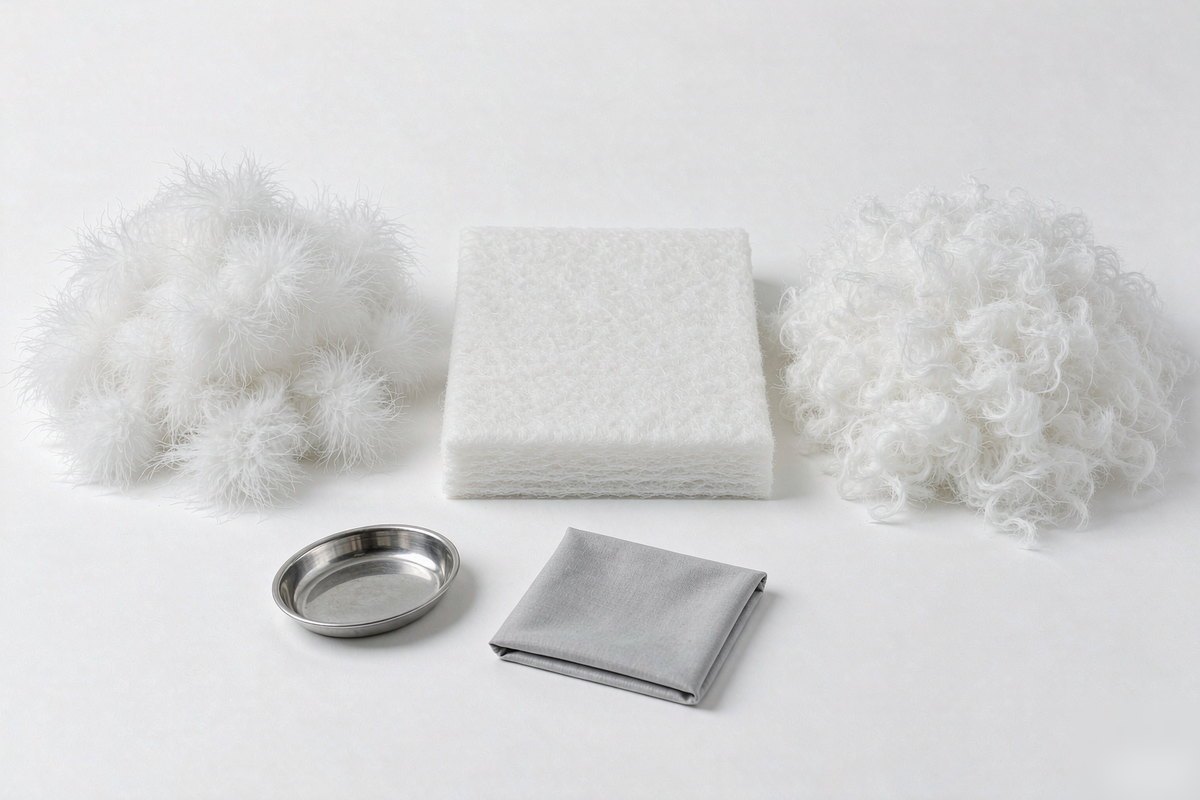
This is the most expensive misunderstanding in puffer development. Fill power measures the quality of down: how much volume a set weight occupies under standardized test conditions. Fill weight measures the quantity inside your jacket. Fill power is the efficiency of the engine; fill weight is how much fuel you put in.
So an 800 fill power jacket is not automatically warmer than a 650 fill power jacket. If the 800-fill piece carries much less down, it will be lighter, pack smaller and often feel colder. Perceived warmth also depends on chamber height, body coverage, hood volume, cuff and hem sealing, shell wind resistance, and how much dead space the fit leaves around the torso.
Do not sign off a quote that lists only a fill power figure. Ask for the total fill weight for the sample size, the planned distribution by garment zone and an acceptable bulk tolerance in grams, so inspection has something objective to measure against.
Front body, back, collar, hood and sleeves do not need equal quantities. A jacket filled evenly across the body but thin at the collar reads as cold the moment someone puts it on. Ask for a chamber-by-chamber filling chart. We record stitch density, needle specification and thread count for every approved construction, because that is what makes the second order match the first.
Choosing the Shell Fabric
The shell decides more than appearance. It sets garment weight, wind resistance, down leakage, abrasion performance, water repellency, how the fabric behaves under the needle and how fast the jacket recovers after unpacking. There is no universally correct answer, only a balance.
Nylon and ripstop nylon
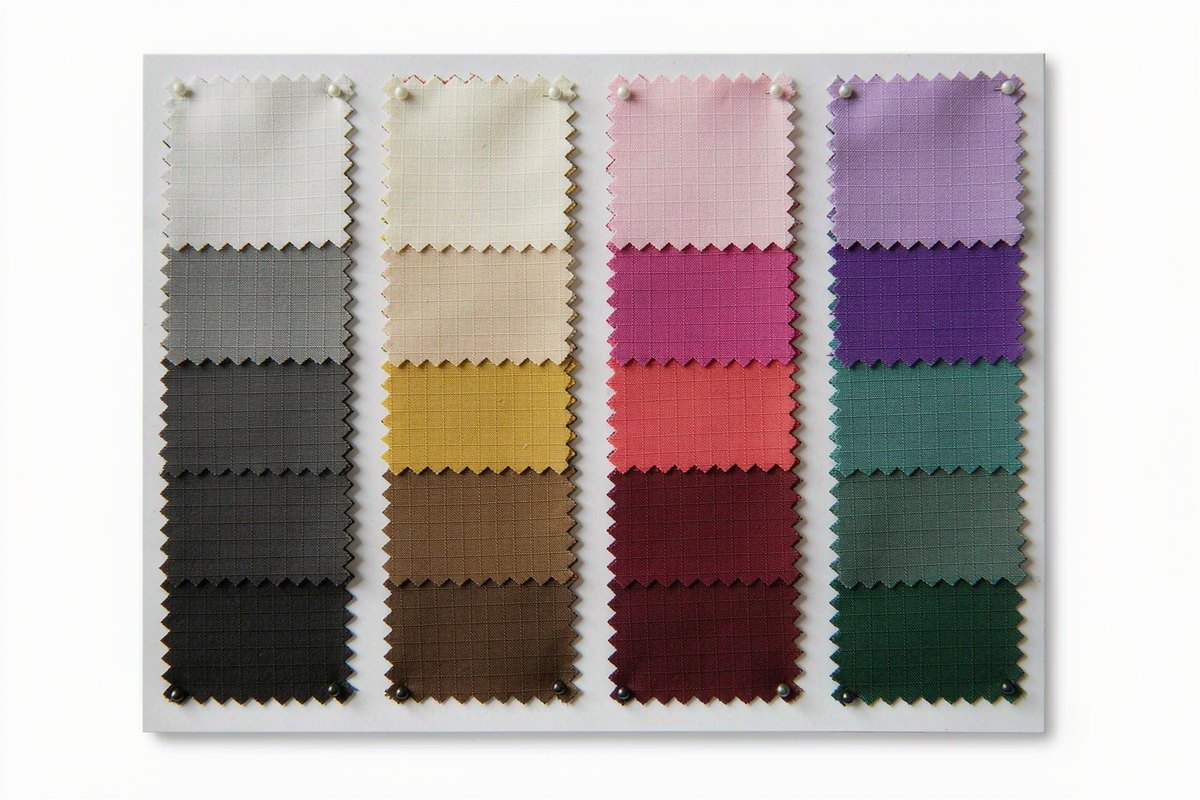
Lightweight nylon is the default for packable and technical puffers because it delivers strength at low weight, and ripstop grids add tear resistance for very little extra mass. We normally work in the 20D to 40D range. Fine nylon does need the right finishing: a calendared or coated surface closes the weave enough to hold down in. Without it you get a jacket that breathes beautifully and sheds feathers onto the customer's black sweater.
Polyester, recycled and textured shells
Polyester covers a wide spread of weights, surface effects and prices, and usually holds color very consistently — which matters when a program repeats across seasons. For streetwear, lifestyle and uniform puffers, it is often the more sensible choice than lighter, more fragile nylon. Recycled shells can carry a responsible-material story provided the transaction certificates exist. Corduroy and other textured shells make a strong statement but are heavier, behave differently under quilting and need their own testing.
| Decision | What you are really asking |
|---|---|
| Fabric weight | Will the finished jacket feel light and packable, or heavy once filled? |
| Downproof performance | Can fibers escape through the weave, coating or needle holes after quilting? |
| Water repellency | Is surface beading enough, or does the claim require tested rain performance? |
| Tear and abrasion | Will it survive bag straps, seat belts, repeated packing and three winters? |
| Handfeel and noise | Does it feel soft and premium, or stiff and rustling like a crisp packet? |
| Color and finish | Will bulk shade, sheen and coating match the approved lab dip across dye lots? |
A DWR finish helps light moisture bead on the surface, but water repellency is not waterproofing — different claims, different test methods. If a performance statement goes onto a hangtag, agree the method and pass threshold before the fabric is ordered. Our fabric lab works to lab dips with defined color tolerance targets and archives the formulas, because shade drift across dye lots is one of the most common reasons a second order looks subtly wrong. The guide on color consistency for apparel programs goes deeper.
If you are weighing up whether insulation is needed at all, compare against a custom windbreaker jacket: a shell-only piece solves different weather, costs less and ships lighter. Many brands build both.
Lining and Downproof Construction
The lining is the layer your customer touches, and it does two jobs: sliding comfortably over a base layer and holding the insulation in from the inside. Lightweight polyester or nylon taffeta is the usual answer. Brushed linings add comfort in selected zones, and fleece-lined pocket bags warm the hands without lining the whole jacket in a heavy material.
Here is what catches people out: down leakage is not purely a fabric problem. A shell can pass a flat-fabric downproof check and still shed fibers once sewn, because the needle damages the weave. Needle size, thread thickness, stitch balance, stitch density and the number of passes all matter, and re-stitching a crooked line enlarges every hole it crosses.
So run seam trials with the exact shell, lining, thread, needle and stitch density that production will use — not an equivalent. When a brand sends us a fault report saying "the sample is already shedding", the cause is usually a needle one size too large or a seam sewn twice, not a defective fabric.
Baffles and Quilting Construction
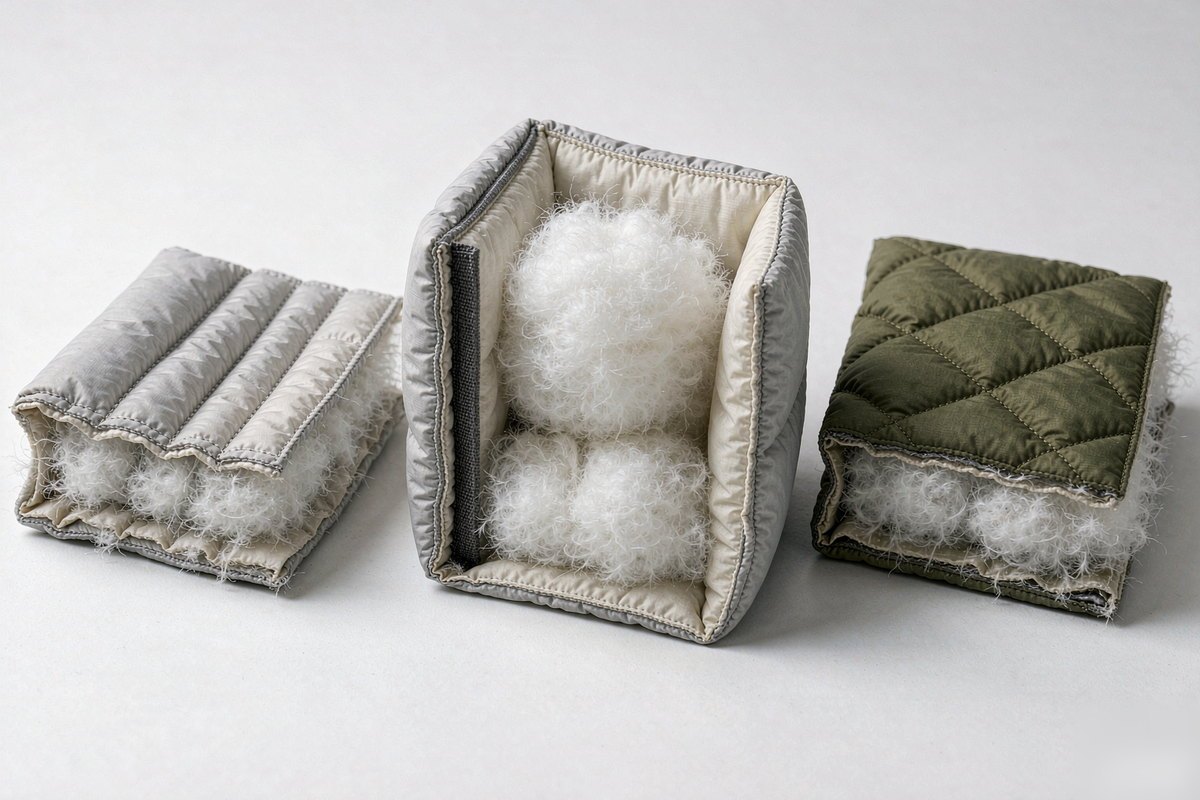
Baffles divide the jacket into chambers so the fill stays where the designer put it. Their size and construction set loft, cold spots, garment weight and the visual identity of the piece. Everyone can see horizontal channels; what buyers miss is that the same channel width performs completely differently depending on how it is built.
Sewn-through construction
Stitching passes directly through shell and lining, creating channels or boxes. It is fast, light and ideal for fashion puffers and moderate cold. The catch is compression: along every stitch line the insulation is squeezed to almost nothing, and that becomes a thin cold line. In a mild winter jacket nobody notices. In a jacket sold for real cold, it is a defect the customer feels on the first walk.
Box-wall and true baffle construction
Box-wall adds an internal wall between shell and lining so the two faces are not pulled together, letting the insulation keep continuous loft. That is how alpine-grade jackets are built, and why they feel warmer at the same fill weight. The cost is material, extra operations, more weight and more sampling risk — plus a more structured silhouette, which for some streetwear directions is the point.
Heat-bonded and decorative quilting
Bonded channels create a cleaner surface with far fewer needle holes, which suits very fine shells, but bond durability has to be tested against washing, flexing and temperature — a failed bond cannot be repaired the way a seam can. Beyond that, quilting is a design language: horizontal, chevron, diamond, wave or a pattern mapped to the body. Curved quilting is genuinely distinctive and genuinely needs templates; without them the left front and right front will not match.
Match the chamber to the fill
Chambers that are too large let fill migrate downhill across a long front panel. Chambers that are too small compress the insulation so it never reaches its rated loft, and you end up paying for down you cannot feel. Every fill type has a working range, and it should be decided together with the quilting width rather than after it.
Pattern, Fit and Functional Details
You cannot copy the measurements of an unlined jacket and add padding. Insulation consumes space in both directions — inward toward the body and outward toward the silhouette — so the pattern has to account for loft, lining ease, layering room and the external shape you want. On an oversized streetwear puffer, shoulder drop, sleeve volume, body length and hem circumference have to move together. Increase only the chest and you get a garment that is wide in the middle, tight in the arms and narrow at the bottom.
Hood and collar
Judge a hood from the front, side and back, on a person, with and without a beanie. Check facial coverage, peripheral visibility, crown volume, where the drawcord lands when tightened, and how the hood sits when down. A stiff hood that stands up like a sail is a common and entirely avoidable fault. The collar should close without pressing on the throat, and a zipper garage or microfleece chin guard prevents the chafing customers complain about most.
Pockets, zippers, cuffs and hem
Pocket openings must stay reachable once the jacket is fully filled: confirm angle, bag depth, reinforcement and whether contents can fall out when the wearer bends. Main zippers on a padded front need to run smoothly over loft, and plackets or internal wind guards must not catch in the slider. Cuffs and hem change both fit and perceived quality, and hem drawcords need cord exits, locks, end finishes and the safety requirements of your market thought through.
Branding and Private Label Options
Branding a puffer is not branding a T-shirt. The surface is unstable, three-dimensional and moving. Large embroidery compresses insulation, pulls the shell and punches many more holes into a fabric already fighting to hold fibers in. A logo placed across two baffles distorts as the jacket lofts and relaxes.
In practice, embroidery is cleanest when applied to the shell panel before the garment is filled, while the panel is still flat. Woven badges, rubber patches, silicone logos and reflective transfers work well on technical shells, but adhesion and edge lifting must be wash tested rather than assumed. Screen print and heat transfer need settings compatible with a lightweight coated nylon, not the settings you would use on cotton fleece. A logo that looks perfect on day one and peels by day thirty is a warranty claim, not a design choice.
Private label usually goes further: neck labels, size tabs, care labels, hangtags, branded zipper pullers, polybags, barcode stickers and printed cartons. Fix the hierarchy early, and check care-label wording against the FTC care labeling requirements if you sell into the US. Reviewing the full spread of fabric, trim and branding techniques before locking the decoration method prevents ordering labels for a method you later abandon. Reversible puffers deserve a warning: both faces must be finishable and correctly labeled, and every seam must look deliberate from both sides. It is achievable, but it is a development project rather than a variation.
What a Puffer Jacket Tech Pack Must Include
A reference photo communicates mood; it does not control production. The tech pack converts taste into numbers. If the specification says "make it puffy", the sample maker guesses, and every guess becomes a revision round you pay for in time.
A puffer jacket tech pack should specify:
- Flat sketches: front, back, side, hood and internal construction
- Finished measurements, grading rules and tolerances by size
- Shell and lining composition, weight, finish, color reference and lab dip
- Insulation type, fill power where relevant, total fill weight, zone distribution
- Baffle dimensions, quilting layout, stitch density and needle specification
- Zipper, snap, elastic, drawcord and hardware references, including pullers
- Pocket construction, depth and reinforcement
- Artwork dimensions, color reference, decoration method and placement measurements
- Label and care instruction positions
- Testing requirements, folding method, polybag spec and carton ratio
If your team only has sketches, reference garments or mood boards, that is a normal starting point — an OEM or ODM partner should turn them into production details during development review. More detail means less quotation uncertainty, which is why the clothing tech pack guide is worth reading before your first sample request.
Sampling and Approval
Sampling is not a look-and-see exercise. It is where the brand and the factory agree on whether the design can be produced the same way three hundred times. A first prototype tests silhouette, construction and proportion; after fitting, the brand returns comments with photographs, measured differences and revised figures.
Write comments that can be reproduced. "Slightly bigger" is not a comment. "Chest plus 2 cm, sleeve minus 1 cm, front body down 3 cm, baffle three filled 4 g lighter" is. Vague feedback resets the sample maker to zero and you pay for it in another round. Samples usually take 7–10 days once materials are available. Custom-developed shells, complex baffles, special insulation or a revised sample can extend development to 15–25 days, so confirm the calendar once materials are booked. Our note on how long clothing production takes from sample to bulk sets out the dependencies.
Before bulk cutting, approve a pre-production sample in confirmed or production-equivalent materials, and record everything measurable: garment weight, measurements, fill distribution, shell shade, trim references, artwork placement, folding and packaging. That sealed sample plus the signed specification becomes the physical standard for the line and for final inspection. Keep it somewhere it cannot be quietly replaced.
Bulk Production
Bulk production starts before the first stitch, with materials and shade control. Shell rolls are inspected, relaxed where the fabric requires it, and grouped by dye lot so no garment is cut from two visibly different batches. Panels are cut from approved CAD markers, and quilting templates plus notches keep left and right panels symmetric.
Filling is the stage that separates a controlled factory from an optimistic one. Loose fill must be weighed into each chamber against the filling chart, and filling equipment calibrated per style. Work areas should minimize contamination and material loss, because down travels. Sheet padding is cut to shape and secured so it cannot shift during sewing or washing.
Inline inspection belongs after critical operations, not only at the end. Quilting alignment, pocket position, zipper installation, sleeve setting, fill consistency and measurement drift are cheap to correct before final assembly and expensive afterward — a jacket 8 mm out at quilting will not match its placket later. Finally, let finished jackets recover their loft before packing. Over-compressed cartons produce jackets that look underfilled when opened, and deep creases in coated nylon do not always relax.
Puffer Jacket Quality Control
Final inspection compares bulk goods against the approved sample, the specification sheet, the color standard, the trim card and the artwork file. Appearance alone is not inspection. These are the nine areas we check, and the nine areas any serious puffer supplier should talk you through.
| QC area | What to check | How the failure shows up |
|---|---|---|
| Fill weight | Total garment weight plus section-by-section consistency | Flat sleeves, thin collars, inconsistent warmth |
| Loft recovery | Appearance after unpacking and gentle redistribution | Jackets that stay compressed or clumped |
| Down leakage | Shell, lining, quilting seams and high-friction areas | Fibers on the surface or on dark garments underneath |
| Measurements | Chest, shoulder, sleeve, body length, hem, hood and cuff | Fit drift caused by padding and sewing tension |
| Quilting | Channel width, line shape, symmetry, skipped stitches | Crooked channels, mismatched left and right panels |
| Shell and lining | Shade, coating integrity, stains, snags, holes, puckering | Visible shade difference, pressure marks, pulled yarns |
| Zippers and hardware | Opening, closing, slider movement, pull strength, finish | Jamming on loft, broken pullers, misaligned fronts |
| Branding | Logo size, color, position, adhesion, embroidery tension | Distortion, peeling, placement drift between units |
| Packing | Folding method, hangtags, size stickers, polybags, carton ratio | Excess compression, wrong assortment, missing labels |
Which lab tests are worth paying for
Tests should answer a risk you actually have, not decorate the specification. The useful ones are usually down composition and fill power where you claim either; dimensional stability after the agreed wash cycle; tensile and tear strength on fine nylons; seam strength and slippage; colorfastness to washing, rubbing and light; the appropriate water repellency test where you claim beading or rain protection; and zipper durability including pull strength. Standard methods for several of these are published by AATCC, and agreeing the method before production is what makes a result comparable.
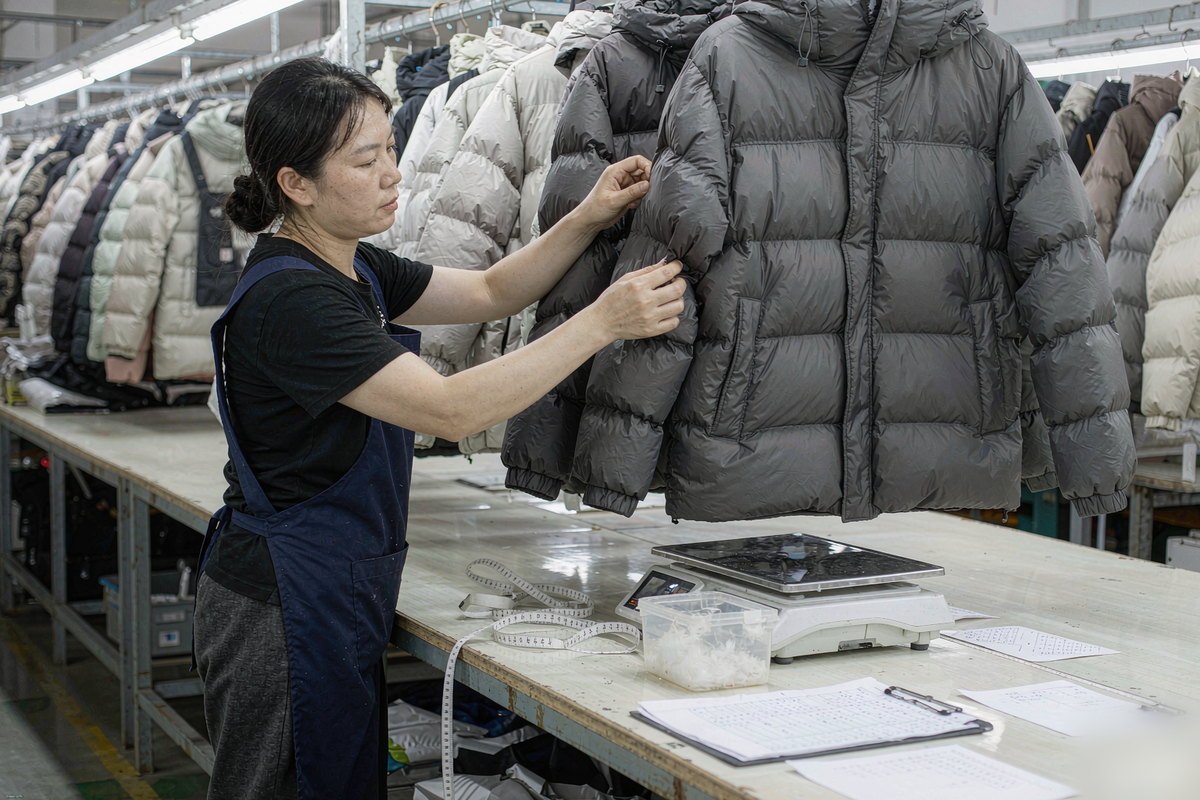
Our QC lab runs inline audits and final inspections at AQL 2.5 and 4.0, with tolerance tables agreed before bulk so inspection is objective rather than a matter of opinion. A measurement that is "close enough" at the factory gate becomes a customer complaint when two sizes are compared side by side. The wider quality control process is set out in more detail if you want to compare it against your own standard.
Common Manufacturing Problems and Fixes
Uneven or migrating fill
Almost always a specification problem rather than a worker problem: chambers too wide for the fill, an inaccurate filling weight, an open internal passage, or no verification before the baffles were closed. Use a chamber-level filling chart and inspect distribution before closing — and on a long front panel, consider splitting a tall chamber into two.
Down or fiber leakage
The cause can sit in the fabric, the needle holes, the thread or a damaged seam. Confirm that both shell and lining are genuinely downproof for your fill type, then run sew-off trials with the production combination of needle, thread and stitch density. Avoid re-stitching, because every extra pass widens the holes.
Cold lines along the quilting
Sewn-through construction compresses insulation at every stitch, so if the jacket is meant for genuinely cold conditions, adding fill will not fix it — the construction is the problem. This is the classic case where a higher fill weight makes the jacket heavier and barely warmer.
Twisted panels and bulk that misses the sample
Uneven feeding, inconsistent shell tension, inaccurate quilting or zipper shrinkage will pull a front panel out of shape, so panel quilting should be controlled before zipper insertion. When bulk simply does not match the approved sample, the cause is nearly always an approval failure: the factory matched the general design while substituting a fill weight, quilting tension, shell lot or trim. Keep a sealed sample and signed specifications, and inspect early production against both. The sample-to-bulk consistency checklist covers the records that prevent this.
The jacket that rustles like a bag
Often overlooked because everyone is looking rather than listening. Very hard-coated fine nylons and certain bonded constructions sound cheap, and customers notice immediately in a quiet shop. Order the shell in a small quantity, make it up, and wear it for an afternoon indoors before committing. Hand feel and sound are specification items — write them into the approval notes. Our pre-production risk checklist for jackets follows the same logic: fabric, fit, hardware and QC, in that order.
Cost, MOQ and Lead Time
Puffer pricing is driven by the whole construction, not one headline material. Shell price, insulation type, total fill weight, lining, baffle complexity, hardware, decoration, testing, size range and packaging all pull on the number. If two quotes for what looks like the same jacket differ, the gap is almost never the shell — it is the fill weight, the baffle method or the trim spec.
Higher fill power raises material cost, and greater fill weight raises the quantity consumed, which makes fill weight a double cost: you pay for the down and you pay to ship it. Box-wall construction costs more than sewn-through channels because it needs extra fabric and operations, and custom shell colors or branded hardware often carry supplier minimums that only make sense at a certain volume.
On quantity, MOQ usually starts from 100 pieces per color per style, depending on fabric, trims, branding method and order quantity. Custom shell colors, special insulation and custom trims carry their own supplier minimums. If your launch needs several colorways, place them together so the fixed setup spreads across the order instead of repeating it. On timing, samples usually take 7–10 days, and bulk production takes about 25–35 days after confirmation. Custom-developed shells, complex baffles or special insulation can extend sampling beyond that. The biggest cause of delay is not factory capacity; it is a brand team still deciding what it wants while the sample sits on the table. Our MOQ guide explains how quantity interacts with setup cost.
How to Evaluate a Puffer Jacket Manufacturer
A puffer factory has to show more than general sewing capacity. Ask to see the shell options they actually hold, insulation references, filling methods, quilting equipment, seam trial records and finished examples at different fill weights. Then pay attention to how they answer: a supplier who agrees with every request has no production opinion, which is the wrong quality in a development partner. The good ones push back, because an ultra-light shell with heavy embroidery, or a narrow chamber with bulky insulation, are contradictions worth naming early.
Ask how approvals are recorded. Are material codes, filling charts, size specifications, artwork positions and trim references documented per style? Can they explain their inline inspection points and final sampling plan? Repeat production quality lives in records as much as in craftsmanship. Our production setup covers in-house pattern development, CAD marker planning, a fabric lab, quilting equipment for baffles and bonded panels, embroidery and printing, sewing, and quality inspection for custom outerwear programs. We publish that because buyers should be able to verify capability rather than take it on faith — the factory capabilities page lists equipment, capacity and inspection systems.
If those answers arrive quickly and specifically, you are probably talking to a factory rather than a trading office. Comparing outerwear capability more broadly is easiest through the custom jacket manufacturer overview. If your range includes insulated layering pieces, note how those constructions differ: a quilted vest uses much less fill but places it far more visibly, and sherpa fleece jackets solve warmth through fabric structure instead of insulation.
Conclusion
A great custom puffer jacket is not the one with the highest fill power or the thickest padding. It is the one where warmth, garment weight, shell performance, baffle construction, fit, branding, cost and repeatability were balanced deliberately — and then written down. Decide what the jacket is for before you choose a fabric. Turn every choice into a number someone can measure. Approve a pre-production sample that represents bulk, seal it, and inspect against it rather than against memory.
Do that and the second order looks like the first. Skip it, and you will spend the season explaining to a retailer why the jackets in the carton look nothing like the sample on their desk. In puffer manufacturing, the specification is the product.
Planning a puffer program for the coming season?
Share your tech pack or reference jacket, quantity, destination country and target budget, plus your target climate, preferred shell and insulation direction. Our team will review material feasibility, baffle construction, sampling and bulk requirements, and come back with a suitable factory quote.
Frequently Asked Questions
Is the minimum order quantity 100 pieces per style or per color?
It is 100 pieces per color, per style. Two colors means a 200-piece minimum and four colors means 400. Buyers often read the figure as per style and then plan four colorways, which is where the surprise comes from. If your launch needs multiple colors, place them as one order so development and dyeing setup is shared across the run.
How many sample rounds should we expect before approval?
For a new silhouette with a confirmed shell and insulation, one prototype plus one revised sample is typical, followed by a pre-production sample in production-equivalent materials before bulk cutting. Each round runs about 7–10 days for a straightforward build, or 15–25 days where shells, insulation or baffles are custom-developed. Programs that need three or four rounds usually have moving specifications rather than difficult construction.
Is 800 fill power always warmer than 650 fill power?
No. Fill power measures loft quality, while fill weight measures how much down is inside the jacket. Total warmth also depends on fill distribution, baffle design, body coverage, fit and wind protection. A high fill power jacket with very little down can be lighter and colder than a lower fill power jacket with more fill.
Our first sample is already shedding feathers. Is the fabric wrong?
Not necessarily. Flat-fabric downproof testing is only half the story, because the needle damages the weave during sewing. The usual causes are a needle one size too large, thread that is too thick, unbalanced stitch tension, or a seam sewn twice to correct a crooked line. Run a sew-off trial with the exact production needle, thread and stitch density before blaming the shell.
Can a puffer jacket be made reversible without ruining the branding?
Yes, but treat it as a development project rather than a variation. Both faces have to be finishable and correctly labeled, and every seam and pocket must look intentional from either side. Embroidery should generally be applied to flat panels before filling, and bonded or woven badges need wash testing on both fabric faces. Allow an extra sample round and expect a higher unit cost.
Keep reading on this topic