How Long Does Clothing Production Take? From Sample to Bulk Manufacturing
How Long Does Clothing Production Take? From Sample to Bulk Manufacturing
You have approved the design, found a clothing manufacturer, and started thinking about your launch date. Then comes the question almost every apparel brand asks: how long does clothing production actually take?
The short answer is that a custom apparel project can take anywhere from several weeks to several months. The useful answer is more specific. Your timeline depends on where you start, how complex the garment is, whether fabrics and trims are available, how many sampling rounds you need, how quickly approvals are made, and what happens between bulk production and final delivery.
That is why an experienced manufacturer rarely treats production lead time as one fixed number. A clothing production timeline is a chain of connected approvals. If one link moves, everything behind it can move too.
Quick Answer: How Long Does Clothing Production Usually Take?
For a custom apparel project, a practical planning range is often around 8–16 weeks from product development to finished bulk goods, although highly customized products or first collections can take longer.
If your sample has already been approved and all bulk materials are ready, bulk clothing production itself commonly takes around 3–7 weeks. Complex jackets, custom fabrics, garment washing, special hardware, embroidery, multiple colorways, testing requirements, or large quantities can extend that window.
International freight is separate. Air shipment may add days, while ocean freight can add several weeks.
So when a factory tells you “production takes 40 days,” ask one more question: 40 days starting from what point?
Clothing Production Timeline at a Glance
Before looking at each stage individually, it helps to see the whole apparel manufacturing process on one screen.
The ranges below are planning references rather than guaranteed lead times. A simple sweatshirt using an available fleece is not the same project as a washed denim jacket with custom metal hardware, embroidery, lining, labels, and special packaging.
| Production Stage | Typical Planning Range | What Happens | Main Delay Risk |
|---|---|---|---|
| Project & Tech Pack Review | 1–5 days | Specifications, quantity, construction, artwork, sizing, and timeline are reviewed. | Missing or conflicting information |
| Fabric & Trim Sourcing | 3 days–3+ weeks | Fabric, rib, zippers, buttons, labels, colors, and decoration materials are confirmed. | Custom development or unavailable materials |
| Pattern & First Sample | 1–3 weeks | Pattern development, cutting, sewing, decoration, finishing, and sample inspection. | Complex pattern or special process |
| Sample Revision | About 1–2 weeks per round | Fit, measurements, construction, fabric, trims, and artwork are adjusted. | Late or unclear feedback |
| Pre-Production Approval | Several days–2 weeks | The final production standard is confirmed. | New changes introduced late |
| Bulk Material Preparation | 1–4+ weeks | Bulk fabric, dyeing, trims, labels, packaging, and accessories are prepared. | Custom dyeing, knitting, hardware, or supplier lead time |
| Bulk Manufacturing | 3–7+ weeks | Cutting, decoration, sewing, washing, finishing, and in-line inspection. | Order complexity, quantity, and factory capacity |
| Final QC & Packing | 3–10 days | Measurement checks, workmanship inspection, sorting, labeling, and packing. | Rework discovered during inspection |
| International Freight | Days–several weeks | Air or ocean transportation, customs, and final delivery. | Shipping mode, customs, port conditions |
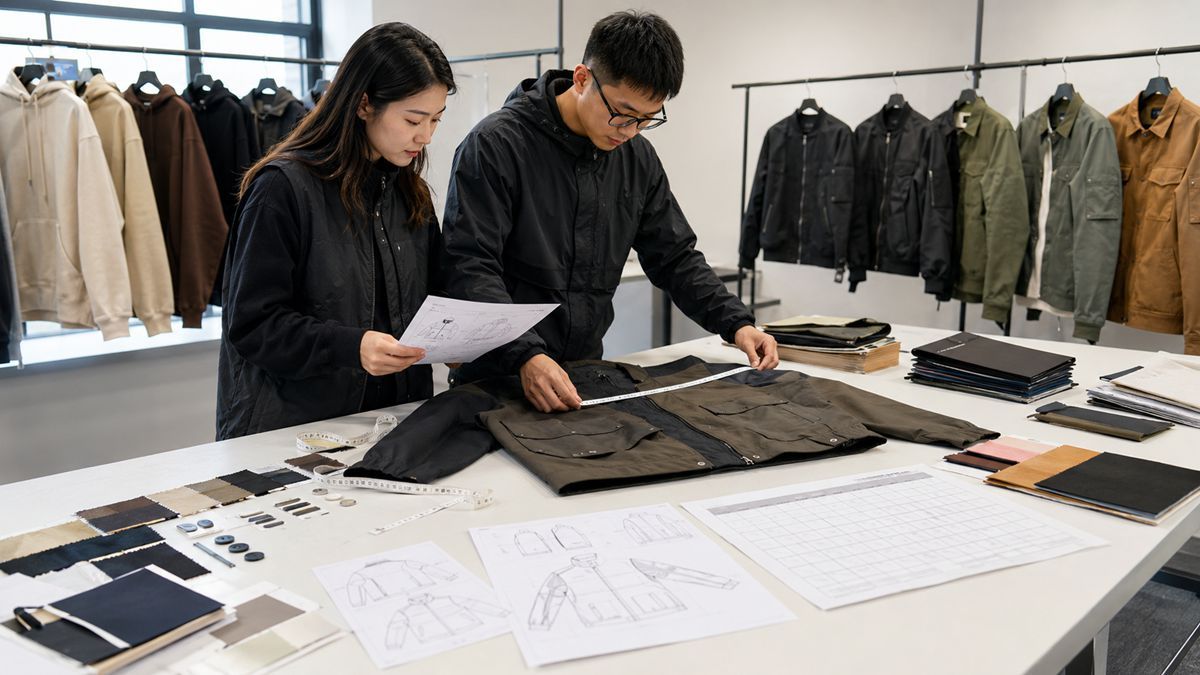
Typical Clothing Production Timelines by Project Complexity
The stage-by-stage table above is useful for planning, but buyers often want a simpler benchmark. The following scenarios show how the overall calendar may change depending on how much development is required. These are planning examples, not guaranteed lead times.
Best suited to established patterns, available fabrics, simple decoration, limited revisions, and fast approvals.
More realistic for new private label styles requiring sourcing, sampling, fit revisions, custom branding, bulk production, QC, and packing.
May apply when projects involve custom fabric, hardware, lining, washing, multiple techniques, extensive testing, or several approval rounds.
Important planning assumption:
Lead-time estimates only become meaningful when the manufacturer knows what is approved, what still needs development, which materials are available, and when buyer feedback will be returned. A short number without those assumptions is not a production plan.
What Does “Clothing Production Time” Actually Include?
One of the biggest sources of confusion between brands and factories is that both sides may use the words production time while talking about completely different periods.
A brand founder may be thinking about the day the design is sent to the factory until the day cartons arrive at the warehouse. A production manager may be referring only to the time between approved bulk materials entering the cutting department and finished garments leaving the factory.
Those are not the same timeline.
Think about building a house. The number of days workers spend physically constructing the building is only part of the project. Architectural drawings, material orders, permits, approvals, revisions, inspections, and delivery all happen around the construction itself. Apparel manufacturing works in much the same way.
Manufacturer-side perspective:
The sewing line is often not the biggest source of uncertainty. The uncertain part usually appears before the line starts: incomplete specifications, fabric decisions, sample revisions, artwork approvals, custom trim development, or changes made after the production standard should already have been locked.
This is why you should ask your factory for a stage-by-stage production calendar instead of relying on one attractive lead-time number.
Stage 1: Product Brief and Tech Pack Review
A reliable production timeline starts before anyone cuts fabric.
The manufacturer first needs to understand exactly what you are trying to produce. This usually means reviewing your technical drawings, measurements, fabric requirements, construction details, artwork, labels, packaging, order quantity, size range, colorways, and target delivery window.
A strong clothing tech pack can save more time than almost any attempt to rush the sewing stage later.
What Should Be Confirmed Before Sampling?
- Front, back, and detail garment drawings
- Finished garment measurements
- Fit direction: regular, relaxed, oversized, cropped, boxy, or another defined silhouette
- Fabric composition, weight, construction, and finishing
- Color references or Pantone standards
- Print, embroidery, patch, appliqué, or other decoration methods
- Zippers, snaps, buttons, drawcords, rib, and other trims
- Main labels, size labels, care labels, and hangtags
- Packaging requirements
- Estimated quantity by style and color
- Target delivery date and destination
You do not always need every answer before your first conversation with a manufacturer. An experienced OEM/ODM apparel development partner may help convert sketches, samples, references, and concepts into manufacturing specifications.
But before bulk production, ambiguity becomes expensive. A vague idea may survive one sample. It is much harder to reproduce consistently across hundreds or thousands of garments.
Stage 2: Fabric, Trim and Color Sourcing
Material sourcing is one of the most underestimated parts of a clothing production timeline.
If your project uses an available fabric and standard trim, sourcing can move quickly. If you need custom knitting, a specific GSM, Pantone dyeing, specialty washing, custom zipper pulls, branded snaps, unique rib, or specially developed packaging, the material calendar can become much longer.
Stock Materials vs. Custom Materials
Imagine two brands developing almost identical hoodies.
Brand A chooses an available heavyweight fleece in an existing black color, standard rib, and an in-stock metal zipper. Brand B wants a custom-developed fleece, a specific faded pigment color, branded zipper pullers, custom drawcord tips, and specially dyed rib.
The garment silhouette may look almost identical on a sketch. The production timelines will not.
That is why material decisions should be made early. VANRD's fabric and technique capabilities can also help brands compare fabric, finishing, printing, embroidery, and other production routes before locking the sample.
Color Approval Can Become Its Own Timeline
Custom colors may require lab dips, strike-offs, print tests, embroidery samples, or wash tests. If the first result is rejected, another approval round may be necessary.
That does not mean the manufacturer is wasting time. The purpose of the approval is to discover the problem while the problem is still small.
Correcting a shade before bulk dyeing is inconvenient. Correcting several hundred completed garments is much worse.
Stage 3: Pattern Making and First Sample Development
Once the specifications and materials are clear enough, the product enters pattern development and sampling.
This is the moment when a two-dimensional design becomes a three-dimensional garment.
Pattern making controls far more than whether the garment is technically a size M. It controls balance, shoulder shape, sleeve angle, armhole, body volume, rise, leg shape, neckline, hood shape, pocket position, and the way the entire garment sits on the body.
That matters especially in streetwear. An “oversized hoodie” is not simply a normal hoodie enlarged in every direction. The chest may become wider while body length remains controlled. Shoulders may drop. Sleeves may gain volume. The hood may need to be proportioned to match the new silhouette.
What Is the First Sample Supposed to Achieve?
Your first sample does not need to prove that the product is perfect.
Its real purpose is to expose what still needs to be solved.
Does the garment match the intended proportion and brand aesthetic?
Are seams, pockets, closures, lining, reinforcement, and assembly correct?
Does the fabric behave, drape, stretch, wash, and feel as expected?
Are print, embroidery, labels, patches, and artwork placed correctly?
For a deeper explanation of this stage, see VANRD's guide to streetwear sampling and production lead time.
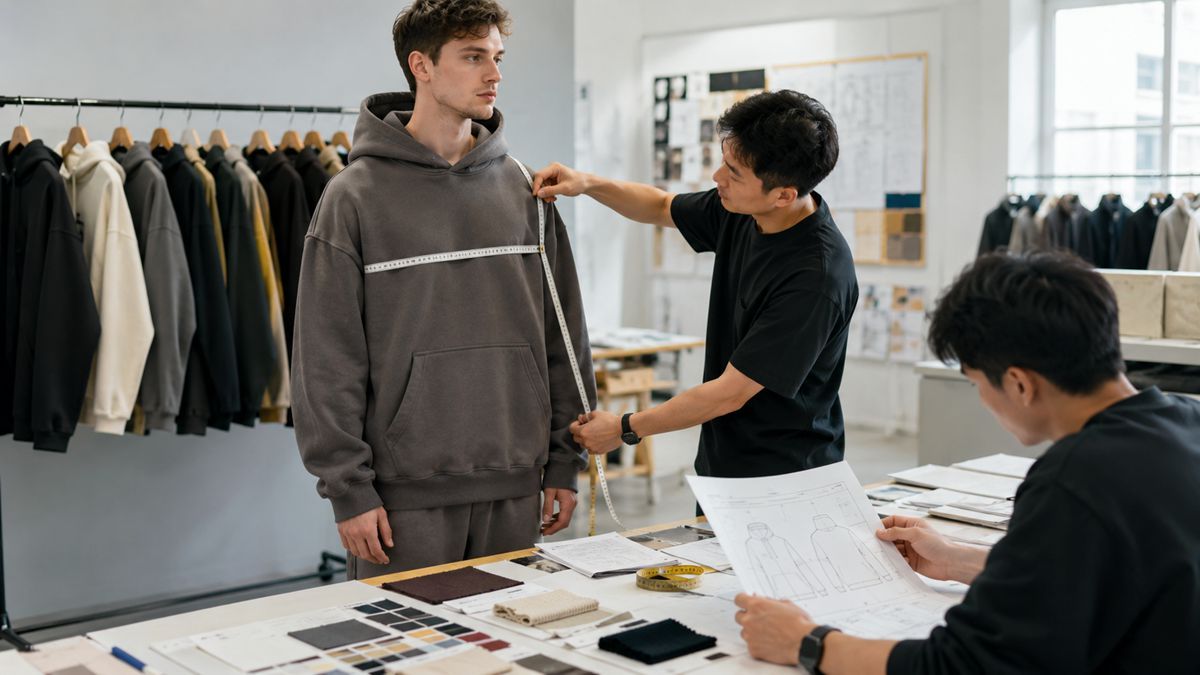
Stage 4: Sample Review and Revision Rounds
This is often where production calendars quietly expand.
A brand receives the sample and says, “The fit feels wrong.” What should the pattern maker change? The chest? Body length? Shoulder width? Sleeve pitch? Armhole? Hem circumference?
Compare that with feedback such as: “Increase finished chest width by 4 cm, shorten body length by 2 cm, keep shoulder width unchanged, and reduce sleeve opening by 1 cm.”
The second message can become an instruction. The first message starts another conversation.
How Many Sample Rounds Are Normal?
There is no universal number.
A simple T-shirt developed from an existing block may be approved quickly. A custom bomber jacket with lining, rib, zippers, embroidery, padding, custom hardware, and multiple pockets naturally has more variables to test.
One to three development rounds is common for many custom apparel projects, but the number can increase if the design changes substantially during sampling.
Every New Decision Can Reset Part of the Timeline
Suppose you approve the fit, then decide to change from lightweight nylon to heavy canvas.
Technically, the drawing did not change. In reality, the garment did. Canvas may alter drape, thickness, seam construction, collar structure, pocket behavior, and zipper requirements. Another sample may be the responsible choice.
This is why faster approval does not mean careless approval. It means making decisions in the right order.
Stage 5: Pre-Production Sample Approval
Before bulk manufacturing begins, the project should reach a controlled production standard.
Depending on the manufacturer and product, this may be called a pre-production sample, PPS, sealed sample, approved sample, or golden sample.
The terminology matters less than the purpose.
This sample answers a critical question: what exactly is the factory supposed to reproduce in bulk?
What Should Be Locked Before Bulk Cutting?
- Garment measurements and tolerances
- Fit and silhouette
- Fabric and color
- Construction details
- Thread and stitching
- Print and embroidery placement
- Labels and trims
- Wash or finish
- Packaging requirements
- Size and quantity breakdown
Skipping this stage may appear to save a few days. In reality, it can turn a small unresolved question into a bulk production problem.
The safest point to correct a jacket pocket is before 500 jackets have that pocket.
Stage 6: Bulk Material Preparation
Sample approval does not always mean sewing can start tomorrow.
The factory may now need to prepare the actual bulk quantity of fabric, rib, lining, labels, zippers, buttons, packaging, embroidery thread, or other components.
For projects using custom materials, this stage can be one of the most important parts of the apparel manufacturing process.
Why Sample Fabric and Bulk Fabric May Follow Different Timelines
A development sample might use a small quantity from an existing roll. Bulk production may require hundreds or thousands of meters.
The mill may need to knit, weave, dye, finish, inspect, and ship the bulk material before garment cutting can begin.
Similarly, a prototype may use a temporary zipper while your final production requires branded hardware manufactured specifically for the order.
For this reason, experienced production teams try to run tasks in parallel when it is safe to do so. For example, label development or packaging preparation may start while another approval is being finalized.
The goal is not to skip approval gates. The goal is to avoid unnecessary idle time between them.
Stage 7: Bulk Clothing Production
Now we arrive at the stage most people imagine when they hear the word manufacturing.
Bulk production commonly includes several connected operations:
Bulk fabric is checked, spread, marked, cut, and bundled according to size and production requirements.
Printing, embroidery, patches, appliqué, or other processes are completed at the correct production stage.
Cut components move through sewing operations and become finished garment structures.
Garments may be washed, pressed, cleaned, trimmed, shaped, and prepared for inspection.
How Long Does Bulk Clothing Production Take?
For many custom apparel programs, bulk manufacturing may take approximately 3–7 weeks after production standards and materials are ready.
That range can change substantially.
A plain fleece sweatshirt with straightforward construction is easier to schedule than a multi-layer puffer jacket. A basic screen print is different from dense embroidery across multiple panels. A standard black fabric is different from a custom garment-dyed vintage wash.
Quantity matters too, but not always in the way buyers expect. A larger order can require more line time, yet very small orders involving highly customized materials can also be inefficient because suppliers still need minimum dye lots, machine setup, or specialized processing.
Why You Should Not Rush the Sewing Line
There is an important difference between removing wasted time and forcing physical production to move beyond a safe speed.
You can shorten approval delays. You can prepare files earlier. You can reserve a production slot. You can choose available materials. You can use air freight.
What you cannot safely do is pretend that 40 hours of controlled manufacturing suddenly becomes 10 hours without consequences.
Speed gained by removing uncertainty is healthy. Speed gained by removing control is expensive.
Brands developing outerwear can see how this becomes more complex in the custom jacket manufacturing process. If your program focuses on sweatshirts and fleece, the private label hoodie manufacturing guide covers the equivalent process for hoodies.
Stage 8: Quality Control and Final Inspection
Quality control should not be treated as something that happens only after the last garment is sewn.
A stronger system checks the product at several stages.
For buyers, the key question is not simply whether a factory says it has QC. Ask what is inspected, what approved standard is used, when the check happens, and what corrective action is taken if the result fails. That turns “quality control” from a marketing claim into a measurable production process.
In-Line Quality Control
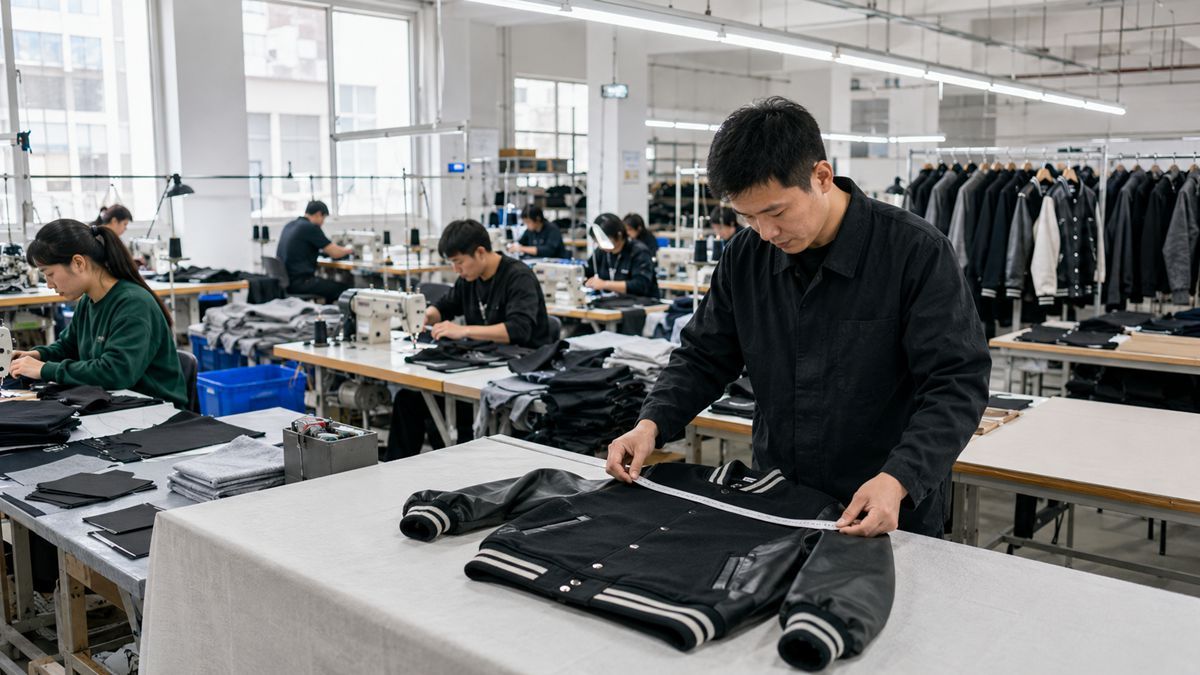
During production, the team may review measurements, seam quality, artwork placement, construction, trim attachment, color, and workmanship.
Why inspect early?
Because a repeating problem becomes more expensive with every garment produced.
If a pocket is positioned incorrectly on the first units, correcting the setup may be manageable. Discovering the same issue after the entire batch is finished can require extensive rework.
Final Inspection
Finished garments should then be checked against the approved requirements. Depending on the project and agreed QC system, inspection may cover:
- Finished measurements
- Appearance and workmanship
- Seam and stitching quality
- Print and embroidery placement
- Color consistency
- Zippers, snaps, buttons, and hardware
- Labels and care information
- Wash and finishing effect
- Quantity and size assortment
- Folding and packaging
This stage takes time, but it is not “dead time.” It is risk-control time.
For apparel brands, receiving a shipment several days earlier is rarely valuable if those days were gained by removing the checks that protect the order.
Stage 9: Packing and International Shipping
Another common planning mistake is treating the factory completion date as the product arrival date.
They are two separate milestones.
After final inspection, garments may still need size sorting, folding, labeling, polybagging, barcode application, carton packing, carton marks, shipping documentation, export handling, and freight pickup.
Then international transportation begins.
Air Freight
Air shipping is faster and is often useful when a launch window is tight, but the freight cost per unit is usually higher.
Ocean Freight
Sea freight is normally more economical for larger orders, but transit can add several weeks depending on origin, destination, sailing schedule, port congestion, customs clearance, and inland delivery.
This means your business should manage at least three separate dates:
- Bulk production completion date
- Shipment departure date
- Expected warehouse delivery date
Confusing these dates is an easy way to launch a marketing campaign before your inventory exists.
How Production Time Changes by Garment Type
There is no universal apparel production lead time because different garments carry different manufacturing risks.
T-Shirts & Basic Tops
Basic T-shirts usually have fewer pattern pieces, trims, and construction steps. If fabric is available and branding is straightforward, development and bulk production can move relatively quickly.
Custom fabric, garment dyeing, complex prints, unusual fit blocks, or specialty washes can still increase the timeline.
Hoodies & Sweatshirts
Hoodies introduce more variables: fleece weight, rib recovery, hood shape, drawcords, kangaroo pockets, zipper options, embroidery, printing, and garment washing.
A custom hoodie manufacturer should evaluate these decisions as one connected product rather than separate options.
Jackets & Outerwear
Jackets tend to require more development because shell fabric, lining, insulation, rib, zippers, snaps, pockets, reinforcement, hardware, embroidery, and multiple layers must work together.
Brands developing varsity, bomber, denim, work, puffer, or racing jackets should work with a specialized custom jacket manufacturer capable of controlling these variables from sample to bulk.
Denim & Washed Garments
Denim and vintage-wash products add another variable: finishing. Shade, abrasion, fading, shrinkage, handfeel, and wash position need to be controlled, making approval more complex than a standard solid-color garment.
When the wash itself defines the product, a wash trial is part of product development—not simply a finishing detail.
7 Factors That Can Delay Clothing Production
1. An Incomplete Tech Pack
Every missing decision has to be made somewhere. If it is not made before sampling, the factory will need to ask questions, make assumptions, or wait.
Clear information reduces clarification loops and gives every department a more stable reference.
2. Custom Fabric and Trim Development
Custom knitting, dyeing, weaving, zippers, buttons, labels, packaging, and hardware involve upstream suppliers. Your garment factory cannot sew a component that has not arrived.
3. Too Many Sample Revisions
Sampling is necessary. Endless sampling caused by changing creative direction is different.
Changing measurements, then fabric, then artwork, then silhouette one after another creates serial delays.
4. Slow Buyer Approvals
Production calendars are shared calendars. A factory may finish a sample on Tuesday, but if approval arrives ten days later, those ten days still exist in the launch schedule.
This is especially important when a reserved production slot depends on approval arriving before a cutoff date.
5. Complex Decoration or Garment Finishing
Embroidery, appliqué, chenille patches, rhinestones, screen printing, garment dyeing, enzyme washing, distressing, padding, bonding, and special construction all introduce additional processes.
Each extra process may involve testing, approval, transportation between departments, setup, and QC.
6. Seasonal Factory Capacity
Factories do not operate inside your project alone. Production lines serve multiple customers.
If you wait until the final moment before a major seasonal delivery period, the perfect line slot may already belong to another order.
Reliable brands therefore discuss capacity before the sample is finally approved, not after.
7. Freight and Customs
A perfectly executed factory schedule can still miss your final warehouse date if freight planning starts too late.
The production calendar should therefore include logistics from the beginning.
How to Shorten Apparel Production Lead Time Without Sacrificing Quality
The fastest way to manufacture clothing is not to tell everyone to work faster.
It is to remove avoidable uncertainty.
- Prepare a complete tech pack. Define measurements, materials, construction, trims, artwork, and packaging early.
- Separate “must-have” requirements from preferences. If a certain fabric is unavailable, decide in advance whether an alternative is acceptable.
- Approve samples quickly and precisely. Send one consolidated revision document instead of scattered comments across email and messaging apps.
- Avoid changing multiple variables in different rounds. Review fit, material, construction, and decoration systematically.
- Choose available materials when speed is critical. Custom development is valuable, but it needs a realistic calendar.
- Reserve production capacity early. Discuss potential line scheduling before final approval.
- Prepare labels and packaging in parallel. Do not wait until garments are finished before deciding what goes inside the carton.
- Define QC standards before production. Quality should not become a negotiation after goods have already been made.
- Choose your freight method early. Production speed has limited value if logistics planning starts at the last minute.
The broader principle is simple: make decisions earlier, not inspections later.
VANRD's article on how streetwear brands develop custom collections explains this same idea from the wider collection-development perspective.
Plan Backward From Your Launch Date, Not Forward From Today
This is one of the most useful habits a clothing brand can develop.
Do not start with today's date and ask, “When could everything possibly be finished?”
Start with the date your inventory must be available and work backward.
A Simple Backward Planning Example
Imagine your new collection needs to be ready in your warehouse before September 1.
You may work backward like this:
- September 1: Inventory must be in the warehouse
- August: Freight, customs, and domestic delivery
- July: Final QC, packing, and shipment preparation
- June–July: Bulk manufacturing
- May: Bulk material preparation and final production approvals
- April–May: Sampling and revision rounds
- March–April: Tech pack, sourcing, costing, and project review
The dates will change according to your product and shipping method, but the principle stays the same.
Your launch date is not the moment the factory should finish sewing. It is the end of a supply-chain calendar.
Add a buffer.
A production schedule with absolutely no buffer assumes every sample is approved on the first attempt, every fabric arrives on time, every test passes, every machine remains available, every shipment departs as scheduled, and customs behaves exactly as expected.
Possible? Yes. A safe business plan? Not really.
Questions to Ask Your Clothing Manufacturer About Lead Time
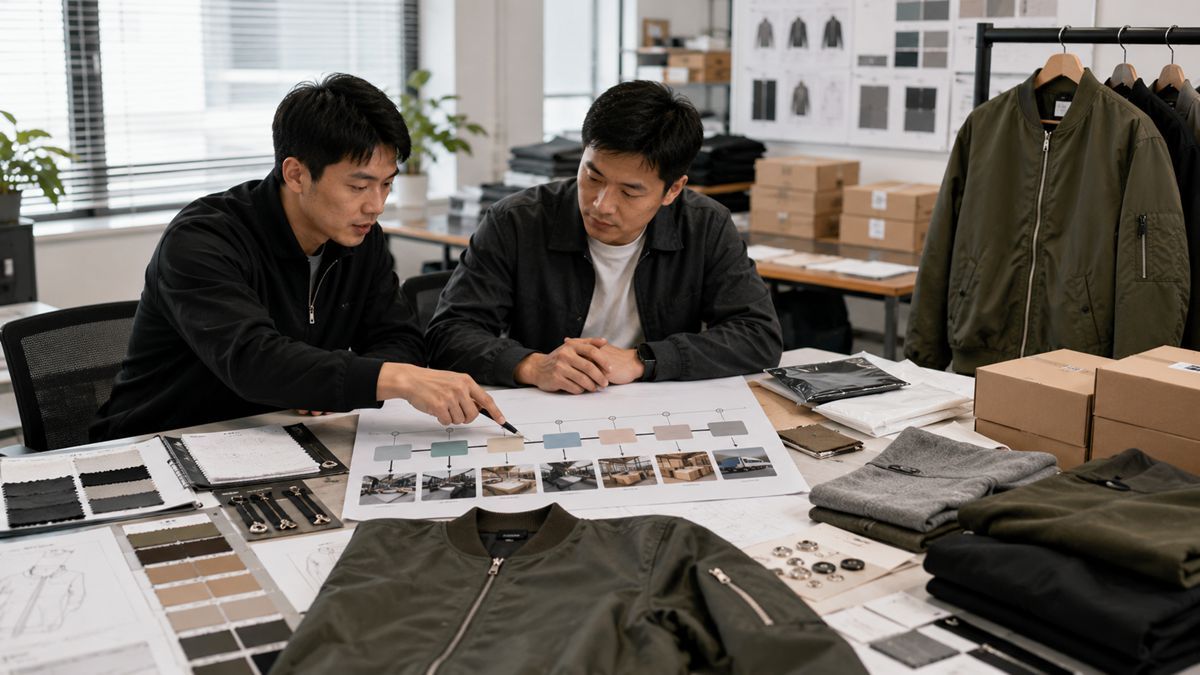
When evaluating an apparel factory, do not ask only, “How many days is production?”
Ask questions that reveal how the timeline is actually managed.
Before Sampling
- How long will the first sample take after all specifications are confirmed?
- Which materials are currently available?
- Which fabrics or trims require custom development?
- How long does each sample revision usually take?
- What information do you need from us before sampling can begin?
Before Bulk Production
- When does bulk lead time officially begin?
- Do all materials need to be ready before the production slot is confirmed?
- What is the expected material lead time?
- What happens if we approve the sample late?
- Which production processes are completed in-house and which are outsourced?
- What quality checkpoints happen during production?
Before Shipment
- What does the quoted completion date mean: finished sewing, packed goods, or shipment handover?
- How long does final inspection and packing normally require?
- What export documentation is included?
- When should freight be booked?
The quality of a manufacturer's answers often tells you as much as the number itself.
A professional factory should be able to explain why a timeline is realistic, what assumptions it depends on, and which decisions could change it.
How VANRD Manages Sample-to-Bulk Clothing Production
At VANRD, apparel development is treated as a connected process rather than a handoff from one isolated department to another.
Depending on the project, the workflow can include design and feasibility review, fabric sourcing, pattern development, sample making, custom trims, printing, embroidery, washing, private labels, bulk production, quality inspection, packaging, and shipment preparation.
You can review the complete VANRD apparel manufacturing process to see how the development stages connect.
For brands developing outerwear, explore VANRD's custom jacket manufacturing options. For fleece and sweatshirt programs, see the custom hoodie collection.
What Helps Us Build a More Accurate Production Calendar?
When contacting a manufacturer, include as much of the following as possible:
- Tech pack or reference garment
- Product category
- Fabric preference
- Fit direction
- Artwork and branding methods
- Colorways
- Estimated quantity per style and color
- Size range
- Packaging requirements
- Destination country
- Required delivery window
The more clearly the project is defined, the easier it becomes to distinguish a realistic production plan from a generic estimate.
Planning Your Next Apparel Production?
Send VANRD your tech pack, reference images, garment sample, quantity, customization requirements, and target delivery window. Our team can review your project and help define a practical path from sample development to bulk manufacturing.
Discuss Your Apparel ProjectConclusion: A Reliable Production Timeline Is Built Before Bulk Sewing Begins
So, how long does clothing production take?
For many custom apparel programs, the complete journey from development to finished bulk goods may take roughly 8–16 weeks or longer, while bulk manufacturing after final approvals often occupies only part of that calendar. More complex products, first collections, custom materials, repeated revisions, seasonal capacity, and international freight can extend the schedule further.
The important lesson is not the number. It is understanding what creates the number.
A clothing production timeline is a chain: product specifications affect sourcing, sourcing affects sampling, sampling affects approval, approval affects material preparation and factory scheduling, production affects QC, and QC affects shipment.
Pull one part of the chain late and the final date moves.
That is why professional apparel manufacturing is less about promising the fastest possible date and more about controlling decisions, approvals, materials, production, and quality in the right sequence.
If your launch depends on reliable delivery, do not simply ask your manufacturer, “How fast can you make it?”
Ask a better question:
“Can you show me the complete path from our sample to our finished bulk order—and what we need to approve at each stage?”
That answer tells you much more about whether a manufacturer can become a reliable long-term production partner.
Frequently Asked Questions About Clothing Production Time
1. How long does clothing production take from sample to bulk?
From initial sample development to finished bulk goods, many custom apparel projects require approximately 8–16 weeks, although the exact timeline depends on the garment, fabric sourcing, number of sample revisions, custom trims, decoration, order quantity, factory capacity, quality-control requirements, and buyer approval speed. International shipping should normally be planned separately.
2. How long does bulk clothing production take after sample approval?
Bulk production often takes around 3–7 weeks after the final production standard is approved and bulk materials are ready. Straightforward products using available materials can move faster, while jackets, denim, garment washes, custom fabrics, complex embroidery, special hardware, or larger multi-style programs may require more time.
3. What causes the most delays in apparel manufacturing?
Common causes include incomplete tech packs, unavailable fabric, custom dyeing or trims, unclear sample comments, multiple revision rounds, late artwork approval, last-minute design changes, missed production slots, complicated finishing processes, quality rework, and shipping delays. In many projects, slow decisions create more calendar loss than the sewing operation itself.
4. Can a clothing manufacturer speed up production?
Yes, but the safest way to shorten apparel lead time is to reduce uncertainty rather than remove quality controls. Brands can prepare complete specifications, use available fabrics, consolidate sample feedback, approve quickly, reserve production capacity early, prepare labels and packaging in parallel, and choose faster freight when necessary. Rushing manufacturing without adequate QC can create more expensive problems later.
5. When should a fashion brand start production before a launch?
Work backward from the date inventory must be available to customers or your warehouse. Include international freight, customs, final inspection, bulk production, material preparation, pre-production approval, sample revisions, first sampling, sourcing, and technical preparation. For a new custom collection, starting several months before the intended launch is usually much safer than planning around the factory's sewing lead time alone.