Custom Windbreaker Manufacturing Guide: Nylon, Lining, Fit & Branding Options
Custom Windbreaker Manufacturing Guide: Nylon, Lining, Fit & Branding Options
Here is the short version. A windbreaker looks like the simplest garment in your line — a zip, two pockets, a bit of elastic. In production it is the least forgiving. Thin shells show every puckered seam, every wavy zipper, every half-millimetre of tension drift. This guide walks you through the eight decisions that actually determine whether your windbreaker sells at full price or quietly becomes dead stock: shell fibre, water repellency, lining, fit block, panel layout, hardware, branding technique and quality control.
If you have ever approved a windbreaker sample that looked perfect, then opened a bulk carton six weeks later and felt your stomach drop, you already understand why this guide exists. Let's fix that.
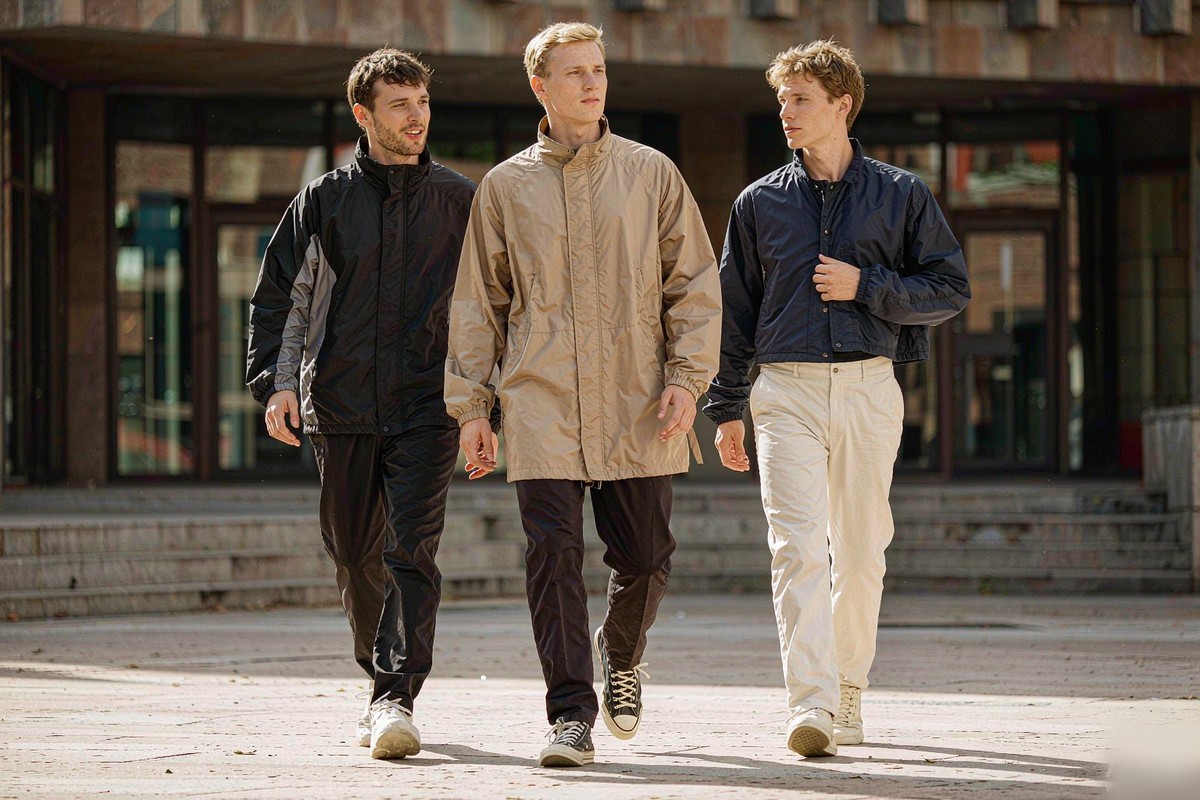 One category, three commercial positions. Left: a regular-fit matte nylon shell with grey colour-block panels. Centre: an oversized longline block with dropped shoulders and extra body length. Right: a cropped, stand-collar coach jacket. Same fibre, same factory — three completely different customers.
Why Windbreakers Are the Smartest Bet for Fall 2026
Every few seasons, a category gets pulled back into the spotlight by forces nobody in the buying office controls. Right now, three forces are pushing lightweight shells hard: the nineties-and-early-2000s nostalgia cycle that keeps resurfacing across streetwear, the practical demand for layering pieces that work in unpredictable shoulder-season weather, and a retail market that badly wants a lower entry price point than a hoodie-plus-parka situation.
That is the demand side. The supply side is more interesting, and it is where most brands get it wrong.
The Retro Nylon Comeback Is Not a Fad
Retro nylon is doing what vintage denim did a decade ago — moving from a niche reference point into a mainstream commercial silhouette. Contrast sleeve panels, a stand collar, the satisfying crinkle of a matte shell: these are visual signals that read instantly as "athletic heritage," and they photograph beautifully on a small screen. A shell that photographs well and ships light is a shell that markets itself.
What Buyers Actually Mean When They Say "Lightweight Jacket"
This is where briefs become dangerous, because "lightweight" is doing three jobs at once. It can mean low weight in grams. It can mean low warmth — essentially a shell with no insulation. Or it can mean low bulk, meaning it packs into its own pocket and disappears into a bag. Those are three different construction briefs with three different fabric specifications, and if you treat them as one word, your sample will come back wrong. Say the number and the behaviour you want: "roughly 60–80 gsm shell, no padding, packs into the left pocket."
Three Signals That a Windbreaker Program Will Scale
- Your size curve is stable. If your top three sizes cover most of your sales, lightweight shells will grade predictably across your range.
- You have one strong panel layout, not five weak ones. Windbreakers reward a clean, repeatable colourway far more than they reward a complicated one — that is what makes seasonal reorders cheap.
- Your branding sits on flat, single-layer areas. The moment a logo straddles a seam or a pocket zip, cost and failure risk both climb.
You can see how we structure these decisions end-to-end on the custom windbreaker jacket manufacturing page, and browse live examples in the windbreaker jacket collection. Judge the construction, not the artwork — the artwork is easy.
Nylon vs Polyester: Choosing the Shell That Carries Your Brand
Shell fabric is roughly seventy percent of how a windbreaker feels in the hand and looks in a photograph, and it is the single decision that most often gets reversed after the first sample. So let's remove the guesswork.
Nylon — The Smooth, Technical Standard
Nylon is the default for a reason. It has a cooler, drier hand feel, higher tensile strength per unit of weight, and a natural sheen that can be tuned from glass-bright to completely matte with the right finishing. Lightweight nylon in the 20D–40D range packs down small while still holding a crisp silhouette — the "swish" factor that makes a schoolyard windbreaker feel authentic rather than flimsy. It also takes a deep, saturated dye better than most alternatives, which matters enormously if your brand palette leans into strong reds, royal blues or acid greens.
The trade-offs are real. Nylon is more sensitive to heat, so a careless fusing or pressing step can leave a permanent shine mark. It also tends to be less dimensionally stable than polyester, which means your pattern team needs to account for slight fabric movement during cutting and sewing.
Polyester — The Cost-Stable Workhorse
Polyester is the practical counterweight: cheaper to source, more stable through production, excellent at holding printed colour, and highly resistant to creasing. If your project involves dye sublimation over large areas, or a teamwear programme where colour consistency across hundreds of units matters more than a buttery hand feel, polyester usually wins on the balance sheet and on the QC report.
Ripstop and Taslan: When Texture Beats Sheen
Ripstop is the same base fibre woven with a reinforcing grid at intervals, so a small tear stops at the grid line instead of running. Visually it reads technical and slightly utilitarian, which is exactly why outdoor-adjacent streetwear brands gravitate toward it. Taslan takes a different route: it is air-textured to produce a softer, less glossy, more matte surface with visible texture. Think of ripstop as engineered and taslan as lived-in.
Here is the part most buyers leave until far too late: your colour range. Fibre choice and colour choice are not separate conversations, because a shell that dyes into deep, saturated tones behaves differently from one that only holds muted, chalky shades — and the colour card your factory develops is effectively a map of what your brand can actually sell for the next two or three seasons. Build the colour card before you build the collection.
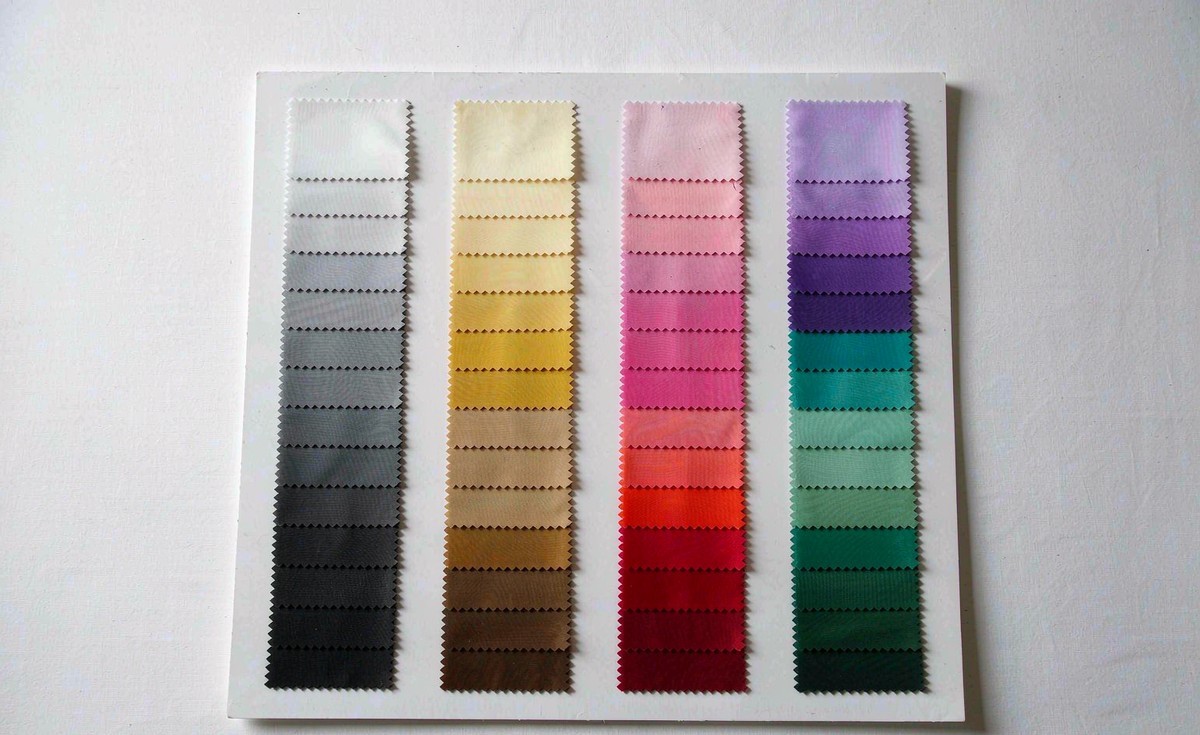 A factory colour card for woven nylon shell: neutrals, warm golds and tans, pinks through burgundy, and lilacs through forest greens. The strips are pinned in continuous graded columns rather than scattered swatches, because what you are approving is the progression — and whether your target shade sits inside the band that can be reproduced consistently at bulk.
| Shell Direction | Hand Feel & Look | Strongest For | What to Watch |
|---|---|---|---|
| Lightweight nylon (20D–40D) | Smooth, cool, lightly lustrous, packs small | Packable shells, running and lifestyle windbreakers | Heat sensitivity; fabric movement during cutting |
| Polyester woven | Stable, versatile, holds print colour well | Teamwear, large-format graphics, cost-controlled runs | Drape and sheen must be confirmed on a real sample |
| Ripstop / micro-ripstop | Visible reinforcement grid, technical character | Outdoor-inspired streetwear, uniform programmes | Grid scale and tear performance need specifying |
| Taslan / textured nylon | Soft, matte, noticeably textured surface | Casual outdoor-lifestyle and retro references | Texture reduces fine-detail print legibility |
Still deciding? Our team documents the full material and finish option set on the fabrics, finishes and techniques reference.
Water Resistance, Coatings and Breathability: Getting the Balance Right
Nothing derails a buyer conversation faster than the words "waterproof windbreaker" used loosely. Let's be precise, because precision here protects you from returns and chargebacks later.
What a DWR Finish Really Does (And What It Doesn't)
A durable water repellent finish is a surface treatment. It lowers the surface energy of the fabric so water beads up and rolls off instead of soaking in. That is genuinely useful in a drizzle, during a commute, or when someone gets splashed at a festival. What it does not do is stop water that is driven through the fabric by pressure or prolonged contact. Picture a freshly waxed car bonnet: rain beads and slides beautifully, but park it in a downpour with the windows open and you will still find water inside.
That analogy is your fence against over-promising. A DWR-finished shell is water-repellent. It is not waterproof, and if you market it that way, you are writing the customer service email before the product even ships.
Coating, Membrane or Nothing at All?
Three routes, three commercial profiles. A PU coating on the reverse of the shell adds meaningful water resistance for a moderate cost, but it cuts breathability and gives the fabric a slightly stiffer hand. A laminated membrane delivers the strongest performance story — higher hydrostatic head, real breathability — and it is the choice when your positioning genuinely sits in technical outdoor. DWR only is the lightest and cheapest option, and for most streetwear and teamwear windbreakers, it is honestly the correct one.
Decision rule: spec a membrane only if your customer will actively stand in sustained rain. If your windbreaker lives in cities, on running routes and in school corridors, DWR plus a well-designed hood will outperform expectations at a fraction of the cost — and it will stay light, which is the whole point of the category.
Breathability Without Losing the Wind Block
Wind resistance comes largely from how tightly the fabric is woven, and tightly woven fabric resists airflow — including your own body heat escaping. This is the tension at the heart of the category, and you resolve it with construction rather than chemistry. Back yokes, underarm vents, mesh-lined panels and half-mesh backs all release trapped heat without opening the front of the jacket to the wind. On a windbreaker, ventilation is a pattern-design question, not a fabric question.
Lining Options: Unlined, Mesh, Taffeta or Lightweight Fleece
Lining is the decision most brands treat as an afterthought and most wearers feel first. It sets the internal temperature, the way the jacket slides over a tee, and how premium the garment feels when someone tries it on in a changing room.
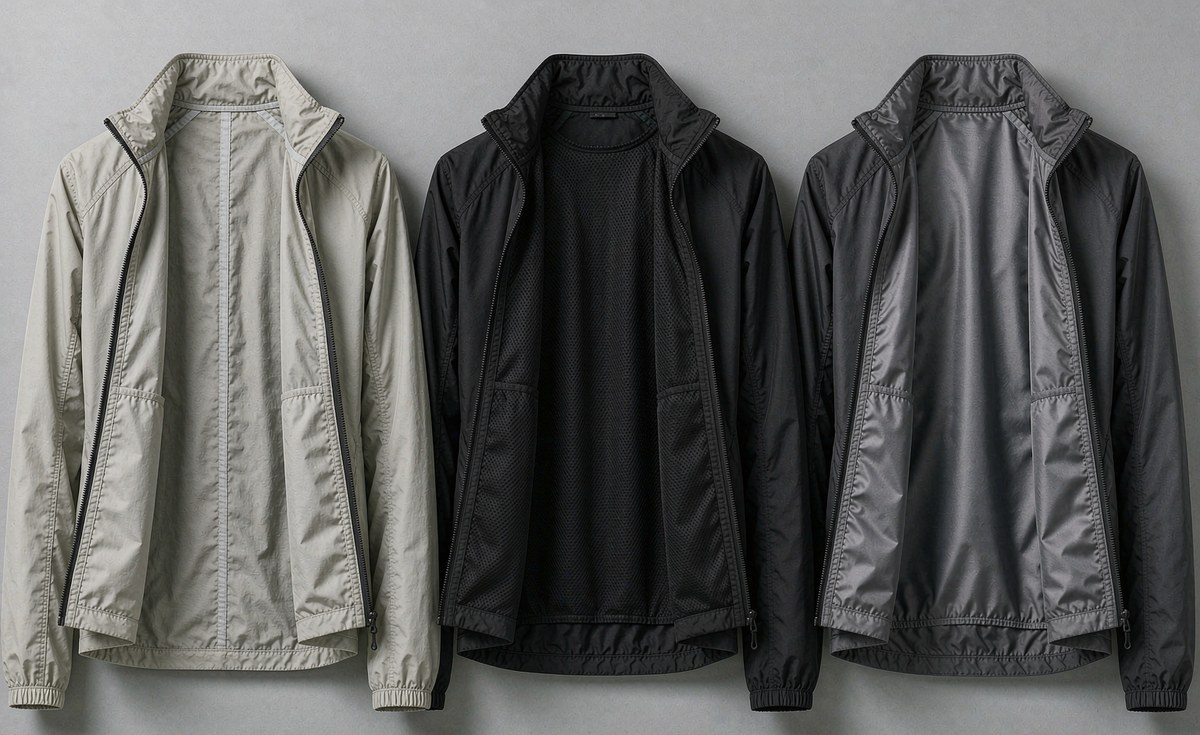 Three interiors, three price points: a clean unlined shell with taped seams, a breathable mesh lining, and a smooth taffeta lining with a more premium slip.
Unlined: The Purist's Choice
An unlined windbreaker is the lightest and most packable version, and it is the right answer for travel pieces and emergency layers. The obligation it creates is seam finishing: without a lining to hide behind, every internal seam has to be cleanly bound, flat-felled or taped. That is not free, which is exactly why a well-made unlined shell signals craft to anyone who knows what they are looking at.
Mesh Lining: Breathability You Can Feel
Mesh is the default for active windbreakers because it keeps the shell off the skin, allows moisture vapour to move, and — critically — adds structure that helps a thin shell hang straight instead of clinging. If your product will be worn during movement, mesh is usually the safe, sensible specification.
Taffeta Lining: The Smooth, Premium Slip
Taffeta gives a smooth, slightly crisp interior that slides easily over other garments. It reads more considered and more retail-ready than mesh, which is why coach jackets, vintage-inspired shells and higher price-point streetwear styles so often use it. It is warmer than mesh, slightly heavier, and it photographs well when the jacket is hung open.
Lightweight Fleece: Adding Warmth Without Bulk
A light fleece or brushed-back lining converts a windbreaker into a shoulder-season jacket. The catch is that lining plus shell plus lining means more layers to keep aligned during sewing, and more weight in the finished piece. If you go this route, expect your fit block to need extra body ease so the jacket does not feel restrictive over a hoodie.
Fit Is a Business Decision: Oversized, Cropped, Coach and Track-Inspired
Fit is not an aesthetic preference. Fit is a market position, and it is priced into everything downstream — fabric consumption, grading complexity, returns rate.
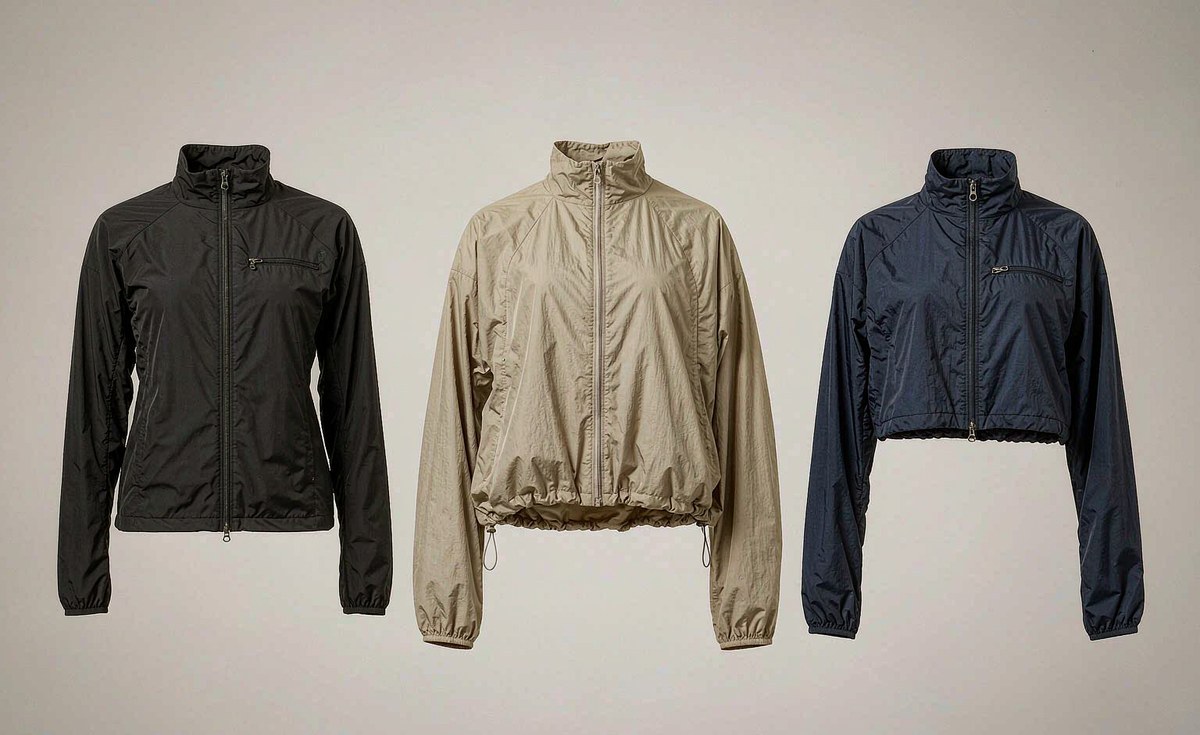 Same category, three markets: a regular-fit shell, a boxy oversized shell with dropped shoulders, and a cropped stand-collar coach jacket.
Oversized and Boxy for Streetwear
An oversized windbreaker is not simply a large windbreaker, and this is where plenty of first samples go wrong. Genuine oversized blocks drop the shoulder seam, widen the body through the chest, and shorten the body length relative to width. The visual effect is a square, deliberate shape. If you only size up, you get a long, droopy jacket that looks like a mistake — and on a lightweight shell, that reads as cheapness immediately.
Cropped Cuts and the Coach Jacket Revival
The coach jacket is the quiet winner of this cycle. A stand collar, a snap or zip front, a hem that stops at the hip bone, elastic cuffs: it is a windbreaker that has been to a design school. Cropped lengths need careful grading, because an aggressive crop that reads well in a size small can look oddly proportioned at 3XL. Confirm the crop ratio across your full size range before you commit.
Track-Inspired Racing Silhouettes
Raglan sleeves, contrast side panels, a slightly higher stand collar and a dropped back hem: the track-jacket language is the fastest way to make a shell read as sportswear rather than outerwear. It also pairs naturally with a matching bottom, which is where a shell stops being a single SKU and becomes a set — see how that works in practice with a custom tracksuit jacket and shorts set.
Grading Across US, UK, EU, CA and AU Sizes
A windbreaker block that fits perfectly in Los Angeles can hang awkwardly in Manchester, because sleeve length, body length and chest ease priorities differ by market. Our pattern team grades to Western standards with typical XS–3XL ranges and extended sizes on request, adjusting sleeve articulation, body length and hood shape for your primary market. For broader-fit programmes there is more detail on our established brand production support page.
Color Blocking, Paneling and Decorative Detail That Sells
A windbreaker has very little surface area for storytelling. What it does have is geometry. Use it.
Panel Layout: Where the Eye Travels First
Humans read a garment top-down and centre-out, so a windbreaker's visual logic usually runs from the collar, across the chest junction, down the zipper line, then out along the sleeve. Design your contrast panels to that route and the jacket reads as intentional at twenty paces. Ignore it and you get a shape that only makes sense at sample-review distance — which, unfortunately, is never where your customer stands.
Piping, Binding and Contrast Zips
Piping and binding are the cheapest premium signals available to you. A single contrast line tracing a raglan seam, or a bright zip tape against a matte shell, changes the perceived price bracket for a marginal material cost. On a thin shell, however, avoid heavy trims: anything with weight will drag on the fabric and distort the silhouette. Think pencil lines, not marker strokes.
Reflective Trims for Visibility and Street Cred
Reflective piping, tape or a printed hit serves two audiences simultaneously — the runner who genuinely needs to be seen, and the streetwear customer who just wants the piece to look sharper. Both are valid commercial reasons, and both are supported by our wider windbreaker and wind jacket line-up, where you can compare how the same shell transforms with and without reflective detail.
Zippers, Elastic Cuffs, Hems and Hood Construction
Hardware and trims are where a windbreaker either earns its price or reveals its shortcuts. There is no hiding behind fabric here.
Zipper Choice: Coil, Vislon or Water-Resistant Tape
A standard nylon coil zip is light, flexible and inexpensive — and on a lightweight shell, its flexibility actually helps the front panel lie flat. A moulded Vislon-style zip is stronger and more tactile, but heavier, so it suits chunkier streetwear styling better than an ultra-light packable piece. Water-resistant zips with a coated tape or a reverse-coil construction reduce seepage at the front opening; they cost more and they are only worth it if the rest of the jacket can meet the same standard.
Whatever you choose, the zipper's stiffness must match the shell's. Pair a rigid zip with a gossamer nylon shell and the front of the garment will ripple no matter how good your sample room is.
Elastic Cuffs and Hems: The Discipline of Tension Control
Here is the detail that separates a good factory from a fast one. Elastic tension varies from roll to roll and from operator to operator. If the tension is inconsistent, two jackets cut from identical patterns and measured within tolerance will still look visibly different on the rack — one cuff crisp, one cuff lazy. If you ever wonder why certain brands' basic shells look uniformly sharp season after season, this is often the invisible reason.
What we've learned in our own sample room: the single most effective quality habit on lightweight outerwear is checking panel alignment, zipper flatness, pocket position and elastic tension continuously during sewing — not only at final inspection. On a thin shell, a defect you catch at the end is already a defect you have paid for ten times over in wasted handling.
Hoods: Fixed, Detachable or Stowable
A fixed hood is simple, robust and always available. A stowable hood tucks into the collar for a cleaner neckline when it is not in use, but it demands careful pattern work to avoid bulking out the collar — a stowable hood executed badly is worse than no hood at all. On running and cycling windbreakers, a hood with a rear adjustment cord and a slightly taller front edge is worth the extra trims: it keeps the hood on in wind, which is, after all, the entire point.
Branding on Lightweight Shells: Print, Embroidery and Placement
A windbreaker's branding problem is simple to state and hard to solve: the fabric is too thin to absorb the techniques we instinctively reach for.
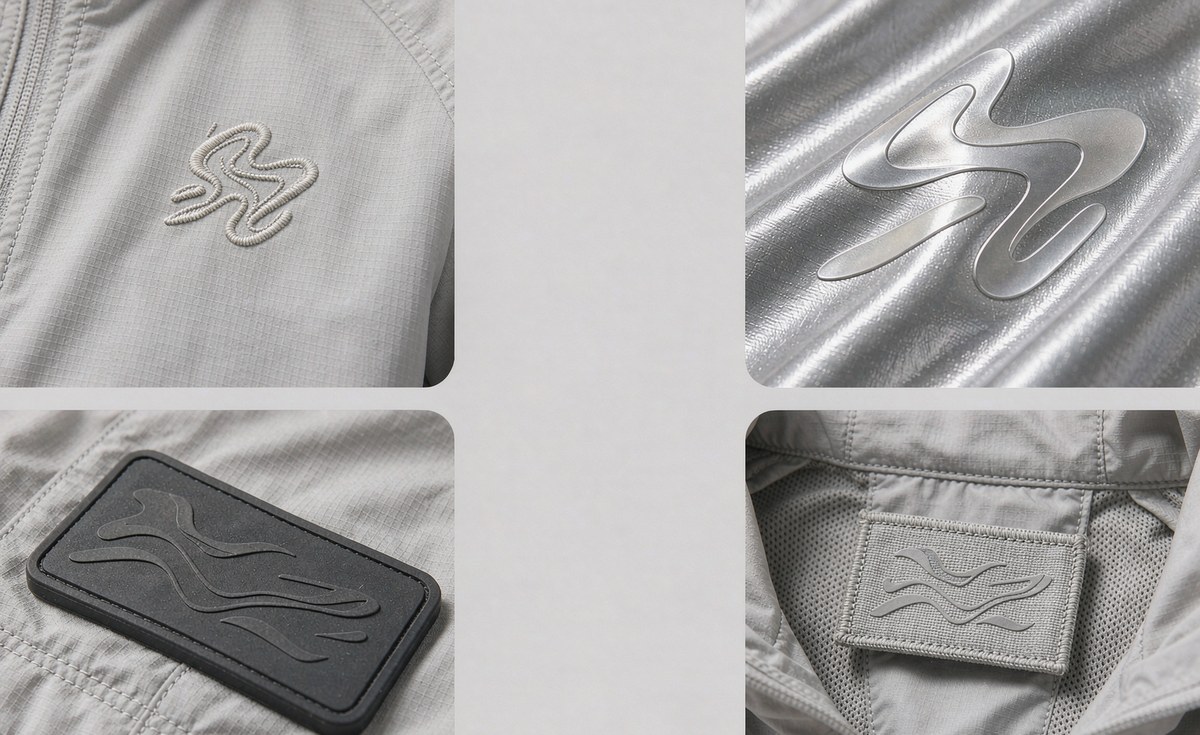 Four techniques, one shell: flat embroidery, reflective heat transfer, a raised rubber patch and a woven neck label. Each behaves differently on a thin, heat-sensitive nylon.
Which Logo Technique Survives a Thin Shell?
Dense embroidery on a lightweight nylon shell is the classic trap: too many stitches on too little substrate and you get puckering and a stiff, cupped panel that never lies flat again. The fix is to keep embroidery small, reduce stitch density, and add a light fusible or a paper backing so the shell has something to carry the load.
Screen printing works well on polyester and on coated nylon, provided the ink system is matched to the shell — the wrong plastisol on the wrong finish cracks along the fold lines. Reflective and standard heat transfers give you fine detail with almost no weight penalty, which makes them ideal for thin shells, but application temperature and dwell time have to be right or the fabric will mark. Rubber patches and woven badges add a premium, three-dimensional layer and are a smart choice when you want a heavier brand presence without stressing the shell.
A quick honest ranking for a 30D nylon windbreaker: heat transfer and small embroidery are the safest starting points; rubber patches are the strongest premium signal; heavy multi-colour screen print should be tested before you commit. Review the full breakdown of the available print and embroidery techniques before locking your artwork.
Placement That Sells: Chest, Back, Sleeve and Neck
Left chest is the classic small-logo position and the easiest to execute well. Full back is your maximum-visibility real estate — best for teamwear, event programmes and capsule collections where the graphic is the product. The sleeve carries secondary marks and sponsor logos neatly. And never underestimate the collar zone: a woven neck label, a printed inside-neck hit and a branded zip puller do quiet persuasive work every time the jacket is hung open or worn unzipped.
Before you finalise anything, confirm three things: how the logo behaves on the actual shell, how it sits relative to the nearest seam, and how it survives a wash cycle. We test logo placement and application method ahead of bulk precisely because rework at the end of a production run is expensive for everyone.
From Tech Pack to Bulk: Sampling and QC on Thin Fabric
Lightweight shells punish imprecision more than any other garment category. Here is how to run the process so you are not the buyer opening that bad carton.
What to Put in Your Tech Pack
A usable tech pack for a windbreaker should carry flat sketches for front, back and side; a clear colourway schedule with pantone references or physical swatches; a graded measurement chart with tolerances; the exact shell, lining and trim specifications including denier or weight; the zipper type and puller; hood, cuff and hem construction notes; the branding placement guide with coordinates and artwork files; and stitch-and-seam requirements. If you are building this from scratch rather than from a reference, our OEM and ODM development service can help translate sketches or reference images into a production-ready specification.
The Sampling Loop and What to Look For
Expect to move through one to three rounds. Sample development on windbreakers typically runs around 7–10 days once your measurements, materials and construction points are confirmed, and bulk production generally follows 30–50 days after pre-production approval. When the sample lands, examine more than the mirror: check zipper flatness without holding the jacket, look at the interior seam finish, confirm cuff and hem tension consistency, test the hood with your hands full, and check that pocket entries do not gape.
Inline Checks, Measurement Tolerance and AQL Inspection
Good QC on lightweight outerwear is front-loaded. Fabric inspection on receipt, accurate cutting, panel alignment and seam appearance checks during sewing — then a final inspection against the approved sample. Colour is normally controlled one stage earlier still, through a lab dip matched to your target shade and then a shade band agreed against that dip, so that mill deliveries across a season sit inside a defined tolerance instead of drifting. AQL 2.5 random inspection and metal detection on finished garments are standard expectations in export programmes, and compliance documentation such as ISO 9001 processes, OEKO-TEX material options and REACH support should be available on request. Our factory capability overview covers how these checkpoints are structured across a production run.
The Five Mistakes That Quietly Kill a Windbreaker Program
1. Choosing fabric from a photograph. A swatch that looks perfect on a screen can arrive with a hand feel that contradicts your entire price positioning. Always approve physical swatches.
2. Using a hoodie pattern to make a windbreaker. Shell construction, seam finishing and ease requirements are different. Reusing the wrong block produces a jacket that hangs badly in exactly the way reviewers notice.
3. Overspecifying branding. Dense embroidery on thin nylon is the most common cause of puckered, irrecoverable panels.
4. Choosing a zipper by price alone. The zip is the part your customer touches most often and the part most likely to fail. A cheap zip on a good shell is a false economy.
5. Starting bulk before the sample is fully signed off. Verbal approvals and "we'll fix it in production" are how first orders turn into expensive lessons.
Conclusion
A custom windbreaker looks like an easy product and behaves like a demanding one. The fibre you choose sets the hand feel and the price ceiling. The finish sets what you can honestly claim about weather. The lining sets comfort and perceived quality. The fit block decides which market the jacket belongs to. Panels, trims, hardware and branding are where a competent shell becomes a brand statement. And QC is what keeps a good sample from becoming a bad shipment.
Get those eight decisions right, ideally in this order, and you will not be guessing at your product's future — you will be steering it. Fall 2026 is a genuinely favourable window for lightweight shells, and windows like this do not stay open for long.
When you are ready, send your windbreaker reference or tech pack to our team for fabric and construction recommendations before you commit to sampling. Judging a shell from a photograph is how brands lose seasons; judging it in the hand is how they win them.
Send your windbreaker reference or tech pack and we will come back with fabric, lining and construction recommendations for your target market, quantity and price positioning.
Send Your Tech Pack for ReviewFrequently Asked Questions About Custom Windbreaker Manufacturing
What is the minimum order quantity for a custom windbreaker, and can I mix colours within it?
Our minimum order quantity is 100 pieces per colour, per style — a fixed minimum rather than a starting-point guideline. That structure exists because dyeing, panel cutting and trim booking each carry their own setup load, and spreading a colour across a smaller run pushes unit cost up for everyone. If you want four colourways, plan for four hundred pieces. A very common and sensible compromise for a first drop is two colourways at full minimum, then adding additional colourways once the style proves itself.
Which branding method works best on a lightweight nylon windbreaker?
For 20D–40D shells, reflective or standard heat transfers and small, low-density embroidery are usually the safest and most attractive options, because they add almost no weight and distort the shell least. Rubber patches and woven badges give you a stronger premium signal. Dense, multi-colour screen print is achievable but should be sample-tested, since ink systems behave differently on coated versus uncoated nylon. In every case we recommend testing the exact artwork on the exact shell before bulk, because a logo that looks flawless in a flat file can pucker on a garment.
Should I choose mesh, taffeta, unlined, or a fleece lining?
It depends on how the jacket will be worn. Mesh for active use, because it keeps the shell off the skin and helps release heat. Taffeta for a smoother, more premium interior that slips easily over other layers and looks considered when the jacket is hung open. Unlined for maximum lightness and packability, provided you are willing to pay for clean internal seam finishing. Lightweight fleece when you want a genuine shoulder-season jacket rather than a pure shell — just expect more layers to control during production and a slightly roomier fit block.
How long do sampling and bulk production take for a lightweight jacket?
Sample development typically takes around 7–10 days once your measurements, materials and construction details are confirmed. Bulk production generally follows 30–50 days after pre-production sample approval and deposit, depending on order volume, fabric readiness and trim sourcing. Ninety percent of delays we see do not come from the factory floor — they come from approvals that arrived late or changed mid-flight. Lock your shell, colours, trims and branding before bulk opens, and the timeline protects itself.
Can a DWR-finished windbreaker be sold as waterproof?
No, and it is worth being firm about this. A DWR finish makes a shell water-repellent: light rain beads and rolls off. It does not make the garment waterproof, because waterproofness depends on the shell, any coating or membrane, seam sealing, the zipper system and every other opening. If genuine waterproof performance is central to your product claim, that needs to be specified and tested as a complete system — not implied by a surface finish. Getting this distinction right upfront protects your brand far more than a bold claim ever will.
Keep exploring the VANRD manufacturing library: