Screen Print vs Puff Print vs Embroidery for Custom Hoodies
Screen Print vs Puff Print vs Embroidery for Custom Hoodies
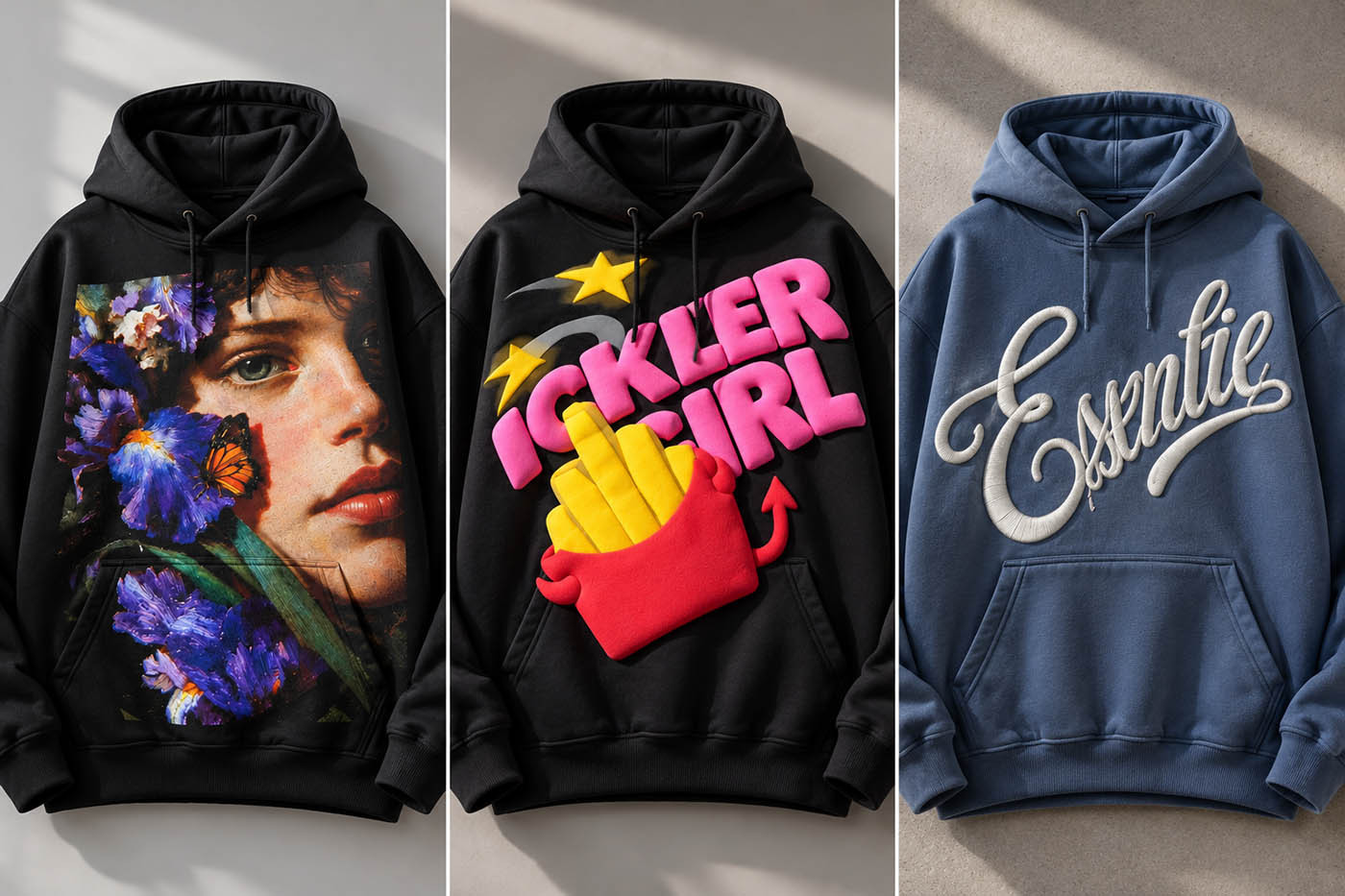
Picture three identical hoodies made from the same fabric. One has a crisp printed graphic, one carries a soft raised logo, and the third has a stitched emblem. Their silhouettes haven't changed, but they don't feel like the same product anymore. That's the difference decoration makes.
For a streetwear label, choosing between screen print, puff print and embroidery isn't just a matter of taste. It affects how clearly your artwork comes through, how the hoodie feels against the body, what happens after washing, and what your production quote will look like. If you're planning a custom hoodie collection, this guide will help you choose the decoration that fits your design rather than force the design into the wrong technique.
Quick answer
Choose standard screen printing for detailed artwork, bold graphics and larger print areas. Choose puff printing when simple lettering or shapes need a raised, tactile finish. Choose embroidery for a stitched brand mark with a more structured, textured appearance. None is automatically the most durable, most premium or least expensive in every situation. The artwork, fabric, application quality and order volume all matter.
1. Three Hoodie Branding Methods Explained
All three methods put artwork onto a hoodie, but they build the image in different ways. Standard screen printing deposits ink through a mesh screen. Puff printing also uses a screen, but the ink expands during curing. Embroidery forms the design from stitches. Understanding that construction is useful because it explains nearly everything you can see and feel later.
Screen Printing: Flat Graphics With Room for Detail
Screen printing pushes ink through a prepared mesh stencil onto the fabric. Each spot color in a conventional design generally needs its own screen, while specialty separation techniques can reproduce more complex images. The deposited ink is then cured according to the ink system, making it part of the finished decoration. On a hoodie, the result is usually a relatively flat graphic with defined edges.
The appeal is its range. A small left-chest mark, an oversized back illustration, a multi-color band graphic or a sharply defined slogan can all work with screen printing. It gives designers room to use fine outlines, negative space and multiple colors in a way that raised puff ink or thread stitching may struggle to match.
But “screen printed” doesn't describe one single hand feel. A heavier plastisol ink deposit may sit noticeably on the surface. A suitable water-based print can feel softer, depending on the fabric and process. Large areas of thick ink can also make a hoodie feel less flexible. So the question isn't simply whether to print; it's what kind of printed finish you want.
For custom graphic hoodies, standard screen printing is often the starting point. The design is meant to be seen clearly from several steps away, and flat ink lets the artwork do the talking.
Puff Printing: A Raised, Three-Dimensional Finish
Puff print is a specialty form of screen printing, not an entirely separate printing family. An expanding additive or specially formulated puff ink responds to heat during curing, lifting the deposited artwork above the garment surface. That's what gives puff print its rounded edges, shadow and touchable relief.
Imagine a block-letter logo that looks perfectly ordinary in a flat PDF. Puff printing gives it a second dimension. Even a single-color design can become the focal point of a hoodie because the raised surface catches the light. This is why puff print hoodies are frequently associated with bold typography, simple emblems and graphic streetwear collections.
The trade-off is precision. Expansion can soften tiny gaps and blur delicate details. Very narrow lines, tightly spaced lettering, fine halftones and miniature icons may not remain as sharp as they do in a standard print. The amount of rise also depends on the ink, deposit, curing conditions and fabric. More height is not automatically better if it makes the logo look rounded and crowded.
For a clean wordmark or an oversized symbol, puff printing can create a distinctive finish without adding extra colors. For a complicated illustration, it may be better to reserve puff for one bold element and leave the smaller details in a flat screen print.
Embroidery: Branding Built From Thread
Embroidery uses a programmed stitching pattern to build the artwork with thread. The design is digitized into stitch paths, placed in a hoop or frame with appropriate backing, and sewn into the garment or panel. Rather than an ink layer, the finished logo has the visible texture, direction and slight sheen of embroidery thread.
Custom embroidered hoodies work particularly well for a restrained brand identity: a small chest logo, a monogram, a compact sleeve symbol or a heritage-inspired emblem. There are different stitch styles and thread finishes, so an embroidered logo doesn't have to look like a standard corporate uniform. It can feel sporty, vintage, minimal or luxurious depending on the artwork and garment.
Embroidery has limits of its own. Stitches occupy real space, so extremely small lettering, delicate gradients and photographic detail do not translate directly. A dense, oversized design can create stiffness, extra weight or puckering, especially on softer fabrics. The reverse side may also need attention if the stitching sits near the skin.
It's also worth separating flat embroidery from 3D puff embroidery. The latter uses foam beneath the stitching to create relief. It is not the same process as puff screen printing. When you compare a puff print vs embroidery hoodie, make sure everyone is describing the same technique.
2. Look, Texture and Design Detail
The easiest way to compare the three techniques is to imagine your actual logo on each finish. You might be surprised by how much its personality changes even when the size and color remain the same. A flat print emphasizes the shape and color of the artwork. Puff print emphasizes its silhouette and depth. Embroidery emphasizes texture and craftsmanship.
Screen printing is the most flexible option for visual detail. Fine lines, color transitions and elaborate illustrations can often be reproduced using an appropriate screen-printing process and artwork preparation. For a full-back graphic with several visual layers, it can retain more of the original design than either raised puff or dense stitching.
Puff print works best when the shapes are confident. Wide letters, thick outlines and open spaces let the raised effect remain easy to read. The same visual effect can become a problem with fine-serif fonts or tightly grouped text, because expansion reduces the breathing room between elements. A minimalist logo may become more expressive with puff, while a delicate logo may lose what makes it recognizable.
Embroidery brings a different kind of detail. Thread direction, stitch texture and edge definition help a small emblem feel intentionally made. It can be especially attractive on heavyweight hoodies with simple branding. Yet the shape must be translated into stitches rather than merely copied from a digital file, and that translation can change the appearance of fine details.
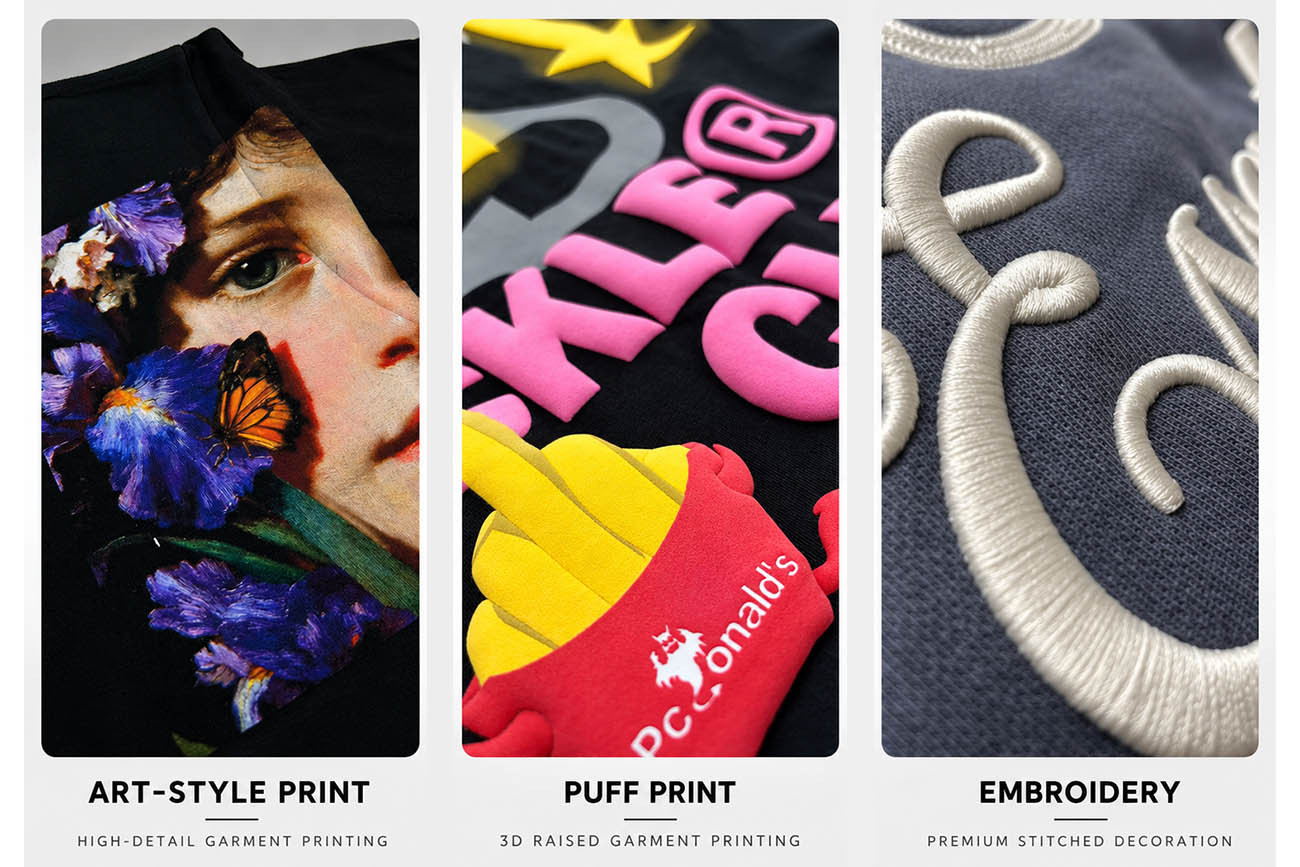
Comfort can be just as noticeable as appearance. A light print typically adds less bulk than dense embroidery, although a thick ink film can feel firm over a large area. Puff printing creates localized thickness on the outside. Embroidery adds thread mass and a stitched reverse, so large chest designs can affect how fabric drapes. On a roomy oversized hoodie, the difference may be less noticeable than on a lighter, closer-fitting style, but it still deserves attention.
Think about your design direction, too. A washed graphic hoodie with vintage artwork often looks natural with screen printing, as part of a wider custom streetwear collection. A tonal, heavyweight streetwear piece may gain interest from a raised puff logo. A clean, understated hoodie can feel complete with a small embroidered chest emblem. None of those associations is a hard rule. They simply show how the decoration supports the visual language of the collection.
When you're comparing hoodie embroidery vs screen print, don't judge from digital mockups alone. A graphic that looks bold on a screen may feel too heavy in thread; a puff logo that looks subtle on paper may become the dominant feature on the garment. Physical samples show whether the chosen texture actually matches your design.
3. Fabric and Placement Considerations
The hoodie isn't a blank sheet of paper. Its fabric stretches, bends, wrinkles and moves, and the decoration has to work with that surface. Two hoodies with the same GSM can behave differently because their knit structures, fiber blends and finishes differ. GSM describes fabric mass, not a guaranteed level of quality or decoration compatibility.
French terry often offers a relatively smooth outer face with a looped inside. That can provide a useful surface for clean prints, including standard screen printing and selected puff designs. It may also carry embroidery, provided the knit has sufficient stability and the stitch design is suitable. A lightweight, stretchy terry and a dense heavyweight terry won't react identically to the same decoration.
Brushed fleece is another common base for custom hoodies. Its outer face can support printing, while the brushed interior influences the garment's softness and warmth. A firmer fleece body may help a compact embroidered logo stay controlled, but surface preparation, knit stability and backing still affect the result. Heavyweight fabric can be helpful; it is not a substitute for a correctly developed application.
For cotton-polyester blends, ink compatibility and heat exposure need consideration. Polyester-containing fabrics may be susceptible to dye migration with certain inks and curing conditions. Pre-washed, pigment-dyed or garment-dyed hoodies can introduce additional variables, particularly when another wash or finishing process is planned after decoration. It's important to compare the final appearance on the exact proposed fabric and colorway, not on an unrelated blank.
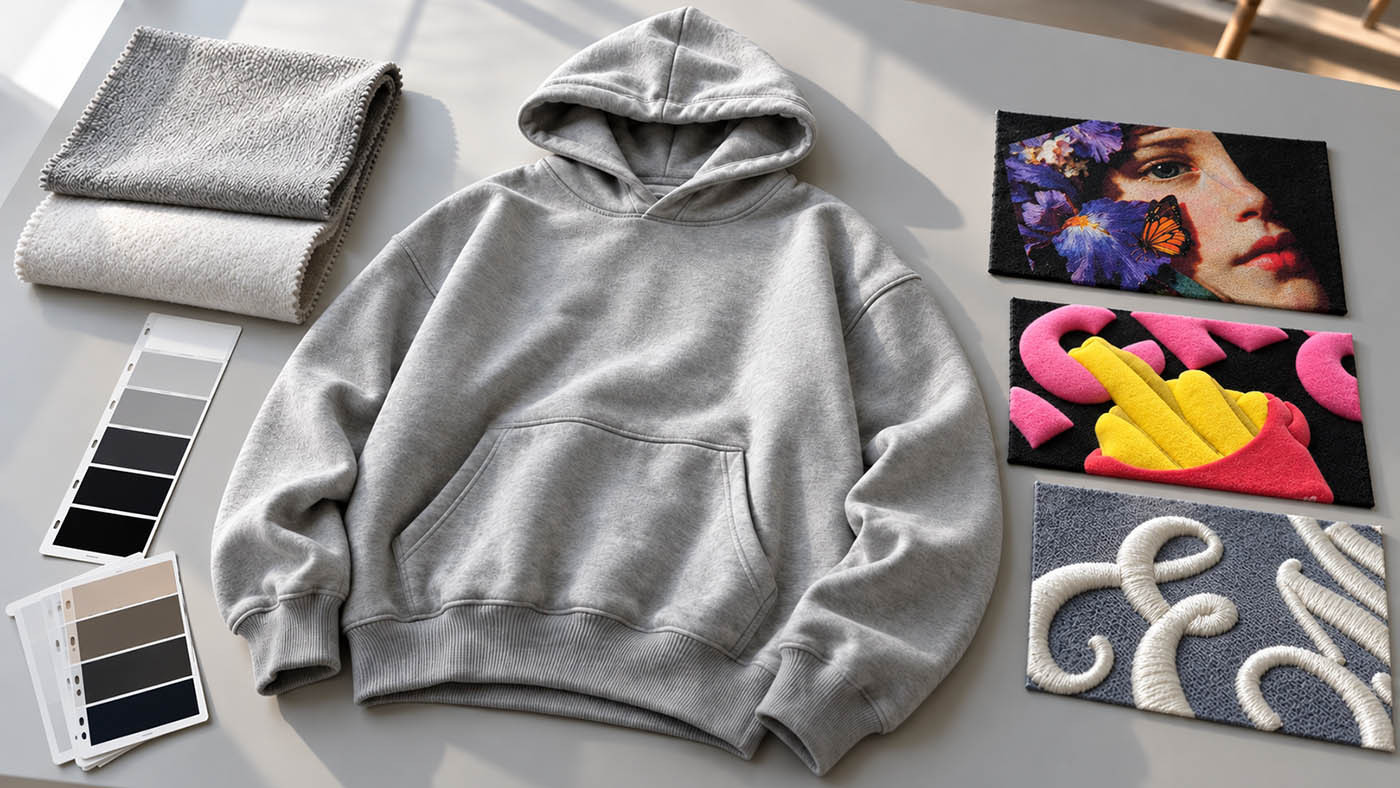
Placement brings its own considerations. A broad front or back panel gives screen printing room for larger graphics. On pullover hoodies, the kangaroo pocket and seams limit the usable lower-front area, while a zip-up hoodie has a center opening that interrupts artwork. A raised puff print can stand out across the upper chest or on a relatively flat back panel. Embroidery is often especially effective on the left chest, sleeve or another compact, stable zone.
Hood and sleeve placements are possible, but they aren't interchangeable with a flat front panel. Curves, seam allowances and narrow areas can make screen registration, heat curing or embroidery framing more complicated. A large stitched motif across a bend may also feel stiff. Rather than treating every placement as equally easy, it's useful to see whether the desired location supports the size and finish of your design.
For brands building matching sets, the same visual language can be used across hoodies and bottoms without placing the same technique everywhere. A back screen print on a hoodie might pair well with a smaller embroidered symbol on the pants. Our custom sweatpants fabric, fit and branding guide covers the considerations for the lower half of a coordinated set.
If you're still deciding on the base garment, the broader private label hoodie manufacturing guide explains how fit, fleece selection, labeling and sample development connect with the finished collection. Here, the key point is simpler: choose the decoration with the hoodie fabric, not after it.
4. Durability, Wash Care and Cost
It's tempting to rank these methods with a single statement such as “embroidery lasts forever” or “puff print cracks after ten washes.” Neither is a reliable way to plan a collection. The performance you get depends on the material, stitch or ink system, preparation, curing or embroidery quality, washing conditions and everyday wear.
How the Three Finishes Wear Over Time
A correctly cured standard screen print can hold up well through repeated laundering. Problems such as cracking, loss of adhesion or premature fading can appear when the ink and fabric aren't compatible, curing is inadequate, or the graphic is subjected to inappropriate care. A very large, heavy print can also feel different after the fabric has been stretched and washed many times.
Puff print introduces another variable: the raised film. Its texture is the attraction, but raised edges can be more vulnerable to abrasion, flattening or cracking under unsuitable conditions. Excessive heat, harsh washing and direct ironing can alter the finish. That doesn't mean puff print is inherently short-lived; it means its durability should be assessed with the specific ink and garment rather than assumed from the name.
Embroidery doesn't normally crack like an ink film because it is made from thread. It may nevertheless snag, develop loose stitches, pucker or lose its neat appearance if the thread, backing, digitizing or stitch tension is unsuitable. Heavy designs can place stress on stretchy fabric. Well-executed embroidery is often a strong choice for frequently worn brand marks, but even embroidered work needs proper care and construction. Keeping an approved print or stitched logo consistent during a production run is also part of sample-to-bulk quality control.
If durability is a major selling point, use an agreed reference sample and an appropriate wash-care assessment for your actual garment. There is no universal wash-count guarantee that applies to every hoodie and decoration combination. Our garment quality control guide explains why approval standards and consistent bulk workmanship matter more than a dramatic durability claim.
Wash Care Without Making Unrealistic Promises
Care instructions should follow the approved garment's fabric and decoration, not a generic rule copied from another product. For many decorated hoodies, turning the garment inside out, using a gentle cycle and avoiding unnecessary heat can help protect the surface. Care may differ for specialized inks, washed finishes or delicate embroidered elements, so the final label should reflect the tested garment and applicable care requirements.
In particular, avoid pressing a hot iron directly against a raised puff print. High heat can damage or change the relief. Direct heat can also affect other printed finishes, and embroidered details may benefit from protection during pressing. A customer should never need specialist knowledge to care for an everyday hoodie, but the instructions should be realistic.
What Actually Drives Decoration Cost?
Cost follows the process and artwork rather than a universal ranking. Conventional screen printing usually includes artwork preparation, screen setup, ink, printing and curing. When the same design is repeated at higher quantities, setup cost can be spread over more garments. Adding spot colors, placements or specialty effects may increase the work involved.
Puff printing uses a specialty ink or additive and requires tighter control of the raised effect. Design area, ink deposit, color count, production efficiency and whether puff is combined with standard printing affect the quotation. A simple one-color puff wordmark may be easier to produce than an elaborate puff-plus-flat multi-location graphic, but it is not automatically cheaper or more expensive than every embroidery option.
Embroidery is strongly influenced by stitch count, density, design size, thread changes, digitizing and machine time. A small, well-designed embroidered chest logo can be commercially practical, while a large, densely filled back piece can take considerably more time. This is why comparing a full-back screen print with a small embroidered chest mark does not reveal which technique has the lower price on a like-for-like basis. For the bigger picture, see the factors in our clothing manufacturing cost guide.
For a meaningful quote, keep the comparison fair: same hoodie fabric, quantity, logo size, location, colorways and packaging requirements, then compare the decoration options. If the artwork must be modified for puff or stitching, that is part of the decision. Our clothing tech pack guide describes how to document artwork size, placement and approved references clearly.
Don't forget the development calendar. Different artwork files, sample revisions and finishing steps can change the time required before production. If your launch date is fixed, our sample-to-bulk production timeline provides a broader picture of the stages involved.
5. Which Method Should You Choose?
For most brands, the best answer starts with the artwork rather than a preference for one machine or technique. Does the design need to reproduce detail? Does it need noticeable surface depth? Or is the logo intended to look like a permanent stitched signature? The table below puts the main trade-offs in one place.
| Decision Factor | Screen Print | Puff Print | Embroidery |
|---|---|---|---|
| Visual finish | Flat ink graphic | Raised, rounded ink | Textured thread stitches |
| Best design types | Illustrations, detailed logos, larger graphics | Bold text, simple symbols, open shapes | Monograms, small to medium logos, stitched emblems |
| Fine detail | Generally the strongest of the three for fine printed detail | Limited by ink expansion | Limited by stitch size and digitizing |
| Hand feel | Depends on ink and coverage; can be soft or firmer | Noticeably raised surface | Stitched texture, potential reverse-side bulk |
| Typical placements | Front, back, some sleeves | Upper chest, back, simple sleeve graphics | Left chest, sleeve, small logos and emblems |
| Main durability considerations | Ink adhesion, curing, abrasion, care | Raised layer, abrasion, heat, care | Thread security, puckering, snagging, backing |
| Major cost drivers | Screens, colors, quantity, print locations | Specialty ink, effect control, colors, coverage | Stitch count, density, digitizing, machine time |
Here are three realistic collection scenarios. A brand launching an illustrated hoodie with a large back design will usually get more creative control from standard screen printing. A label building a heavyweight, minimal streetwear drop may prefer one confident puff wordmark on the chest. A more restrained premium-casual line may find that a compact embroidered mark gives it enough identity without dominating the garment.
Can you combine techniques on the same hoodie? Absolutely. You can use a small embroidered chest logo with a large screen-printed back design, or add puff to selected lettering within an otherwise flat print. The combination can be visually powerful because it creates contrast between smooth, raised and stitched areas. It also introduces more cost and coordination, so the added effect should earn its place in the design.
One useful way to evaluate options is to create a controlled comparison: the same logo, on the same hoodie fabric, at the same placement and visual scale, finished in each feasible technique. You're not testing which method wins a popularity contest. You're checking which version looks like it belongs in your collection. If you're preparing artwork for development, the streetwear hoodie tech pack checklist is a useful companion.
Develop a Custom Hoodie With the Right Decoration
VANRD supports apparel brands with hoodie fabric sourcing, sample development, printing, embroidery and private label manufacturing. Share your artwork, preferred hoodie fabric, planned logo placement and estimated order quantity, and our team can discuss suitable decoration options for your project.
Discuss Your Hoodie ArtworkConclusion
Screen printing gives a design clarity and scale. Puff printing adds surface depth. Embroidery turns a mark into texture. Each can look excellent on a custom hoodie when it complements the artwork and the garment beneath it. The strongest choice is the one your customers will recognize as part of your brand—not simply the finish that happens to be trending.
Frequently Asked Questions
1. Is puff print the same as 3D puff embroidery?
No. Puff print uses an expanding ink during screen-print curing, while 3D puff embroidery uses stitches over a foam base to create raised lettering or shapes. Both create dimension, but their texture, production method, detail limits and cost factors are different.
2. Can one hoodie combine screen printing and embroidery?
Yes. A small embroidered chest logo and a large screen-printed back graphic are a natural combination, especially when a brand wants both understated identity and statement artwork. The fabric, artwork locations and production sequence still need to be suitable for the chosen applications.
3. Which technique is best for a logo with small text or thin lines?
Standard screen printing is often the most forgiving of these three for fine graphic details when the artwork and print process are prepared correctly. Puff ink expands and can close small gaps, while embroidery needs enough stitch space to keep tiny letters readable. Extremely fine designs may need simplification regardless of method.
4. Does embroidery always last longer than a printed hoodie logo?
No single durability ranking is valid for every product. Embroidery avoids the cracking behavior of ink films but can snag or loosen, while well-cured screen printing can remain durable through repeated wear and washing. Actual performance depends on the fabric, construction, application quality and care.
5. Should a brand test decoration on the exact hoodie fabric before bulk production?
Yes, particularly when working with raised ink, dense embroidery, cotton-polyester blends or garment-dyed and washed finishes. A sample on the actual fabric helps reveal the real texture, color, flexibility and placement before the approved design moves into a larger production run.
By VANRD Editorial Team. Images in this guide are illustrative visual comparisons, not documented VANRD customer samples or laboratory test results. Actual decoration results depend on approved artwork, selected materials and production conditions.