How to Verify a Clothing Manufacturer Before Paying a Deposit (2027 Guide)
A supplier sends you a convincing quote. The product photos look good, the messages are friendly, and the sample seems close to what your brand wants. Then comes the proforma invoice and a request for a production deposit.
This is where a promising manufacturing conversation becomes a financial commitment. Before you send money, you need to know three things: who will receive the payment, who will actually make your garments, and what the factory has agreed to deliver. Those answers are related, but they are not interchangeable. A real registered company may subcontract production. A capable factory may still be working from incomplete specifications. And an authentic supplier's email account can be compromised.
You do not need to treat every overseas supplier with suspicion. You do need a repeatable verification process that protects your first order and gives a good manufacturing partner a clear foundation to work from.
Quick answer: Before paying a clothing manufacturer, verify its legal identity, confirm its actual production role and product-category capability, review physical samples and written specifications, agree on inspection and payment milestones, and independently confirm the bank details. If any of these checks reveals an unresolved mismatch, pause the transfer until it is explained and documented.
Finding a Supplier Is Only the First Step
Brands discover manufacturers through Google, sourcing platforms, trade shows, referrals, and industry contacts. Each route can introduce a good partner, but none is a substitute for verification. A polished website is not proof of factory ownership; a platform badge is not a guarantee that every order will meet your requirements.
If you are still building a shortlist, start with our guide to finding a private label clothing manufacturer. Once you have two or three serious candidates, use the checks below to decide whether each is ready to receive a deposit.
1. Verify the Company Behind the Quotation
The brand name on a website may differ from the legal entity that signs contracts, issues invoices, or receives payments. That is not automatically a problem. Manufacturers may use an export company or an affiliated trading entity. The important thing is to identify the relationship before money changes hands.
Ask your supplier for its complete registered company name, business license or equivalent registration record, company registration number, business address, production location, and the entity that will issue the proforma invoice (PI). For a supplier in China, ask for the Chinese legal name and the Unified Social Credit Code, rather than relying only on an English company name.
You can cross-check Chinese registration information through the National Enterprise Credit Information Publicity System. Search by registered name or Unified Social Credit Code and review the available registration status, establishment date, business scope, and publicly disclosed risk information. Some details may require account registration or additional access. The State Administration for Market Regulation identifies this as China's national public enterprise-information system.
Pay attention to discrepancies, but investigate them rather than jumping to conclusions. A registered office can be different from a production facility. A trading company can coordinate legitimate manufacturing. What matters is whether the supplier accurately explains which company holds the contract, which factory carries out the work, and who is accountable if something goes wrong.
Ask directly: “Which legal entity will sign our purchase order, which facility will produce the garments, and what is the relationship between them?”
A registration record confirms an aspect of business identity. It does not prove product quality, available capacity, financial strength, or that the bank instructions you received are genuine.
2. Confirm Who Will Actually Make Your Clothes
A supplier may be able to show you a sewing floor without being the factory that will handle your specific order. For a basic T-shirt, that might not change much. For a technical jacket with lining, specialized hardware, embroidery, and washing, the production arrangement can affect both quality and scheduling.
Ask for a Live, Product-Specific Walkthrough
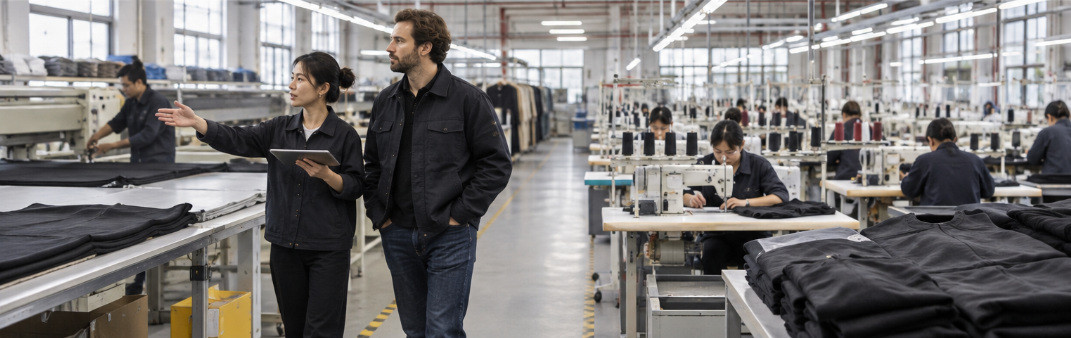
Request a live video walkthrough or an on-site assessment focused on the relevant workflow: pattern development, cutting, sewing, decoration, finishing, quality inspection, and packing. Ask the person giving the tour to show current work in the same category as your project. A prerecorded marketing video can help introduce a supplier, but it cannot answer your detailed production questions.
If you are manufacturing custom jackets, ask how the supplier manages shell and lining alignment, zipper installation, reinforcement, quilting, and trim sourcing. For hoodies, look at fleece handling, rib consistency, hood construction, shrinkage control, and the execution of prints or embroidery. For denim or washed garments, ask where washing takes place and who approves the final shade, hand feel, and measurements after finishing.
Ask Which Stages Are Outsourced
Many apparel supply chains involve outside specialists for processes such as printing, garment washing, or embroidery. Outsourcing is not inherently a warning sign. Undisclosed outsourcing is a risk when you have no clear owner for specifications, timelines, rework, and inspection.
For complex outerwear, use our puffer jacket manufacturing guide as an example of product-specific questions worth asking.
A useful verification request is: “Please identify the in-house stages, any subcontracted stages, and the person responsible for quality across the full order.” For a higher-value order, consider an independent factory audit or a third-party visit. A live video is a useful screen, not the equivalent of a formal audit.
3. Check a Physical Sample Against a Written Standard
A beautiful sample is reassuring, but it is only one garment. Your real question is whether the factory can reproduce the approved version across the required colors and sizes.
Lock the Production Standard
Start by comparing the sample with your latest clothing tech pack. Look beyond its overall appearance. Check the fiber composition and fabric weight, key points of measurement, construction, stitching, artwork placement, labels, trims, and packaging. Record any differences as numbered comments, then issue an updated specification instead of relying on scattered chat messages.
Consider a heavyweight hoodie with a large front embroidery. The first sample may look excellent on a hanger, yet the embroidery might pull the fabric out of shape after washing, or the neck rib might not recover as expected. A useful approval test would include measurements before and after an agreed wash procedure, a close review of the embroidery backing, and the exact rib and fabric references approved for bulk.
For a work jacket, the equivalent checks could involve zipper operation, pocket reinforcement, shell-to-lining balance, snap attachment, and the way the garment fits with its intended layering allowance.
Do not confuse sample approval with permission to change materials later. Identify the approved sample, technical-file version, fabric swatches, color standards, and trim references in writing. If a nominated component becomes unavailable, require notice and approval of a proposed substitute before it is used.
Decide When Pre-Production Approval Must Happen
The timing of a pre-production (PP) sample varies by project. VANRD outlines common approval stages in its manufacturing service process. Some factories can finalize it before a bulk deposit; others need the deposit to purchase bulk materials before producing the final PP sample. In the latter case, specify the approval gate clearly: what can be purchased after payment, what must not be cut or sewn before PP approval, and how a failed approval will be resolved. Do not assume every manufacturer follows the same sequence.
4. Ask How Quality Will Be Measured—Not Just Whether It Is “Good”
“We have strict quality control” tells you very little until you know what the inspector will check and what happens when a garment fails.
Ask the manufacturer to explain the checks for incoming fabric and trims, cutting, in-line sewing, finished garments, measurements, branding, and packaging. Our garment quality control guide walks through how these checkpoints work in apparel. For a high-value or unfamiliar supplier, discuss a third-party inspection at an agreed production stage. An inspection during production may reveal a problem while there is still time to correct it; a final inspection can help inform a shipment-release decision.
An AQL sampling plan can be part of this agreement, but AQL is not a promise of defect-free goods. ISO's 2859-1:2026 standard describes sampling procedures indexed by an acceptance quality limit; the actual sample size and accept/reject decision depend on the chosen plan. Independent inspection providers such as SGS describe final checks covering workmanship, quantity, labeling, packaging, and shipping marks.
Before production, agree on what counts as a critical, major, or minor defect for your product. For example, an unsecured sharp component in a children's garment may raise a very different concern from a small cosmetic mark on an internal seam. Agree on measurement tolerances by point of measurement, not one arbitrary tolerance applied to the whole garment.
For another concrete view, see the stages described on VANRD’s quality control process page. Also decide who pays for a failed inspection, corrective work, reinspection, and any resulting delay. That is a commercial decision to negotiate and write into the order, not something to discover after a shipment is rejected.
5. Read the Proforma Invoice Like a Production Document
Two suppliers can quote the same unit price while offering very different products. One price may include custom woven labels, approved branded packaging, and a specific fabric. Another may assume stock fabric, plain bags, and no testing or inspection allowance.
Compare the PI with the Approved Technical File
Before paying, make sure the PI or purchase order is linked to the current technical specification and records the essentials:
- Legal buyer and seller names, order reference, and date.
- Style numbers, colorways, size breakdown, quantities, currency, and unit prices.
- Fabric, trims, decoration, labeling, packaging, and any agreed testing.
- Sample and material approval references, plus permitted tolerances.
- Production milestones, inspection rights, and a realistic shipment window. For realistic sequencing, review the clothing production timeline.
- Deposit amount, balance-payment conditions, and the consequences of changes or cancellations.
- The agreed delivery term, named place or port, and the applicable Incoterms® edition.
On shipping, the three-letter term alone is not enough. “FOB” without a named port, for example, leaves important responsibilities unclear. The International Chamber of Commerce explains that Incoterms® 2020 allocates transport-related costs, tasks, and risks; it does not replace a sales contract or establish your product quality requirements.
Tie Payment to Clear Milestones
There is no universal deposit percentage that makes a clothing order safe. The appropriate structure depends on materials, order value, development costs, the supplier relationship, and your negotiating position. Instead of looking for a magic number, link payments to clear, documented milestones and understand what work or material purchasing each payment authorizes.
For significant orders or uncertain legal terms, have a qualified trade professional or lawyer review the contract and payment structure.
6. Verify the Bank Details Through a Separate Channel
This may be the most important final check because even a legitimate factory can be impersonated through a compromised email account.
Before sending the deposit, compare the beneficiary name, bank name, account details, and stated beneficiary company with the legal and invoicing entities you verified earlier. If they differ, request a written explanation and supporting documentation. Depending on the country and banking arrangement, a legitimate group may use a different authorized receiving entity; the relationship still needs to be verified independently and accepted by your finance team.
Verify a Bank-Detail Change Independently
Do not confirm payment instructions by simply replying to the same email that delivered them. Call a previously verified company telephone number, or use an independently established contact channel to confirm the beneficiary details. This is especially important if the supplier says its bank account has “just changed.”
The U.S. FBI's Internet Crime Complaint Center specifically recommends verifying changes in account information through secondary channels to reduce business-email-compromise risk.
A sensible internal control is to have one person verify the supplier and bank record and a second authorized person release the transfer. Keep a copy of the PI, written bank confirmation, approval record, and bank transfer receipt together. Those records are useful for both finance and later production discussions.
If you believe you have sent money to a fraudulent account, contact the sending bank immediately to request a recall or recovery attempt and report the incident to the relevant authorities. U.S. victims can also report through IC3. Speed matters; recovery is not guaranteed.
A Practical Pre-Deposit Verification Checklist
Before approving the payment, assign an owner and save evidence for each check. A verbal “yes, confirmed” is difficult to audit later.
| Check | Evidence to keep | Status |
|---|---|---|
| Legal company identity | Registration record and business license | Confirmed / Hold |
| Contracting and invoicing entity | Draft PI or purchase order | Confirmed / Hold |
| Actual production facility | Address, live-tour notes or audit report | Confirmed / Hold |
| Outsourced processes | Written list of partners and responsibilities | Confirmed / Hold |
| Relevant product capability | Category samples and technical discussion | Confirmed / Hold |
| Sample and specification | Approved reference, tech pack, revision date | Confirmed / Hold |
| Materials and branding | Approved fabrics, trims, artwork and labels | Confirmed / Hold |
| Quality and inspection plan | Defect criteria, tolerances, inspection milestones | Confirmed / Hold |
| Quantity, pricing and delivery | PI, size/color breakdown, shipping term | Confirmed / Hold |
| Deposit and balance milestones | Written payment schedule and release conditions | Confirmed / Hold |
| Bank beneficiary | Independently verified payment details | Confirmed / Hold |
| Changes and disputes | Written approval, rework and claim procedure | Confirmed / Hold |
Decision rule: Proceed only when the material checks are confirmed and documented. Put the transfer on hold for unexplained identity or banking mismatches, unknown production responsibility, missing product specifications, or unresolved payment terms. An unresolved red flag is a reason to investigate, not evidence on its own of fraud.
Share your product category, tech pack or reference sample, estimated quantity and timeline. Our team can review the project requirements and explain the next development steps.
Seven Warning Signs Worth Investigating
1. The supplier refuses to identify the contracting company. A brand or trading name is not enough when you need to know who is legally responsible for the order.
2. A last-minute bank-account change arrives by email. Treat it as a verification event, even if the message looks familiar and uses the right signature.
3. The supplier cannot explain who manufactures your product. This is particularly concerning when your order requires specialist construction or subcontracted finishing.
4. The quote is dramatically lower but the specifications are vague. Compare fabric, weight, trims, branding, inspection, packaging, and delivery terms before assuming the price is equivalent.
5. The sample differs from the technical file and nobody records the changes. Without a controlled reference, the bulk team may work from an outdated version.
6. Inspection or corrective-action terms are left until after production. If the acceptance rules are undefined, a quality dispute becomes much harder to resolve.
7. You are pressured to transfer money before basic questions are answered. An urgent production slot or material reservation may be real, but urgency should not replace identity and payment verification.
None of these points should be used as an automatic verdict. Ask for an explanation, seek independent evidence where appropriate, and document the decision.
Example: A Streetwear Brand Ordering Its First 300 Hoodies
Imagine a growing clothing label ordering 300 heavyweight hoodies in two colors. The product is being developed as a private label hoodie program. The supplier has made an attractive development sample and asks for a bulk-production deposit. The buyer notices that the PI names a different company from the website, while the approved sample says only “400 GSM cotton fleece” without a specific fabric reference.
Rather than cancel the project or send the money immediately, the buyer requests the legal relationship between the two companies and cross-checks the contracting entity. The brand then asks for the approved fabric reference, artwork placement measurements, rib specification, size tolerances, and what the initial deposit will authorize. Finally, its finance contact verifies the receiving account through a phone number previously confirmed with the supplier.
The supplier may have perfectly reasonable explanations. Perhaps the website uses a brand name, while the export entity handles contracts. Perhaps the sample used a development fabric and the bulk fabric is still pending approval. The point is that the buyer discovers these differences before they become expensive misunderstandings.
If the order's material or PP sample cannot be approved before deposit, the parties can instead document a staged approval plan that prevents bulk cutting until the necessary standards are agreed. This is a practical way to maintain momentum without giving up control.
This is an illustrative scenario, not a claim about a specific VANRD customer order.
Frequently Asked Questions
How can I check whether a clothing manufacturer in China is legitimate?
Request its Chinese registered name, Unified Social Credit Code, business license, and contracting entity. Cross-check registration records on the official enterprise-publicity system, then separately verify the facility, production responsibility, and payment beneficiary. Registration is a starting point, not proof that every capability claim is accurate.
Is an Alibaba Verified Supplier badge enough?
No. It can provide useful third-party assessment information, but it is not a substitute for order-specific checks. Alibaba's own disclaimer says it does not guarantee the authenticity or accuracy of seller products, certificates, or assessments. Review the available report and perform your own verification.
Should I pay a deposit before approving a pre-production sample?
That depends on the factory's process and whether bulk materials must be purchased to make the PP sample. If a deposit comes first, document exactly what can proceed, which approvals remain mandatory, and what happens if the PP sample fails. Do not allow uncertainty about fit, materials, or artwork to turn into unauthorized bulk production.
Can a trading company be a reliable clothing supplier?
Yes. Trading and sourcing companies can add value through development, coordination, and quality management. What matters is transparency about the production facility, contractual responsibility, subcontractors, and who controls corrective action. Do not confuse “direct factory” with automatically lower risk.
Do I need a third-party factory audit for every order?
Not necessarily. The decision depends on order value, product risk, supplier history, your team's ability to verify the operation, and the consequences of failure. A new supplier handling a large technical outerwear order may justify deeper verification than a small repeat order with a proven partner. Product inspections and factory audits serve different purposes; neither eliminates all risk.
What if the supplier asks me to pay a personal bank account?
Treat it as a high-risk exception. Do not transfer funds until you have independently verified the beneficiary's identity, legal relationship to the contract, and an acceptable explanation reviewed by your finance team. For a standard B2B manufacturing order, a company account aligned with the documented commercial arrangement is generally easier to control.
A Reliable Manufacturing Partnership Starts Before Production
Verifying a clothing manufacturer is not about collecting the most certificates or asking the most questions. It is about knowing who is responsible, what garment standard has been approved, how quality will be judged, and what your deposit permits the supplier to do.
That discipline helps both sides. Buyers get clearer control over money, quality, and deadlines. Manufacturers get fewer ambiguous instructions and a better chance of producing the collection the brand actually intended.
At VANRD, we support apparel brands with OEM/ODM development and production for custom jackets, hoodies, and other streetwear categories. You can review our manufacturing background and quality control workflow when comparing suppliers. Our OEM/ODM services describe our design review, fabric and trim sourcing, sample development, bulk production, and quality-control coordination. If you are comparing manufacturing partners, prepare your tech pack or reference sample, estimated quantity, and timeline so that development feasibility and expectations can be discussed clearly.
Tell us what you plan to make. We can review your design references, customization needs, quantity and intended production timeline before advising on the next step.
Editorial note: This guide is for practical sourcing education, not legal, financial, or customs advice. Local requirements and contract terms vary by country and project.
Sources and editorial scope
Primary references used for specific verification steps include the National Enterprise Credit Information Publicity System, the FBI’s business email compromise guidance, the ICC’s Incoterms® 2020 overview, and ISO 2859-1:2026 for acceptance sampling. Relevant manufacturing examples are linked to VANRD’s published technical and QC content in the article.
This is educational sourcing guidance, not a certification of a particular supplier or legal and financial advice. Before placing a significant order, confirm current registration, contractual requirements, product compliance and bank details for your specific transaction.