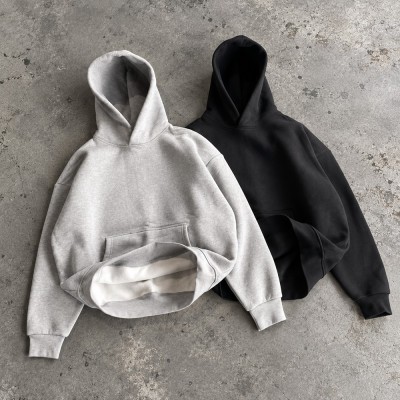
Is 100% cotton or a cotton-polyester blend better for hoodies?
Neither is better in the abstract. 100% cotton delivers the hand-feel, dye depth and “premium” language most streetwear brands sell — at a higher cost and roughly 3–5% shrinkage unless it is pre-shrunk. An 80/20 cotton-polyester fleece shrinks less, keeps its shape through washing, resists pilling and hits a lower unit price — which is why it dominates volume hoodie programmes. At VANRD we quote both for every hoodie brief so the cost and shrinkage trade-off is visible before sampling.
What each fibre actually does
Cotton is a natural staple fibre: it dyes deep, feels dry rather than slick, and takes garment washing and distressing predictably. Its weakness is dimensional stability — loops relax in hot water unless the fabric is compacted or pre-shrunk.
Polyester is a filament: it does not shrink the way cotton does, adds tensile strength and gives the fleece a springier recovery. Blended at 20%, it keeps most of the cotton hand-feel while stabilising the garment. Push the polyester share much higher and the face starts to read synthetic under light.
| 100% cotton | 80/20 cotton-poly | |
|---|---|---|
| Hand-feel | Dry, natural, premium | Slightly slicker, springier |
| Shrinkage | 3–5% unless pre-shrunk | Around 1–2% |
| Pilling | Low to moderate | Lower |
| Dye depth | Deep, garment wash friendly | Slightly flatter in dark shades |
| Unit cost | Higher | Lower |
| Best for | Premium positioning, garment dye | Volume programmes, repeat reorders |
How to decide on one brief
Start from the promise on the hangtag. If the brand sells “heavyweight 100% cotton, garment dyed”, the fabric must support that claim and the price has to carry it. If the brand sells fit, graphic and drop cadence, an 80/20 fleece protects margin and removes shrinkage complaints.
One caveat worth writing into the spec: if you intend to garment dye, polyester resists the dye and produces a muted, heathered result. In that case stay on cotton.
Field example
A Canadian label launched a 100% cotton 430 GSM hoodie for a premium drop and an 80/20 version of the same block for their core range. Nine months later the cotton piece had the better reviews and the blend piece had the better reorder rate — same fit, same pattern record, two different price points doing two different jobs.
Numbers that matter
- 100% cotton shrinkage: roughly 3–5% without pre-shrinking
- 80/20 blend shrinkage: roughly 1–2%, shape retention noticeably better
- Polyester above about 35% starts to read synthetic in photos and in hand
- Garment dyeing requires a cotton-dominant base to take colour evenly
Related questions
- Service Process
- Fabrics & Techniques
- Sweater & Knitwear Manufacturer
- OEM/ODM Apparel Manufacturing by Brand Type
- Custom Headwear Manufacturer
- Streetwear Manufacturer
- Custom Clothing Quality Control
- Tracksuit Manufacturer
- T-Shirt & Jersey Manufacturer
- Pants & Bottoms Manufacturer
- Hoodie & Sweatshirt Manufacturer
- Jacket Manufacturer