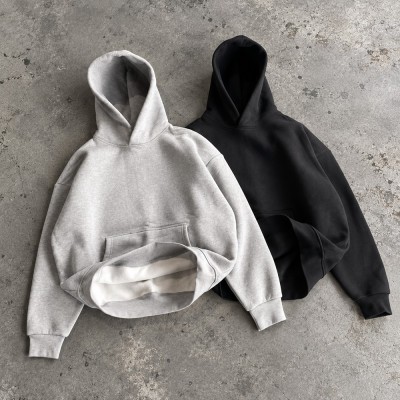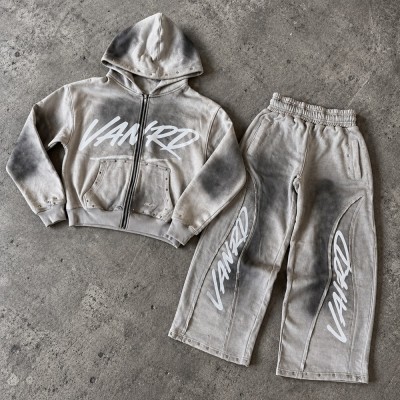
Does higher GSM always mean better fabric quality?
No — GSM measures weight, not quality. A tightly knitted 320 GSM fleece from combed, long-staple yarn will pill less, hold its shape longer and feel better than a loosely built 400 GSM made from short-staple cotton. Weight is a design decision about drape and warmth; quality is decided by fibre length, yarn count, knitting tension, dyeing and finishing. At VANRD we specify all five on the fabric record, because the GSM number alone cannot protect a brand from substitution.
What the number cannot tell you
Two fabrics at 420 GSM can differ by 40% in cost and by years in service life. The difference sits in things the GSM label does not carry: whether the yarn is carded or combed, the loop length, the machine gauge, the tension, and whether the fabric was compacted after dyeing.
This is why “looks heavy” is a weak buying criterion. A slack knit feels thick in the hand but collapses at the seam and pills at the cuff within a season.
| Signal | What it tells you | What it hides |
|---|---|---|
| GSM | Mass, warmth potential, drape | Yarn quality, density, finishing |
| Combed vs carded | Fibre length, pilling resistance | Knitting tension |
| Knit gauge | Surface density and stability | Dye lot consistency |
| Shrinkage test result | Dimensional stability | Colour fastness |
| Pilling grade | Surface durability | Seam strength |
A practical verification routine
Ask for the fabric spec sheet, then verify three things independently: weigh a one-square-metre cut (±5% is normal), run a wash-and-measure shrinkage test, and check a pilling grade after abrasion. If a supplier cannot provide a spec sheet, the GSM claim is marketing.
For orders above roughly USD 5,000, a third-party lab test for composition and weight costs little relative to the risk of a substituted fabric arriving at bulk.
Field example
A buyer sent VANRD a 380 GSM reference that pilled badly after five washes. We rebuilt it at the same 380 GSM but on combed cotton with a tighter gauge and a compacted finish. The garment came back visually identical in weight, and the pilling grade improved from 2–3 to 4 on the same abrasion test.
Numbers that matter
- ±5% GSM variance is normal production tolerance; anything beyond that is substitution
- Pilling is graded on a 1–5 scale — grade 4 and above is a durable knit surface
- A one-square-metre swatch on a digital scale is the cheapest verification available
- Third-party lab tests for weight and composition typically cost USD 30–80
Related questions
- Service Process
- Fabrics & Techniques
- Sweater & Knitwear Manufacturer
- OEM/ODM Apparel Manufacturing by Brand Type
- Custom Headwear Manufacturer
- Streetwear Manufacturer
- Custom Clothing Quality Control
- Tracksuit Manufacturer
- T-Shirt & Jersey Manufacturer
- Pants & Bottoms Manufacturer
- Hoodie & Sweatshirt Manufacturer
- Jacket Manufacturer