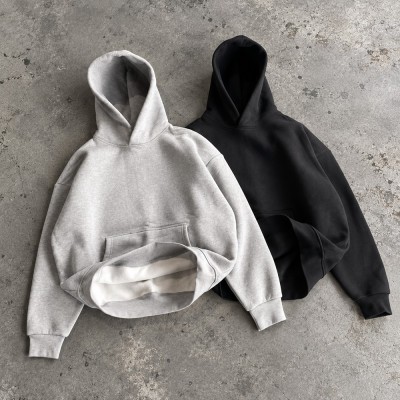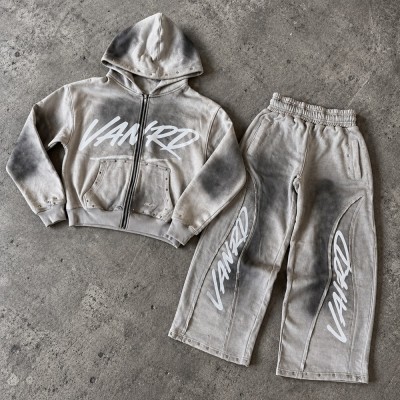
What GSM is best for a premium heavyweight hoodie?
For a premium heavyweight hoodie, target 400–450 GSM in brushed fleece, or 400+ GSM in French terry if you want structure without heat. 320–380 GSM is the volume standard rather than a premium weight, and above roughly 500 GSM you are building outerwear with a hood, not a hoodie. At VANRD we develop these weights as a single recorded specification, so the first run and the reorder feel the same.
What the number actually measures
GSM is grams per square metre — mass, not quality. A loosely knitted 400 GSM fleece made from short-staple cotton pills faster and feels worse than a well-built 320 GSM made from combed yarn. Weight tells you drape, warmth and structure; yarn quality and knitting density tell you how it will survive twenty washes.
That is why two 420 GSM hoodies can feel completely different on the same day: one is a double-face with tight tension, the other a slack single knit with a heavy brushed back.
| Weight | What it is used for | What the buyer feels |
|---|---|---|
| 280–320 GSM | Light hoodies, layering pieces | Soft, drapes close, not premium |
| 320–380 GSM | The volume standard, year-round core | Substantial, holds print and shape |
| 400–450 GSM | Premium streetwear drops, winter programmes | Structured shoulders, obvious heft |
| 450–500 GSM | Flagship pieces | Stands off the body, boxy by default |
| 550 GSM+ | Specialty or bonded constructions | Seams bulk, cuffs recover slowly, slow to dry |
Where premium actually breaks down
Past about 500 GSM the sewing window narrows: needle and feed-dog settings must change, seam bulk appears at the armhole and hood join, and any pattern error that a 350 GSM fabric hides becomes a visible pucker. Heavier fabric also means more grams of cotton per garment, so unit cost climbs with weight before you add a single print.
A practical check: ask for the fabric spec sheet (GSM, composition, knit type), then weigh a one-square-metre cut from the sample. A ±5% variance is normal; a 30 GSM drop at bulk stage is substitution, not tolerance.
Field example
A Berlin streetwear label came to VANRD with a 480 GSM brushed fleece reference that kept arriving lighter at bulk with their previous supplier. We rebuilt the programme on a 430 GSM brushed-back loopback with a documented fabric record, weighed every sample and bulk roll, and held the variance inside 5%. The drop shipped on a 25–35 day bulk window and the reorder ran off the same record with no re-approval.
Numbers that matter
- 400–450 GSM is the range VANRD recommends for a first premium heavyweight hoodie
- 320–380 GSM covers most volume programmes and prints more cleanly
- ±5% GSM variance is the accepted production tolerance; verify with a weighed swatch
- Above 500 GSM, expect longer dry time, higher freight weight and tighter sewing control
Related questions
- Service Process
- Fabrics & Techniques
- Sweater & Knitwear Manufacturer
- OEM/ODM Apparel Manufacturing by Brand Type
- Custom Headwear Manufacturer
- Streetwear Manufacturer
- Custom Clothing Quality Control
- Tracksuit Manufacturer
- T-Shirt & Jersey Manufacturer
- Pants & Bottoms Manufacturer
- Hoodie & Sweatshirt Manufacturer
- Jacket Manufacturer