What is the difference between French terry and brushed fleece?
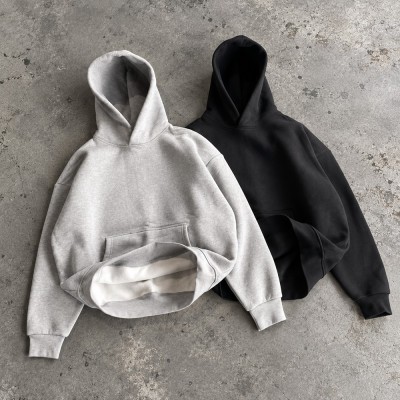
French terry and brushed fleece are cousins, not opposites. French terry keeps the inside loops intact: breathable, structured, better print surface, lower pilling. Brushed fleece is French terry that has been sanded on the inside to raise a nap: warmer and softer at the same weight, but the brushed fibres pill and the garment relaxes with wear. On VANRD hoodie programmes, structured streetwear usually lands on 400+ GSM French terry; cosy winter product lands on 380–450 GSM brushed fleece.
Construction, not branding
A knit is a field of loops. On French terry those loops stay closed on the inside, which traps air without blocking moisture movement — warm enough for autumn, wearable in spring. On brushed fleece the same fabric passes through a brushing machine that breaks the loops into cut fibres, so the surface traps far more air and feels plush on first touch.
The trade is durability. Cut fibres migrate, so the brushed face pills and flattens sooner than an intact loop. That is a property of the construction, not a defect in the mill.
| French terry | Brushed fleece | |
|---|---|---|
| Inside face | Uncut loops | Brushed nap |
| Warmth at equal GSM | Moderate | Higher |
| Structure / drape | Holds boxy shape | Softer, relaxes |
| Print surface | Smooth, crisp edges | Slightly fuzzy edges |
| Pilling | Low | Moderate on the inside |
| Typical range | 280–500 GSM | 260–580 GSM |
Choosing for a real programme
If the hoodie has to photograph structured and hold its silhouette drop after drop, choose French terry. If the selling point is warmth and a soft hand-feel — winter markets, loungewear, gifting — brushed fleece earns its place.
Decoration matters too. DTG and fine screen work sit better on a flat terry face; embroidery behaves identically on both. For print-heavy ranges, terry is the safer base.
Field example
For a Copenhagen label running an oversized drop, we moved the core hoodie from brushed fleece to 420 GSM French terry. The garment kept its boxy shape after ten wash cycles in our shrinkage test, and the front chest print registered 1 mm tighter because the face was flat. Their winter piece stayed on brushed fleece at 400 GSM for warmth.
Numbers that matter
- French terry: 280–500 GSM typical, shrinkage around 1–3%
- Brushed fleece: 260–580 GSM typical, shrinkage around 2–4%
- Brushed face is the pilling surface — expect gradual flattening after repeated washing
- Both accept embroidery equally well; terry takes fine print detail better
Related questions
- Service Process
- Fabrics & Techniques
- Sweater & Knitwear Manufacturer
- OEM/ODM Apparel Manufacturing by Brand Type
- Custom Headwear Manufacturer
- Streetwear Manufacturer
- Custom Clothing Quality Control
- Tracksuit Manufacturer
- T-Shirt & Jersey Manufacturer
- Pants & Bottoms Manufacturer
- Hoodie & Sweatshirt Manufacturer
- Jacket Manufacturer