What measurement tolerances are acceptable in bulk clothing production?
There is no single number: tolerance is set per measurement point. For knitted streetwear we work to plus or minus 1 cm on body length, chest, waist and hip, and plus or minus 0.5-0.6 cm on shoulder, sleeve length, neck width and cuff height. Woven styles are held tighter on the points that carry the fit. Every point has its tolerance printed in the spec before sampling starts.
Tolerance by measurement point
The figures below are the working tolerances we put in a spec sheet. They assume the garment is measured flat, relaxed, 24 hours after production and before packing. A brand can tighten them, but tightening has a cost: tighter tolerance means more pieces reworked and a slower line.
| Measurement point | Knit (hoodie, tee, sweatpants) | Woven (jacket, shirt, denim) |
|---|---|---|
| Body length | ±1.0 cm | ±0.8 cm |
| Chest, 1" below armhole | ±1.0 cm | ±0.8 cm |
| Waist and hip | ±1.0 cm | ±0.8 cm |
| Shoulder width | ±0.5 cm | ±0.4 cm |
| Sleeve length | ±0.6 cm | ±0.5 cm |
| Neck width | ±0.5 cm | ±0.4 cm |
| Cuff and hem height | ±0.3 cm | ±0.3 cm |
Why knits get more room than wovens
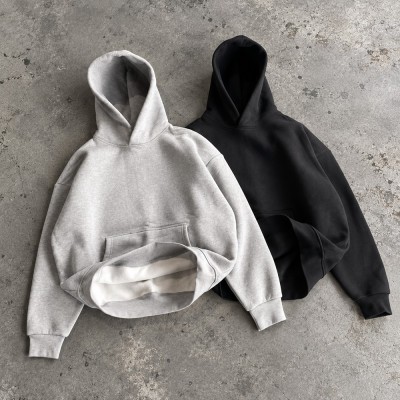
A knitted panel relaxes after it leaves the cutting table and again after the first wash. A 400 GSM loopback hoodie can grow 0.5-1 cm across the chest simply by being folded and stacked for two days. Woven panels are dimensionally stable, so the tolerance can be tighter without punishing the line.
This is also why the measurement must be taken after relaxation, not straight off the machine. Measuring a hoodie still warm from the iron gives a number that will not repeat tomorrow.
How the tolerance is checked in bulk
Our QC measures a minimum of three pieces per size per colour at the start of production, then five pieces per size at final inspection. Every measurement is logged against the spec, and any point outside tolerance is flagged by size and colour so the fault can be traced to a cutting lot.
If two or more pieces in a size are out by more than the tolerance, the size is re-measured after 24 hours. If it is still out, the pattern is corrected before the rest of the lot is cut.
Field example
On a 400 GSM oversized hoodie with a 62 cm chest spec, the first bulk measurement showed 61.2-62.7 cm on most pieces, but six pieces read 63.0-63.4 cm. Re-measured after 24 hours of relaxation, four of the six fell back inside tolerance and two stayed out. Those two were re-cut. The cause was a cutting marker that had been nudged 4 mm at the side seam, not a sewing fault.
Numbers that matter
- Working tolerance: ±1 cm on body points, ±0.5-0.6 cm on detail points for knits
- Measure flat and relaxed, 24 hours after production, at 20 ±2 °C and 65 ±4% relative humidity
- Minimum 3 pieces per size and colour at production start, 5 pieces per size at final inspection
- A 4 mm marker error becomes a 4 mm error on every piece in that lot — cutting is checked before sewing
- Service Process
- Fabrics & Techniques
- Sweater & Knitwear Manufacturer
- OEM/ODM Apparel Manufacturing by Brand Type
- Custom Headwear Manufacturer
- Streetwear Manufacturer
- Custom Clothing Quality Control
- Tracksuit Manufacturer
- T-Shirt & Jersey Manufacturer
- Pants & Bottoms Manufacturer
- Hoodie & Sweatshirt Manufacturer
- Jacket Manufacturer