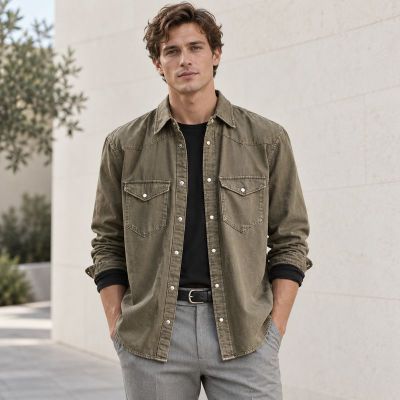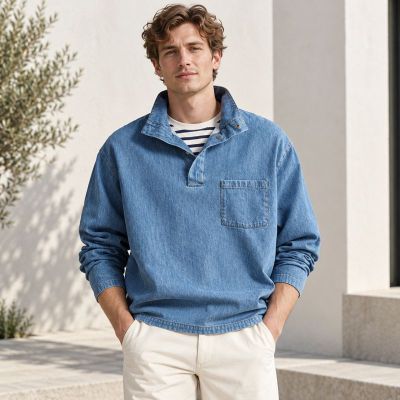
What denim weights and stretch levels are available for custom denim jackets?
Custom denim jackets run from about 9 oz to 15 oz, in 100% cotton rigids and 1–3% elastane comfort-stretch qualities, with selvedge options on shuttle looms for premium drops. The weight decides how the jacket reads; the stretch percentage decides how it wears.
The four weight bands.
- 8–10 oz. Lighter, softer and more fashion-forward. Drains the structure out of a trucker but suits a boxy or cropped streetwear cut, and layers easily under outerwear.
- 11–13 oz. The commercial middle and where most programs sit. Enough body to hold a yoke and pleats, comfortable enough to wear from the first week.
- 14–16 oz. Vintage and heritage positioning. The fabric holds whiskers, fades and distress marks far more visibly, which is what makes a heavy denim worth a wash program.
- 16 oz and above. The heaviest builds. A deliberate statement, with a long break-in and a narrow price band.
Stretch. Rigid 100% cotton is the classic choice and the one that ages most characteristically — it moulds to the wearer, which is the point of the category. Comfort-stretch at 1–3% elastane gives easier movement and better shape recovery across repeat wears, at some cost in how sharply the fabric creases. Above 3% the denim starts to read as stretch rather than as denim, which matters on a jacket where the fabric is the product. Stretch also changes pattern allowances, so the percentage is locked before grading rather than adjusted at sampling.
Construction and fiber. Ring-spun and open-end denims are both available — ring-spun gives a smoother surface and better abrasion behaviour, open-end a more textured hand at a lower cost. Selvedge on shuttle looms is the premium route for a limited drop. Recycled and organic-rich cotton blends can be sourced on request, which suits brands building a sustainability position into the product rather than the marketing.
Why the color program matters as much as the weight. Shade bands are held for each lot so that reorders stay consistent across seasons — an indigo that drifts between production runs is a ranged-product problem, not a single-SKU one. Indigo, black and ecru are the core shade families, and each behaves differently under the same wash program.
The steps that have to follow the fabric decision. A wash program developed and approved on the actual garment, hardware finished to match the wash level, and shrinkage confirmed by wash testing before bulk cutting. Denim moves, and a jacket that was correct before washing and wrong after is a grading problem discovered too late. Fit is approved on the washed garment for exactly this reason.
Indicative FOB pricing is $15–60+ per unit, with fabric weight, wash development and hardware the main cost lines. Sampling runs 7–10 days plus wash development, and bulk production 30–45 days after pre-production approval, plus 20–30 days by sea to the US or Europe. The minimum order is 100 pieces per color per style.
Tell us the weight and the wash you are aiming for and we will specify the denim and hardware to match — contact VANRD.