What Affects the Cost of Custom Sweatpants for Private Label Brands?
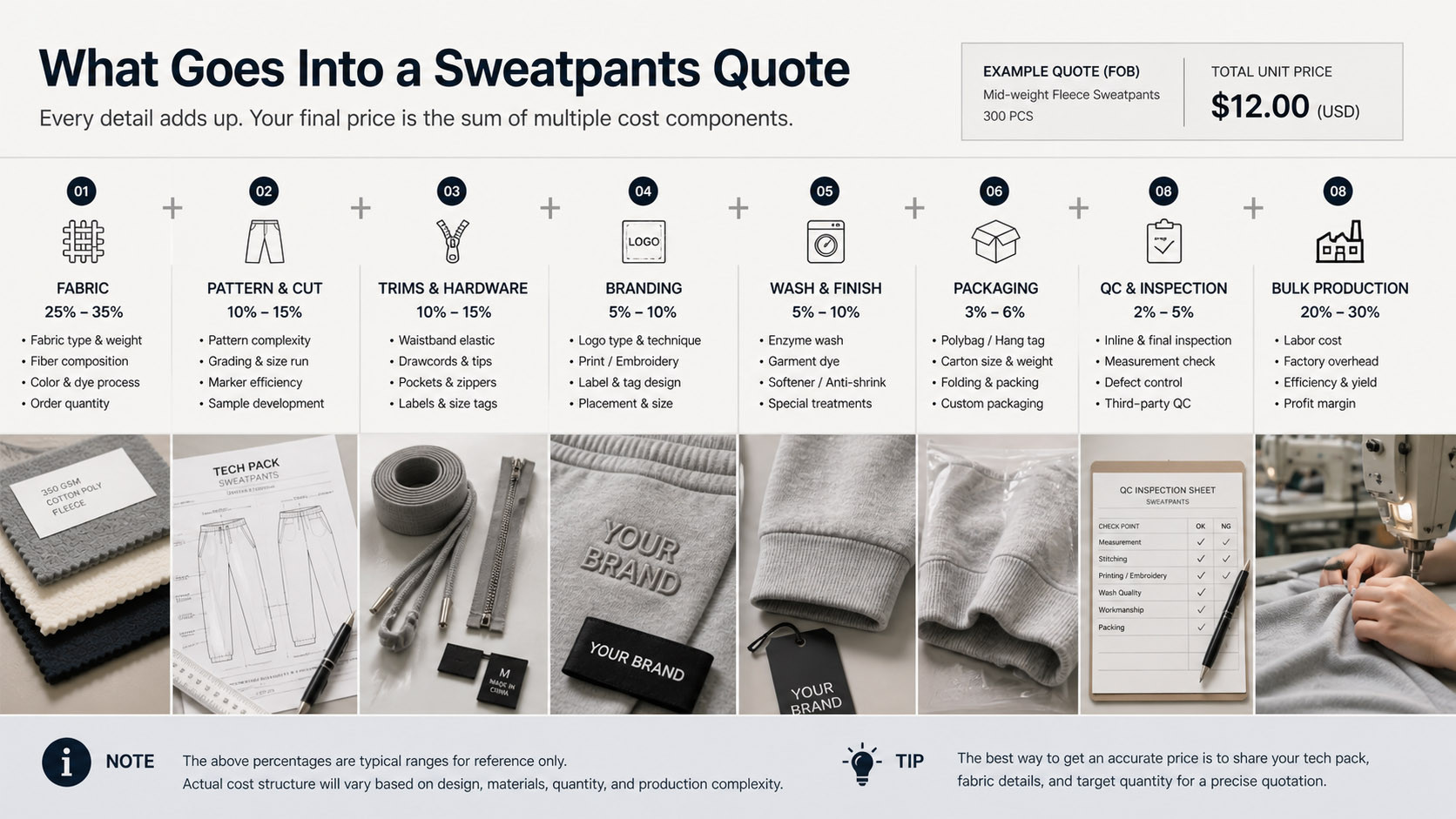
Custom sweatpants cost depends on fabric choice, fabric weight, fit complexity, waistband construction, cuff details, trims, logo technique, wash process, MOQ, packaging, and QC requirements. A lower unit price may not include the same fabric, construction, sample revision, inspection, or private label support. Brands can get more accurate quotations when they provide clear specifications before sampling or bulk production.
Quick Answers
What affects the cost of custom sweatpants?
Custom sweatpants cost is affected by fabric type, fabric weight, fit complexity, waistband and cuff construction, pocket details, trims, logo technique, wash process, MOQ, label and packaging needs, sample revisions, and QC requirements.
Why do heavyweight sweatpants usually cost more?
Heavyweight sweatpants can cost more because the fabric may be more expensive, the garment may use more material, sewing can be more difficult, seams can be thicker, shrinkage control may need more attention, and packing volume can increase.
Does MOQ affect sweatpants price?
Yes. MOQ affects material sourcing, cutting efficiency, trim ordering, dyeing or wash feasibility, labor planning, and unit cost. Smaller orders often have less production efficiency and may carry higher per-piece costs.
Are custom sweatpants more expensive than blank sweatpants?
Custom sweatpants are usually more complex than blank sweatpants because they can involve custom pattern, fabric selection, private label trims, logo placement, sample development, size grading, packaging, and QC standards. Blank sweatpants may be simpler but offer less control.
What information should brands provide for an accurate quote?
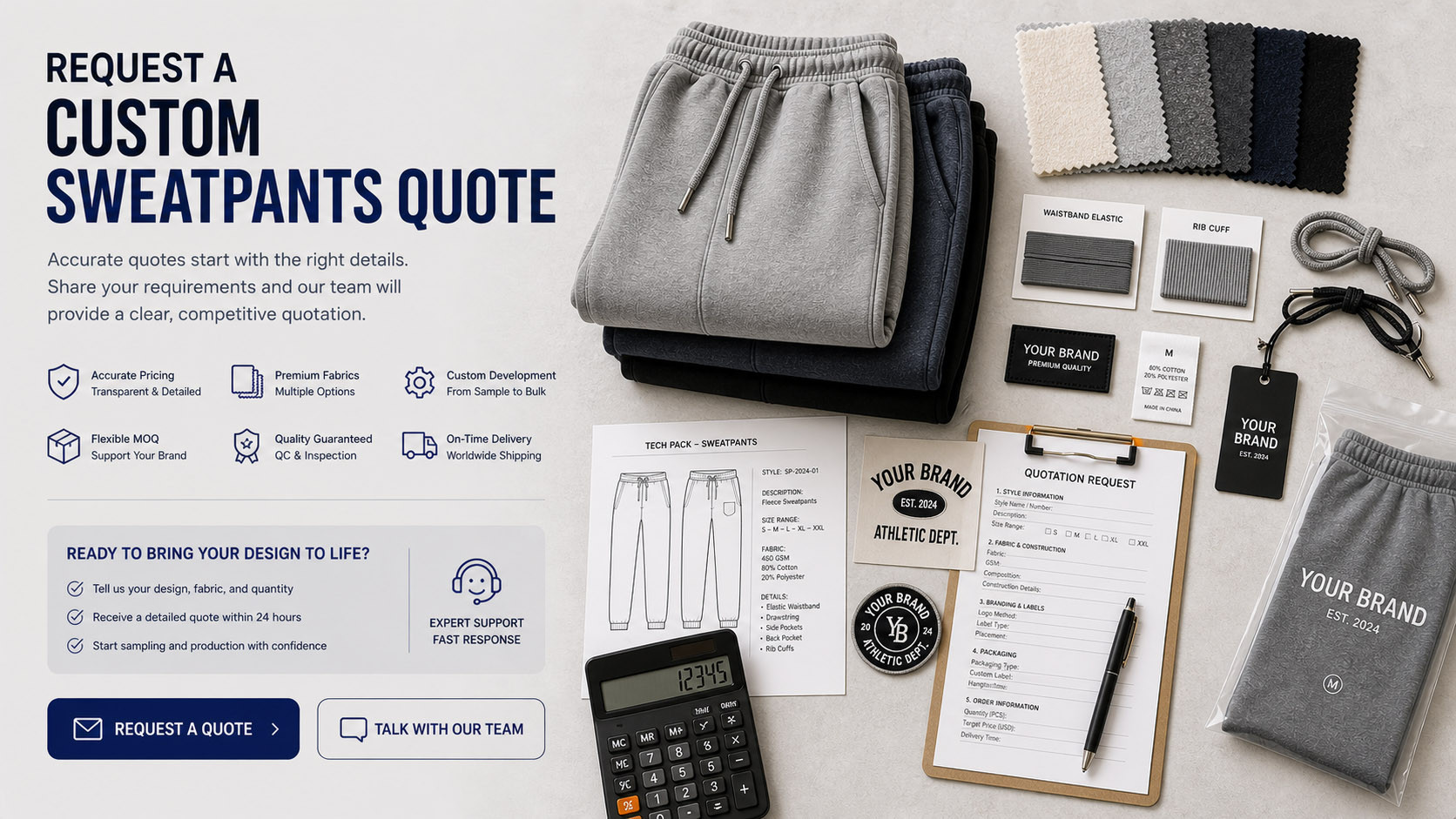
Brands should provide reference images, tech pack if available, size chart, fabric direction, target fit, waistband and cuff details, logo artwork, decoration method, label and packaging requirements, target quantity, and QC expectations.
Does logo technique change sweatpants cost?
Yes. Screen print, puff print, embroidery, applique, woven patch, heat transfer, rhinestone, and reflective details have different costs and production requirements. Placement, size, color count, and wash compatibility also affect pricing.
How can brands reduce unnecessary sweatpants production cost?
Brands can reduce unnecessary cost by confirming fabric direction early, avoiding late design changes, preparing clear artwork, choosing trims that match the target price, approving samples carefully, and aligning QC standards before bulk production.
Why Custom Sweatpants Pricing Is Not Based on One Simple Number
Custom sweatpants pricing is not based on one fixed number because every project has different fabric, fit, construction, branding, quantity, and quality requirements. A basic jogger with standard fleece and simple logo printing is different from heavyweight baggy sweatpants with custom wash, embroidery, branded drawcords, woven labels, and private label packaging.
For private label brands, the goal is not only to find the lowest price. The goal is to understand what is included in the price. Two manufacturers may quote different prices because they are using different fabric weights, trim standards, sample processes, inspection methods, or packaging assumptions.
Vanrd works with private label and streetwear buyers in Dongguan (Humen), China, and cost discussion is usually connected to product development. Brands can review Vanrd's OEM/ODM apparel manufacturing services to understand how custom development, sampling, and production support can be structured before quotation.
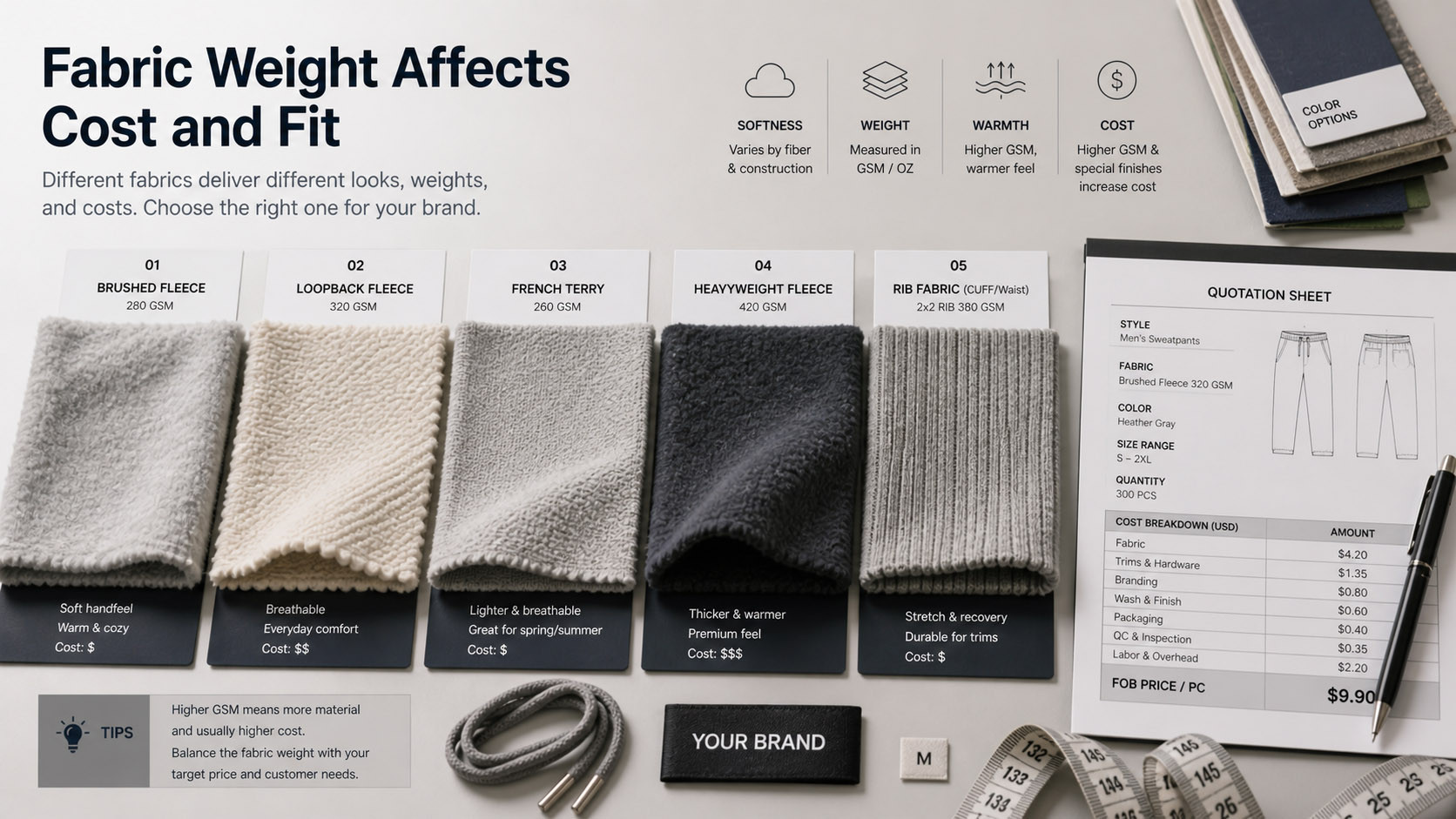
1. Fabric Type and Fabric Weight
Fabric is usually one of the most important cost drivers in custom sweatpants production. The cost changes depending on fabric composition, structure, weight, hand feel, finishing, color, and availability.
Common Fabric Variables
Buyers should confirm:
Brushed fleece, loopback fleece, French terry, or other fabric structure
Cotton, cotton-poly blend, or other composition
Lightweight, midweight, or heavyweight direction
Inside surface feel
Shrinkage behavior
Color requirement
Wash or garment dye requirement
Rib or cuff matching
Fabric availability
A heavier fleece can create a stronger streetwear silhouette, but it may also increase material cost, sewing difficulty, shrinkage concern, and packing volume. A lighter French terry may be more suitable for transitional or year-round sweatpants, but it may not create the same structure as heavyweight fleece.
Why Fabric Cost Can Change Quickly
Fabric cost can change when the buyer requests a special color, uncommon weight, custom dyeing, special brushing, garment wash, or a fabric that is not commonly available. If the fabric needs to be custom developed or sourced from a specific mill, the quotation may change again after confirmation.
For fabric development, wash effects, embroidery, printing, and trim options, buyers can review Vanrd's fabric and technique customization support.
2. Fit Complexity and Pattern Development
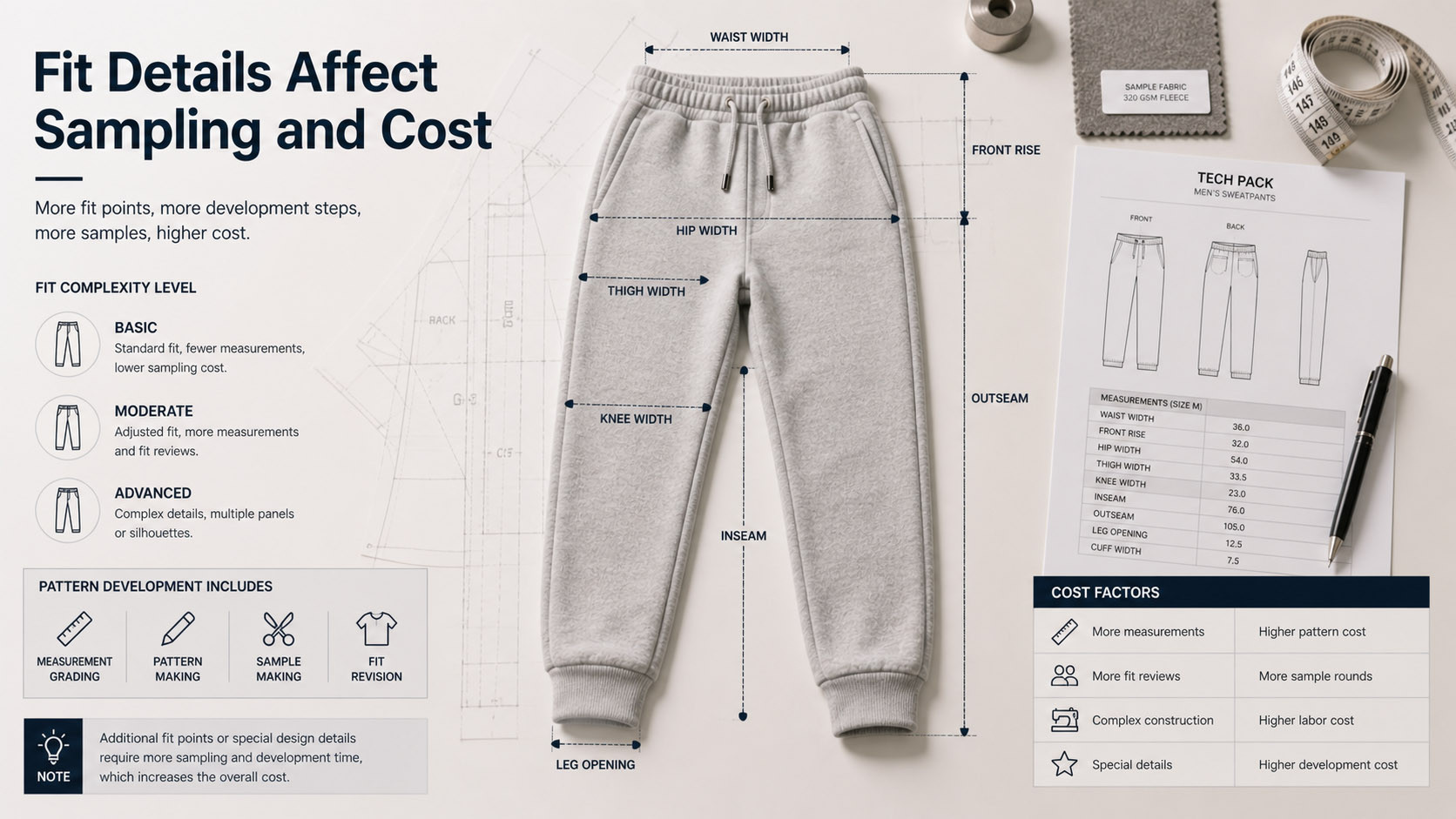
Fit affects cost because it affects pattern work, sample revisions, fabric consumption, and production control. Sweatpants may seem simple, but the difference between baggy sweatpants, joggers, stacked sweatpants, and slim tapered pants can be significant in production.
Fit Details That Affect Cost
Key fit points include:
Waist
Rise
Hip
Thigh
Knee
Inseam
Outseam
Leg opening
Cuff width
Overall silhouette
A standard jogger may be easier to develop than a baggy or stacked sweatpants style with a specific streetwear proportion. Baggy sweatpants may use more fabric and require more fit review around rise, thigh, knee, and leg opening. Stacked sweatpants may need extra length and more careful fabric drape testing.
Pattern Development and Revisions
If the brand has a complete tech pack, size chart, and approved fit reference, sampling may be more efficient. If the brand only provides inspiration images without measurements, the manufacturer may need more development work and more sample rounds.
The cost is not only about sewing one sample. It is also about how much clarification, pattern correction, fit adjustment, and approval communication are needed before bulk production.
3. Waistband, Cuffs, and Construction Details
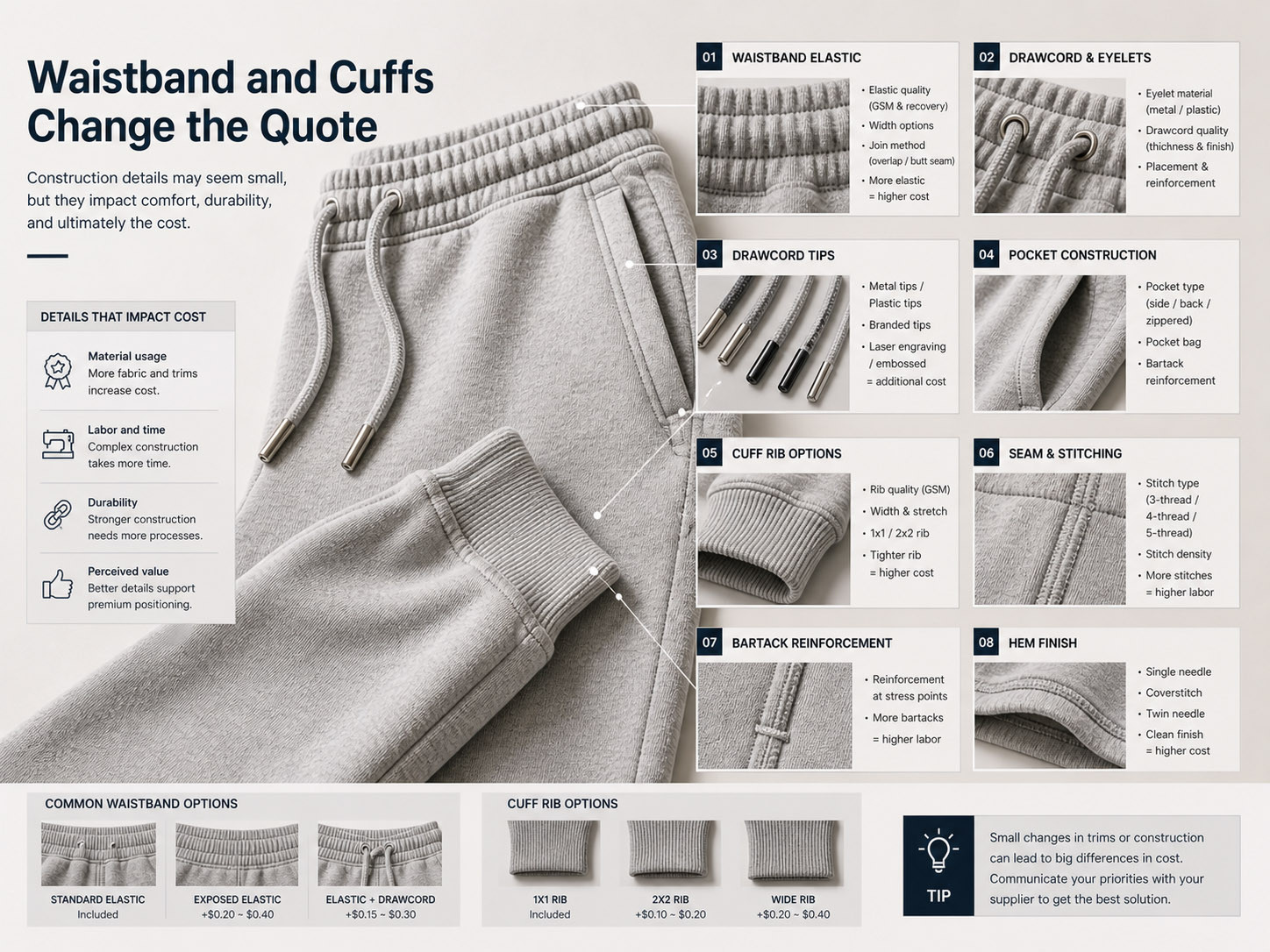
Waistband and cuff construction can change both cost and product quality. These details affect comfort, fit stability, silhouette, and perceived value.
Waistband Cost Factors
The waistband cost can be affected by:
Elastic width
Elastic strength
Waistband height
Drawcord material
Drawcord thickness
Cord tips
Eyelets or buttonholes
Hidden or exposed drawcord
Topstitching method
Inside waistband finish
A simple elastic waistband may cost less than a more structured waistband with premium drawcords, metal tips, branded aglets, reinforced openings, or special stitching.
Cuff Cost Factors
Cuff cost can be affected by:
Rib fabric quality
Cuff height
Cuff opening
Rib recovery
Attachment method
Sewing tension
Leg shape compatibility
For joggers and cuffed sweatpants, the cuff is not a small detail. Weak cuff recovery can reduce the overall quality impression. A heavier fleece may also require stronger rib and more careful sewing.
Pocket and Seam Construction
Pocket type, pocket bag material, reinforcement, side seam detail, flatlock stitching, double-needle stitching, or extra panel construction can also affect cost. More construction details usually mean more production time and more inspection points.
4. Logo Technique and Branding Requirements
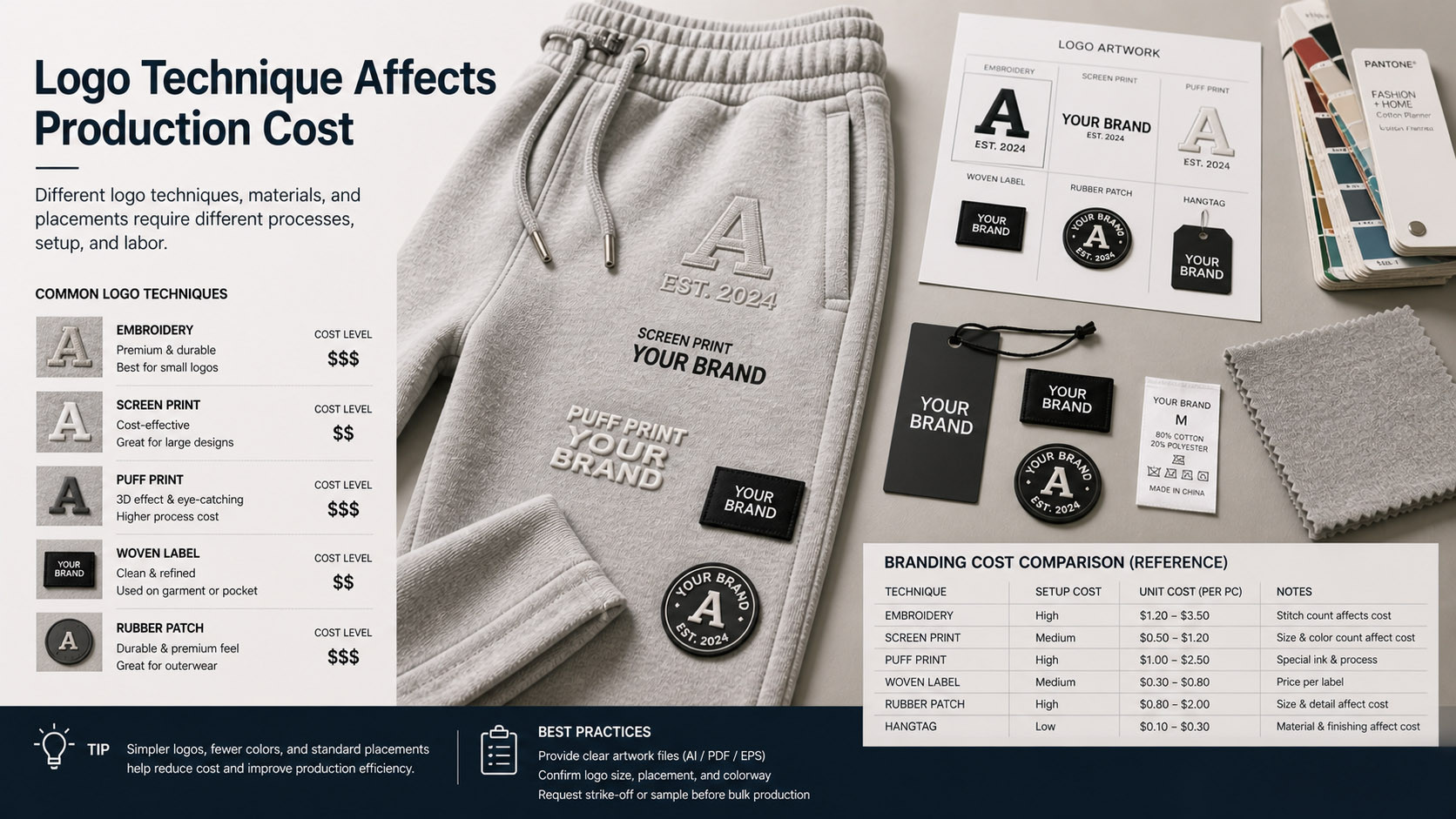
Branding can strongly affect custom sweatpants cost. A simple small print is different from large embroidery, applique, rhinestone placement, custom woven patch, or multiple branding positions.
Common Branding Methods
Sweatpants may use:
Screen print
Puff print
Heat transfer
Embroidery
Applique
Woven patch
Rubber patch
Rhinestone decoration
Reflective print
Custom woven labels
Custom hangtags
Custom packaging
Each method has different setup requirements, labor requirements, material costs, and inspection points. The cost may also change based on artwork size, color count, placement, quantity, and compatibility with wash or garment dye.
Placement Also Matters
A logo on the left thigh may be easier than a large side-leg print or multi-position branding. Leg placement needs careful alignment because the garment shape changes across sizes. Embroidery and patches may also need backing, reinforcement, and placement testing.
Private Label Branding
Private label projects often include main labels, size labels, care labels, hangtags, packaging stickers, and carton labels. These items may seem small, but they affect total project cost, approval timeline, and production coordination.
5. Wash, Dye, and Finishing Processes
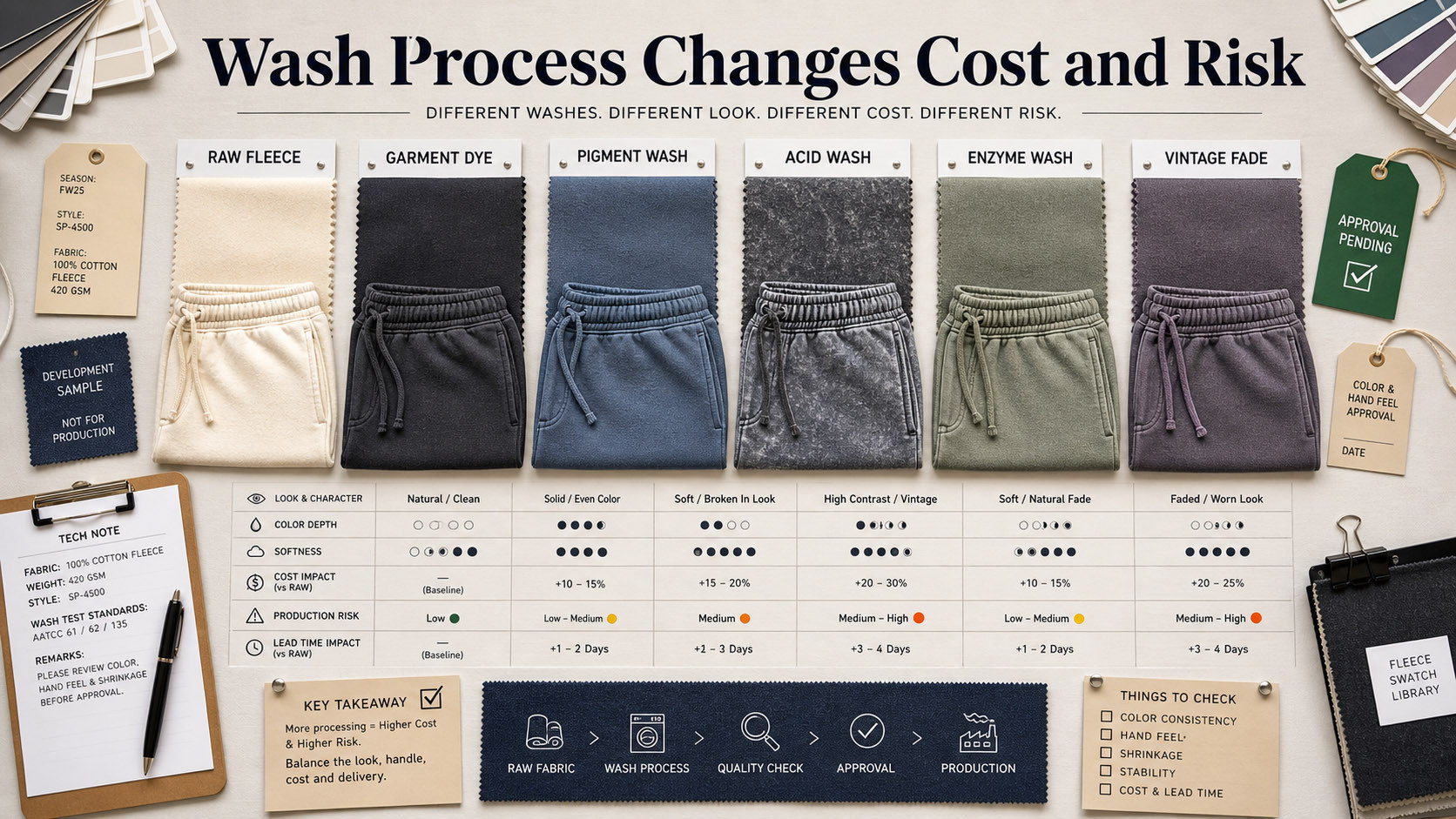
Wash and finishing processes can affect both appearance and cost. Garment dye, pigment wash, acid wash, enzyme wash, vintage wash, or faded effects can require additional testing, processing, and QC control.
Wash Processes That Can Affect Cost
Common options include:
Garment dye
Pigment wash
Acid wash
Enzyme wash
Vintage wash
Faded wash
Distressing
Special hand-feel finishing
These processes can change fabric hand feel, shade, shrinkage, measurements, and logo appearance. A washed sweatpants program may require more sample testing than a non-washed style.
Why Wash Adds Production Risk
Wash effects can vary across fabric lots, garment positions, colors, and sizes. If the buyer expects a specific shade or vintage effect, the factory needs a clear reference and approval standard. Without this, the final goods may not match the buyer's expectation closely enough.
Wash and Logo Compatibility
If sweatpants include print, embroidery, patch, or rhinestone details, the decoration should be tested with the wash or finishing process. Some methods may need to be applied before wash, while others may be safer after wash depending on the technique.
6. MOQ, Quantity, and Production Efficiency
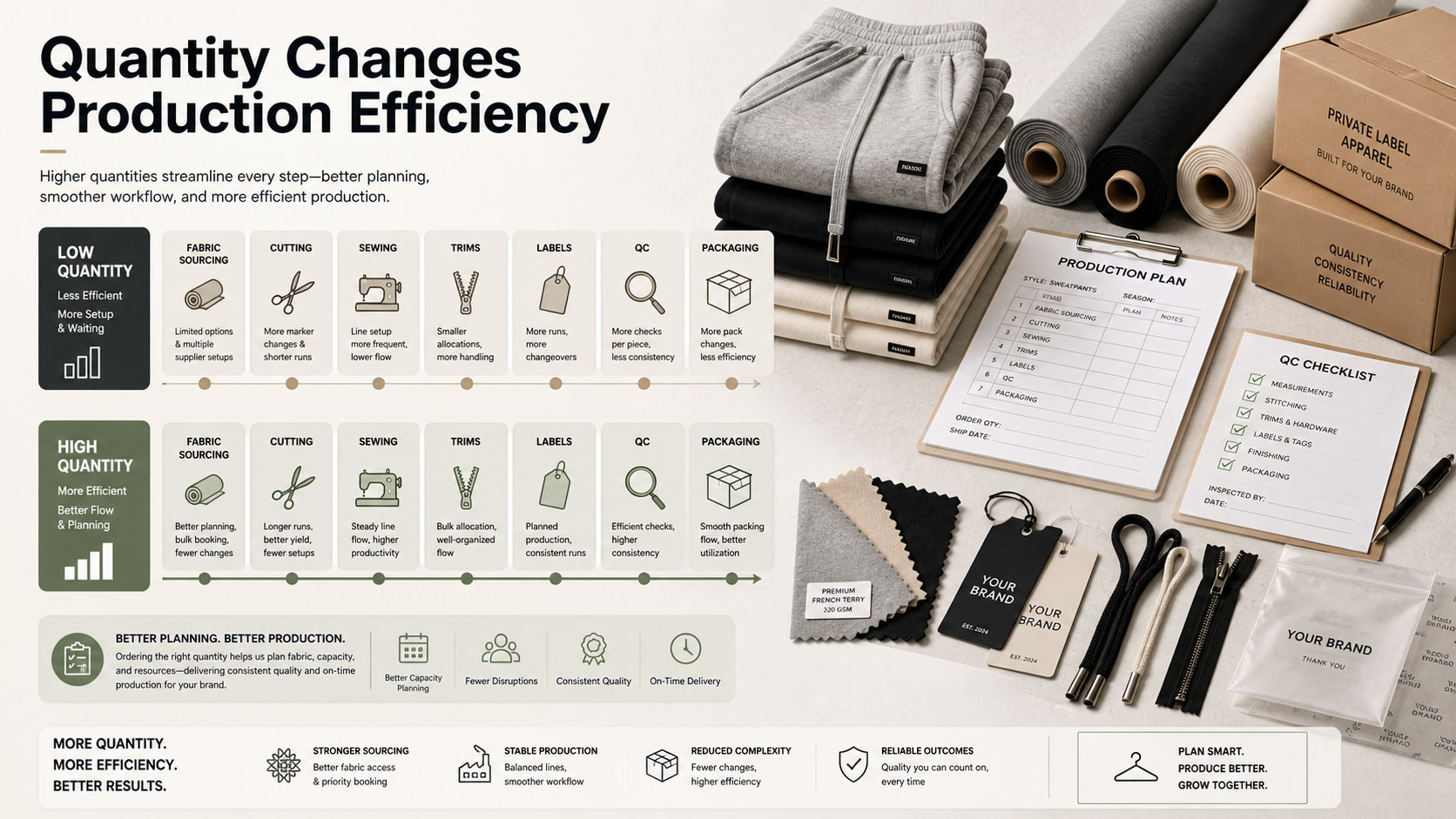
MOQ affects sweatpants cost because production efficiency changes with quantity. Fabric sourcing, cutting, sewing, trimming, packaging, and QC all become more efficient when order planning is clearer.
How Quantity Affects Unit Cost
Quantity can affect:
Fabric purchase efficiency
Dyeing or wash feasibility
Cutting efficiency
Trim ordering
Label and packaging cost
Production line planning
QC time allocation
Packing and carton planning
Small quantities can be useful for testing, but they may have a higher per-piece cost because setup work is spread across fewer units. Larger quantities may improve production efficiency, but they also require stronger planning and clearer approval standards.
Why MOQ Is Not Only a Factory Rule
MOQ is often connected to fabric mills, trim suppliers, dyeing or washing suppliers, label suppliers, and production planning. Even when the garment factory is flexible, some materials or processes may have their own minimum requirements.
How Brands Should Discuss MOQ
Instead of asking only "What is your MOQ?" brands should explain:
Target first order quantity
Expected repeat order potential
Number of colors
Number of sizes
Fabric direction
Logo and label requirements
Packaging needs
Sampling stage
This helps the manufacturer understand whether the project is a test order, capsule drop, wholesale program, or long-term private label plan.
7. Sampling, Revisions, and Approval Workflow
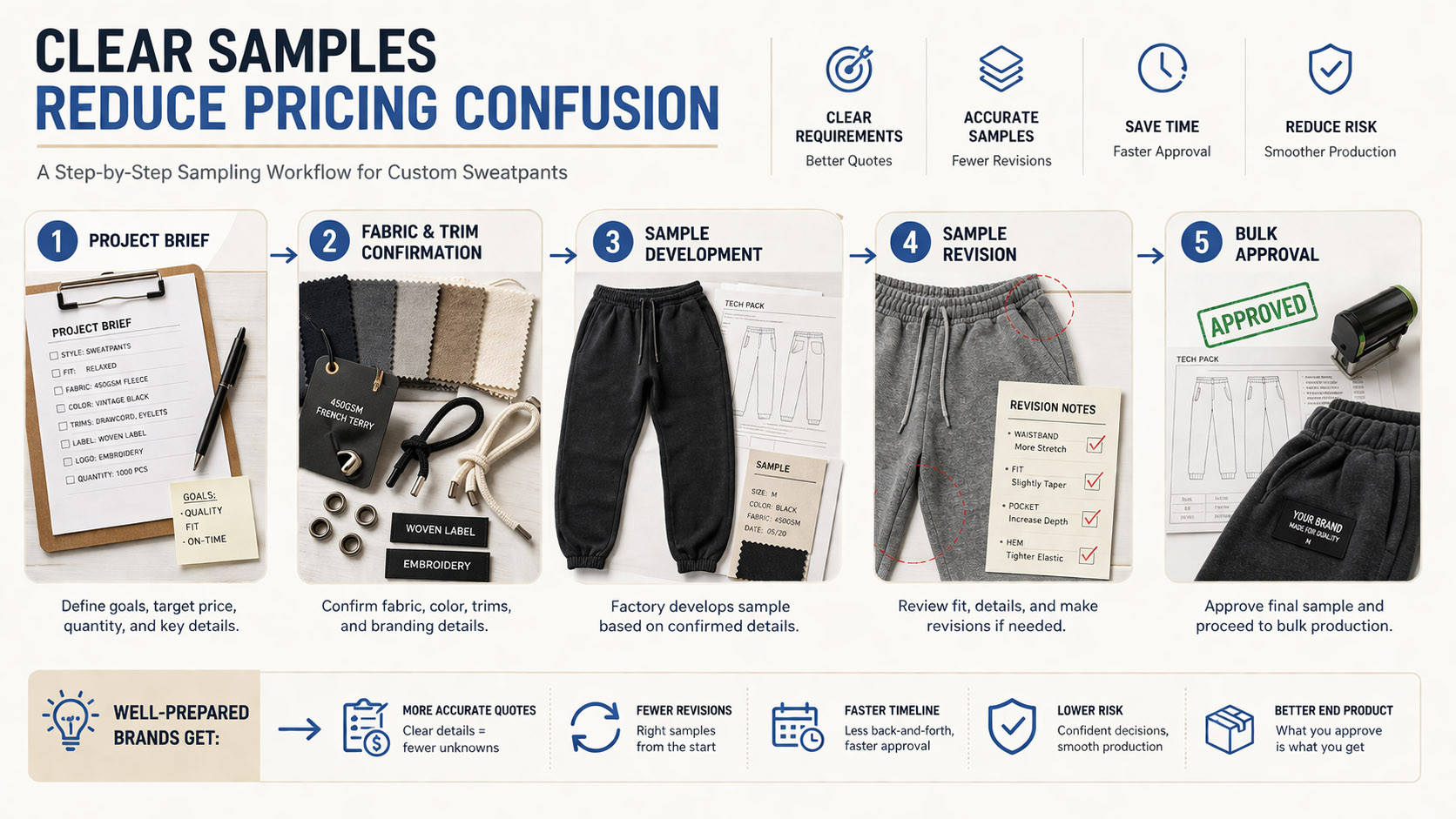
Sampling affects cost because it involves pattern development, fabric sourcing, trim preparation, sewing, decoration testing, and revision communication. A complex sample may require more work before it is ready for bulk approval.
What Can Increase Sample Cost
Sample cost can be affected by:
Incomplete tech pack
Custom pattern development
Special fabric sourcing
Custom dye or wash testing
Multiple logo methods
Custom trims
Repeated fit revisions
Urgent timeline
Complex packaging request
A sample is not only one garment. It is a development step used to confirm whether the fabric, fit, waistband, cuffs, branding, and QC standard can work in production.
How to Reduce Sample Revision Cost
Brands can reduce unnecessary sample revisions by preparing better files before development. A clear brief helps the factory understand what is confirmed and what still needs recommendation.
Before sampling, prepare:
Reference images
Tech pack if available
Size chart
Fabric direction
Fit direction
Waistband and cuff requirements
Pocket layout
Logo artwork
Target quantity
QC expectations
Vanrd's custom apparel service process explains how sampling, approval, and production communication can be structured for custom apparel projects.
8. Packaging, Labels, and Private Label Details
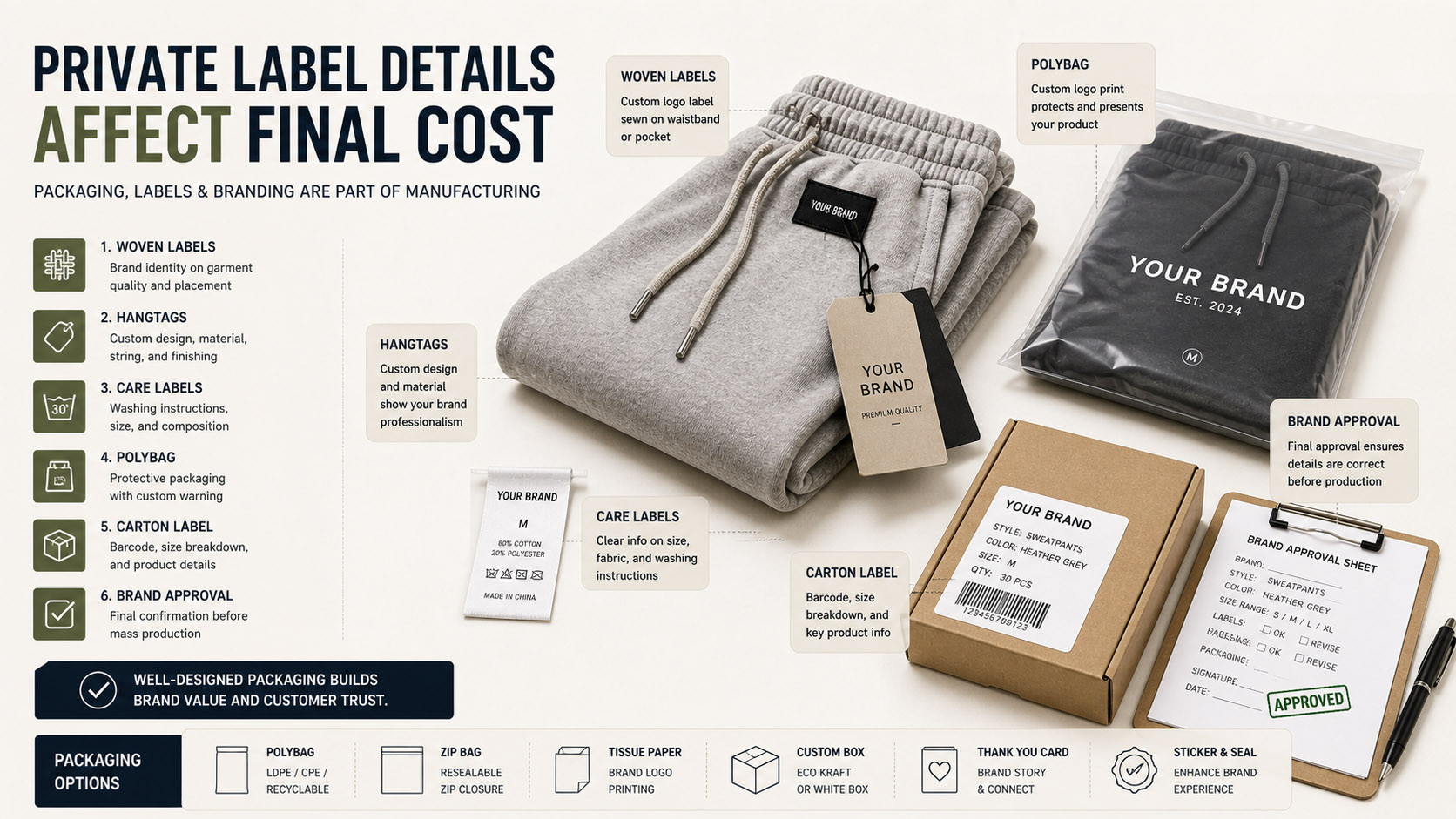
Private label packaging can change the final cost because it includes additional materials, approval steps, and packing labor. These details matter for brands selling through wholesale, ecommerce, retail, or distribution channels.
Packaging and Label Cost Factors
Cost may be affected by:
Main label
Size label
Care label
Woven label
Hangtag
Sticker
Polybag
Barcode label
Folding method
Carton marking
Custom packaging design
Basic packaging is usually simpler than a full private label package. If the buyer needs custom bags, branded stickers, hangtags, barcode labels, or specific folding methods, these requirements should be discussed before quotation.
Why Packaging Should Be Confirmed Early
Packaging requirements can affect lead time, material ordering, packing labor, carton planning, and final inspection. If packaging is added late, the quote and production plan may need to be updated.
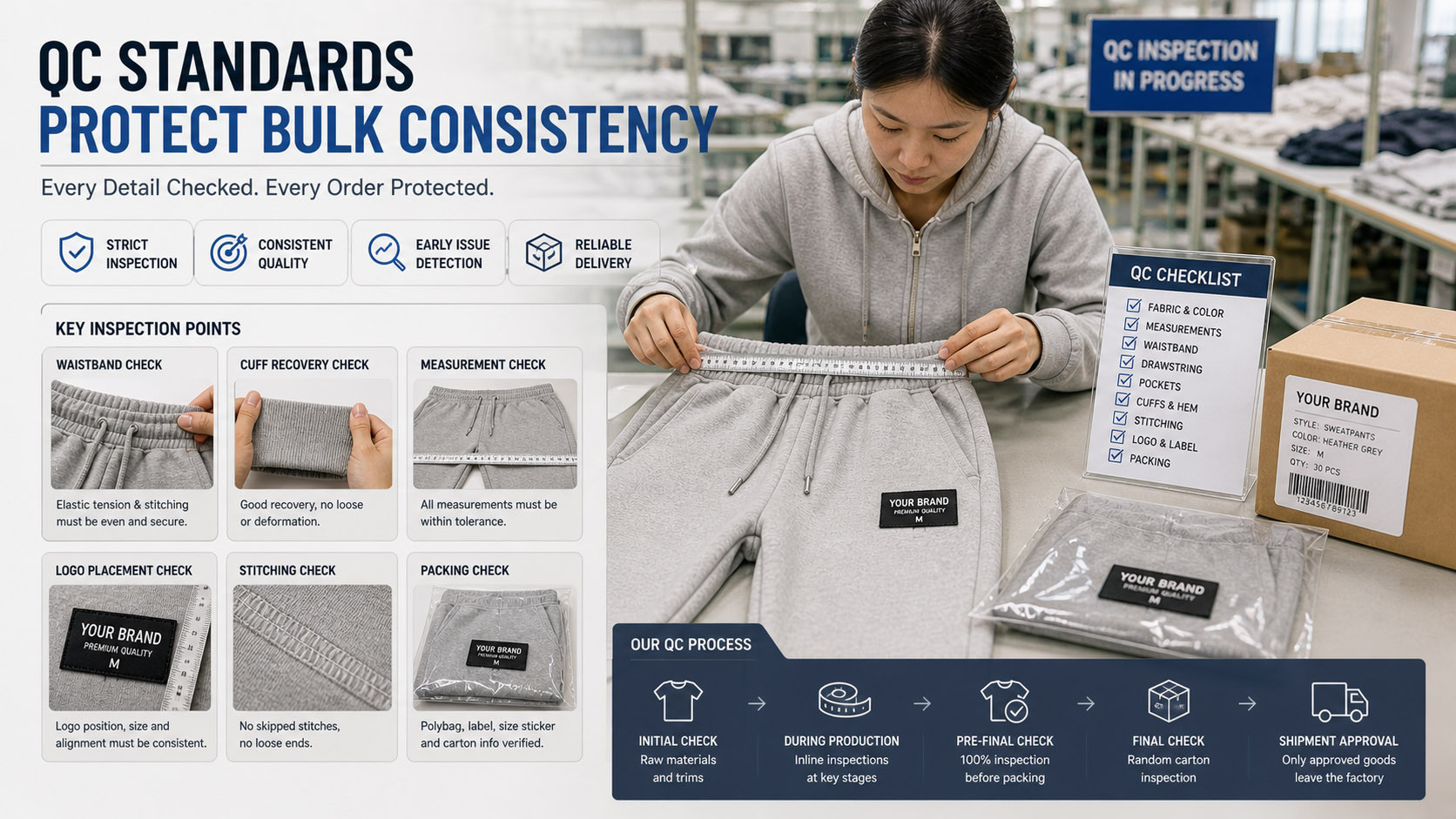
9. QC Standards and Inspection Requirements
QC affects cost because stronger inspection standards require more checking, clearer tolerances, and more production control. However, unclear QC can create bigger problems later, especially for private label brands.
QC Points That Affect Sweatpants Production
Important QC points include:
Fabric quality
Color consistency
Shrinkage
Waist measurement
Rise
Inseam
Leg opening
Cuff recovery
Waistband tension
Pocket placement
Logo placement
Stitching
Loose threads
Packing consistency
Why QC Should Be Discussed Before Bulk Production
If the buyer and factory do not align on tolerance and inspection criteria, the same issue may be judged differently. For example, a small measurement variation may be acceptable in one project but not acceptable in another if the buyer has strict size standards.
Clear QC standards can help reduce disputes and improve bulk consistency. For inspection and quality control planning, buyers can review Vanrd's quality control and inspection standards.
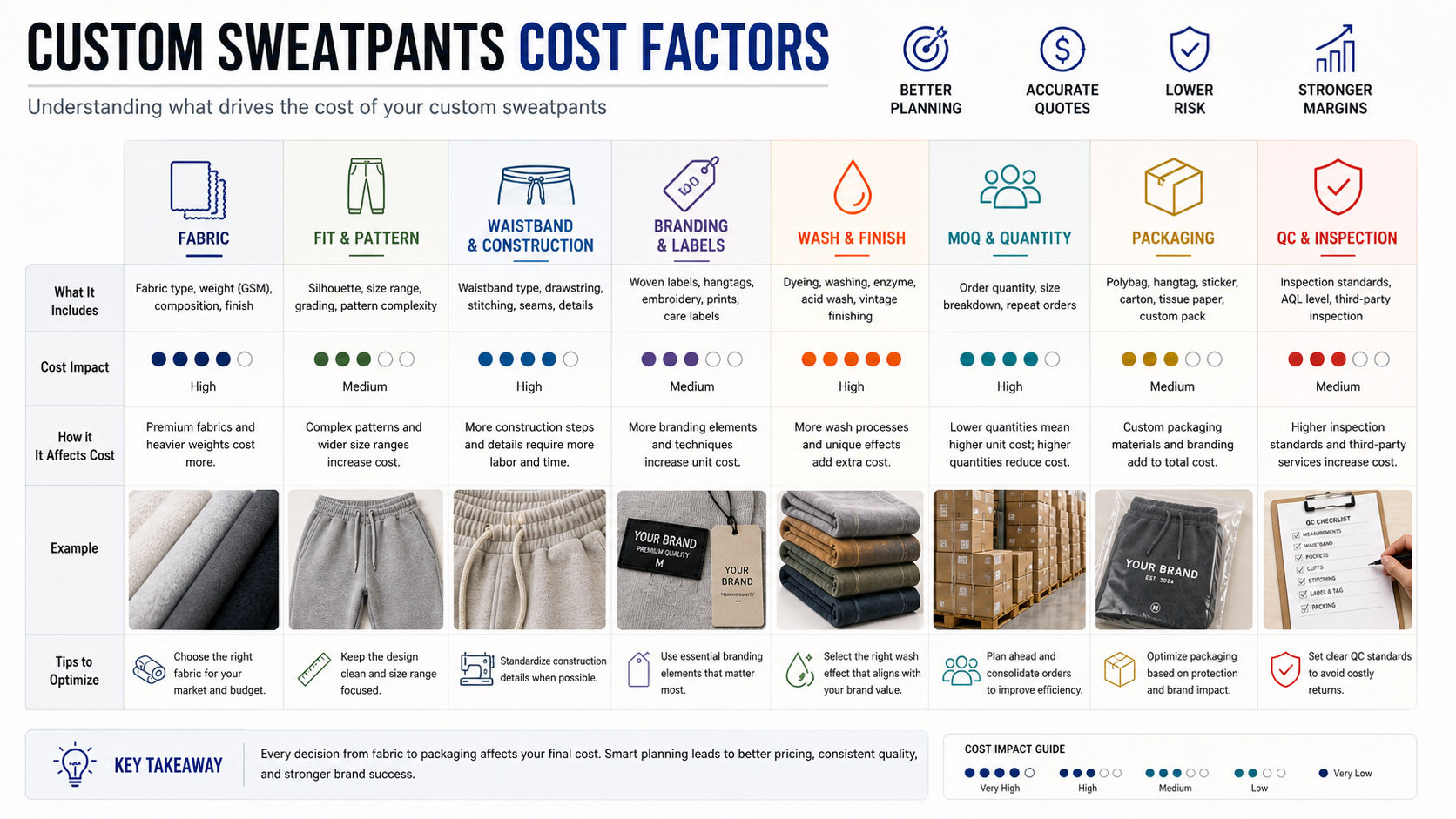
10. Cost Factor Comparison Table
| Cost Factor | Why It Affects Price | What Brands Should Confirm |
Fabric type | Different fabrics have different sourcing, finishing, and performance requirements | Fabric structure, composition, hand feel, color, shrinkage |
| Fabric weight | Heavier fabric can increase material use, sewing difficulty, and packing volume | Lightweight, midweight, or heavyweight direction |
Fit complexity | More complex silhouettes may need more pattern work and revisions | Rise, thigh, inseam, leg opening, cuff width |
Waistband | Elastic, drawcord, stitching, and finish change construction cost | Elastic width, drawcord type, waistband height |
Cuffs | Rib quality and recovery affect both cost and quality | Cuff height, rib quality, cuff opening |
Logo technique | Different decoration methods require different setup and labor | Print, embroidery, patch, applique, rhinestone |
| Wash process | Wash can add testing, shrinkage control, and QC risk | Wash reference, shade standard, shrinkage expectation |
| MOQ | Quantity affects production efficiency and material sourcing | Target quantity, sizes, colors, repeat plan |
Packaging | Private label packaging adds materials and labor | Labels, hangtags, polybags, stickers, carton marks |
QC | Inspection requirements affect production control | Tolerance, logo standard, packing inspection |
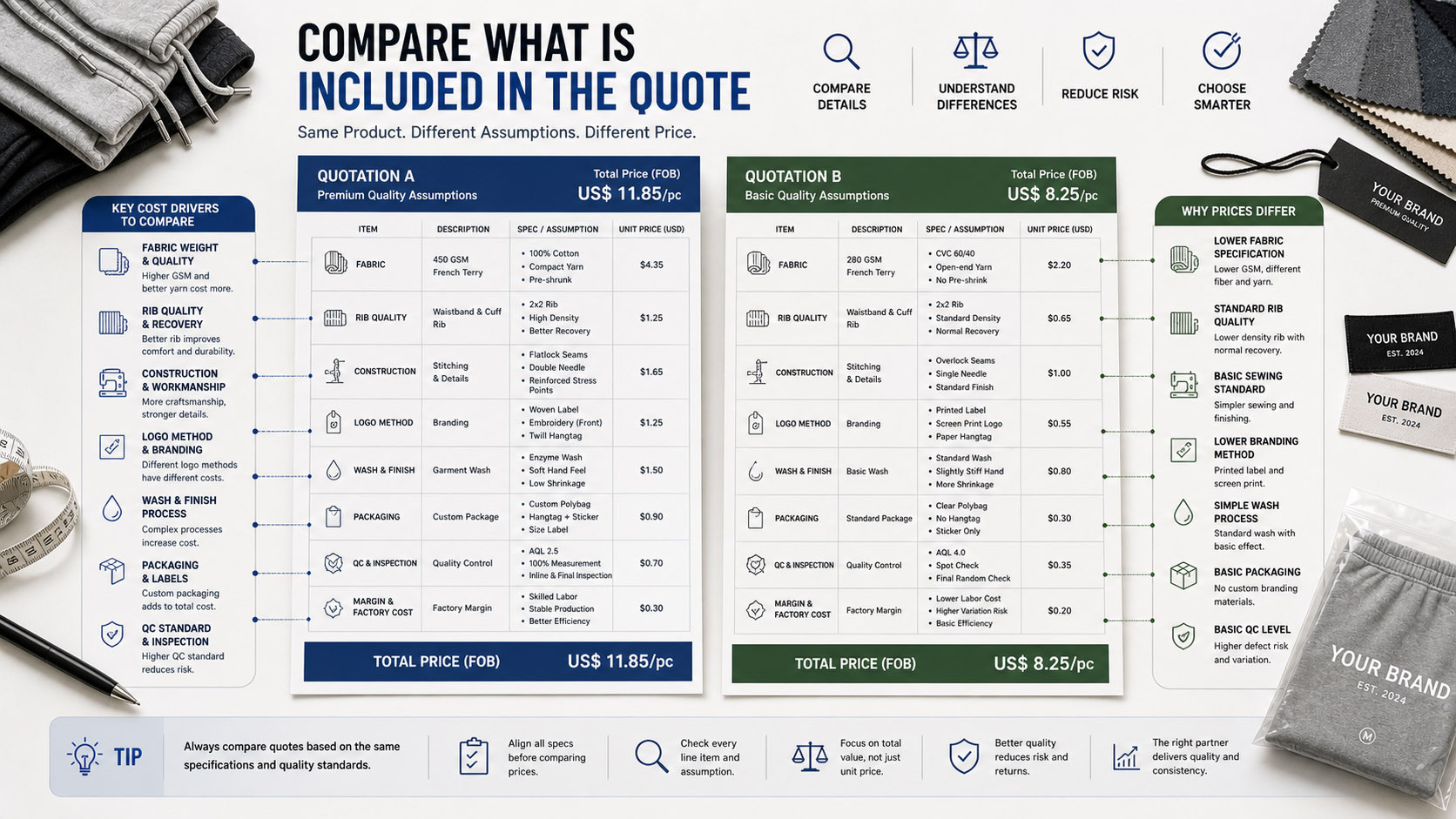
11. Factory Reality: Why Two Quotes Can Be Very Different
Two custom sweatpants quotes can look very different because the assumptions behind them may not be the same. One quote may include heavier fabric, better rib, sample revision support, private label packaging, and stricter QC. Another quote may assume basic fabric, simple trims, minimal packaging, and limited inspection.
Different Fabric Assumptions
One supplier may quote with standard midweight fleece, while another may assume heavyweight cotton fleece. These two options can produce very different garment results.
Different Construction Assumptions
One quote may include reinforced pockets, stronger waistband elastic, better cuff rib, or more complex stitching. Another may assume a simpler construction.
Different Branding Assumptions
A quote for simple screen print is not the same as a quote for embroidery, applique, rhinestones, or multi-position branding.
Different Packaging Assumptions
Private label packaging, hangtags, barcode labels, and custom polybags can change the final cost and timeline.
Different QC Assumptions
Some quotes include more detailed inspection work, while others may only include basic checks. Buyers should ask what QC points are included before comparing prices.
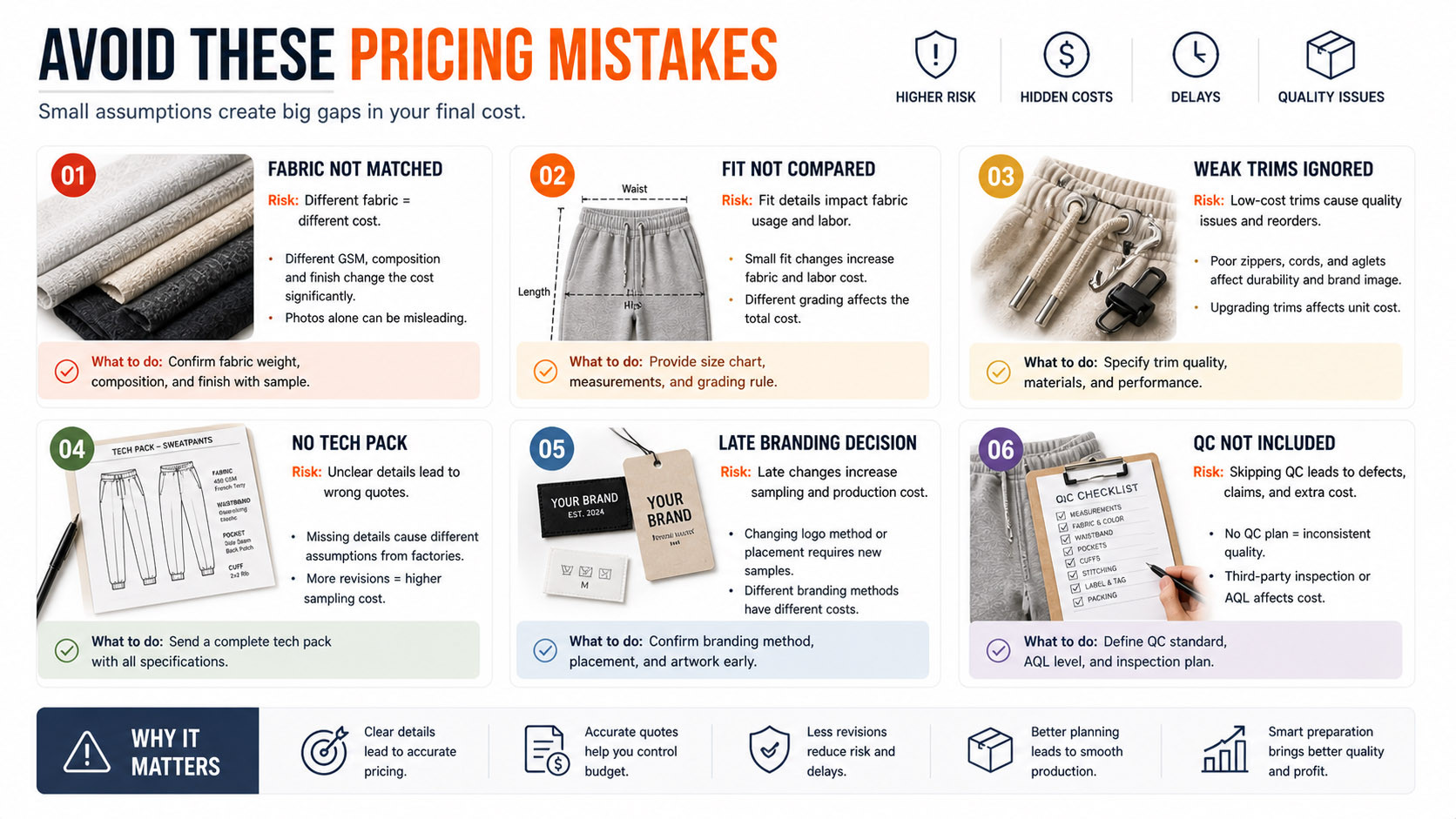
12. Common Mistakes When Comparing Custom Sweatpants Cost
Most pricing mistakes happen when brands compare unit prices without comparing specifications.
Mistake 1: Comparing Quotes Without Matching Fabric
A quote based on lightweight French terry should not be compared directly with a quote based on heavyweight brushed fleece. Fabric details should be aligned first.
Mistake 2: Ignoring Fit and Fabric Consumption
Baggy sweatpants, stacked sweatpants, and wide-leg sweatpants may use more fabric than basic joggers. More fabric can affect cost.
Mistake 3: Forgetting Waistband and Cuff Quality
A lower price may use weaker elastic, cheaper drawcords, or lower-recovery cuff rib. These details affect the final product experience.
Mistake 4: Asking for Price Before Providing Clear Files
If the buyer only sends a photo and asks for a price, the supplier must make assumptions. The quote may change later when details are clarified.
Mistake 5: Adding Branding or Packaging Too Late
Late branding or packaging changes can update the cost, timeline, and production plan.
Mistake 6: Choosing the Lowest Quote Without QC Details
A low quote may not include the same inspection standard. Brands should confirm measurement tolerance, logo placement standard, packing inspection, and final QC process.
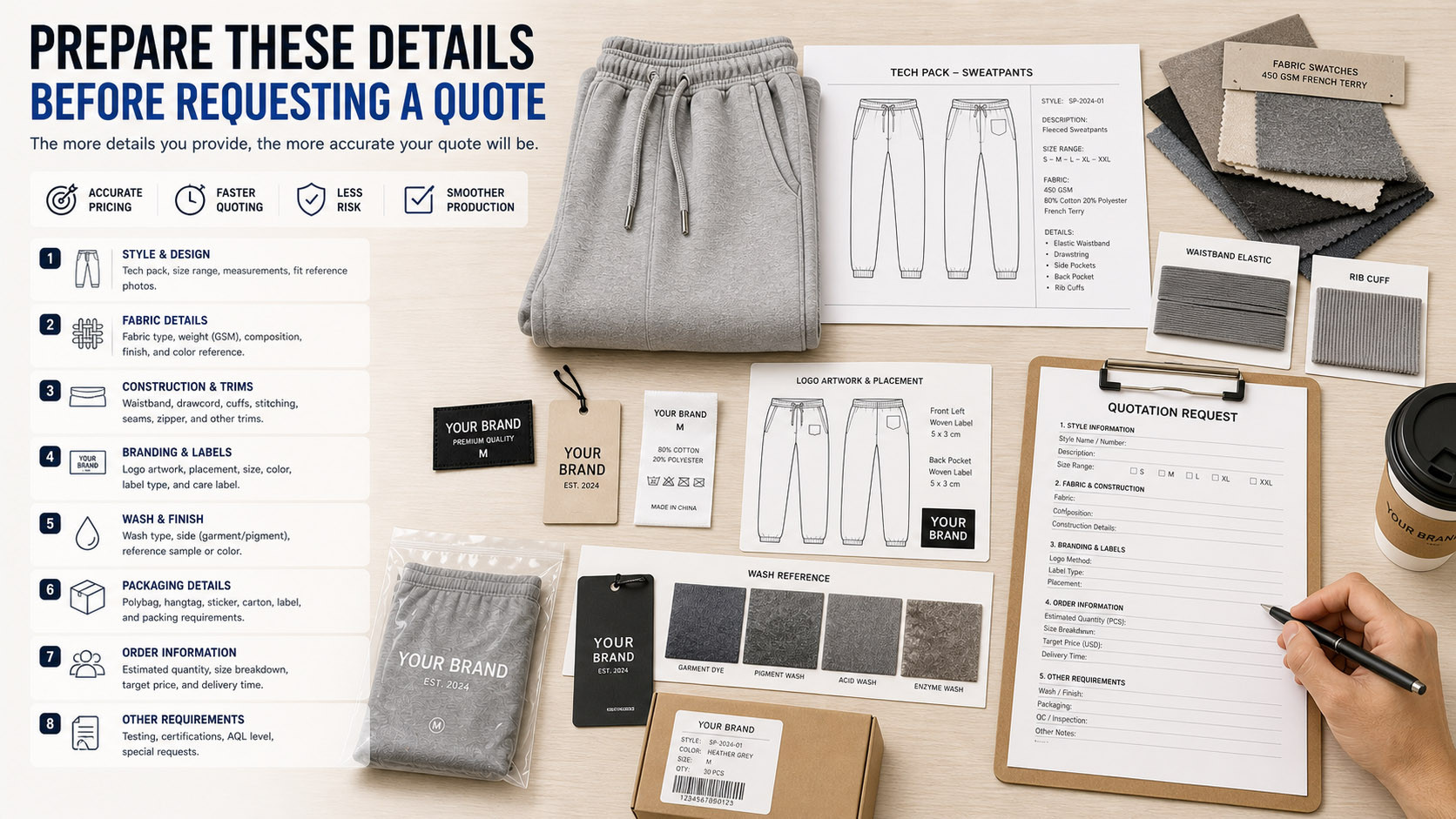
13. How to Prepare for a More Accurate Sweatpants Quote
A better quote starts with better information. The factory can provide more useful feedback when the buyer explains the product clearly.
Prepare These Details
Sweatpants type
Reference images
Tech pack if available
Size chart
Fabric direction
Fabric weight preference
Target fit
Waistband details
Cuff details
Pocket layout
Logo artwork
Decoration method
Wash requirement
Label and packaging needs
Target quantity
Target timeline
QC expectations
Separate Fixed Details From Open Questions
Some brands already know their fabric, fit, and logo method. Other brands need factory recommendations. Both situations are acceptable, but the buyer should clearly state what is confirmed and what still needs advice.
Ask Suppliers to Quote Based on the Same Assumptions
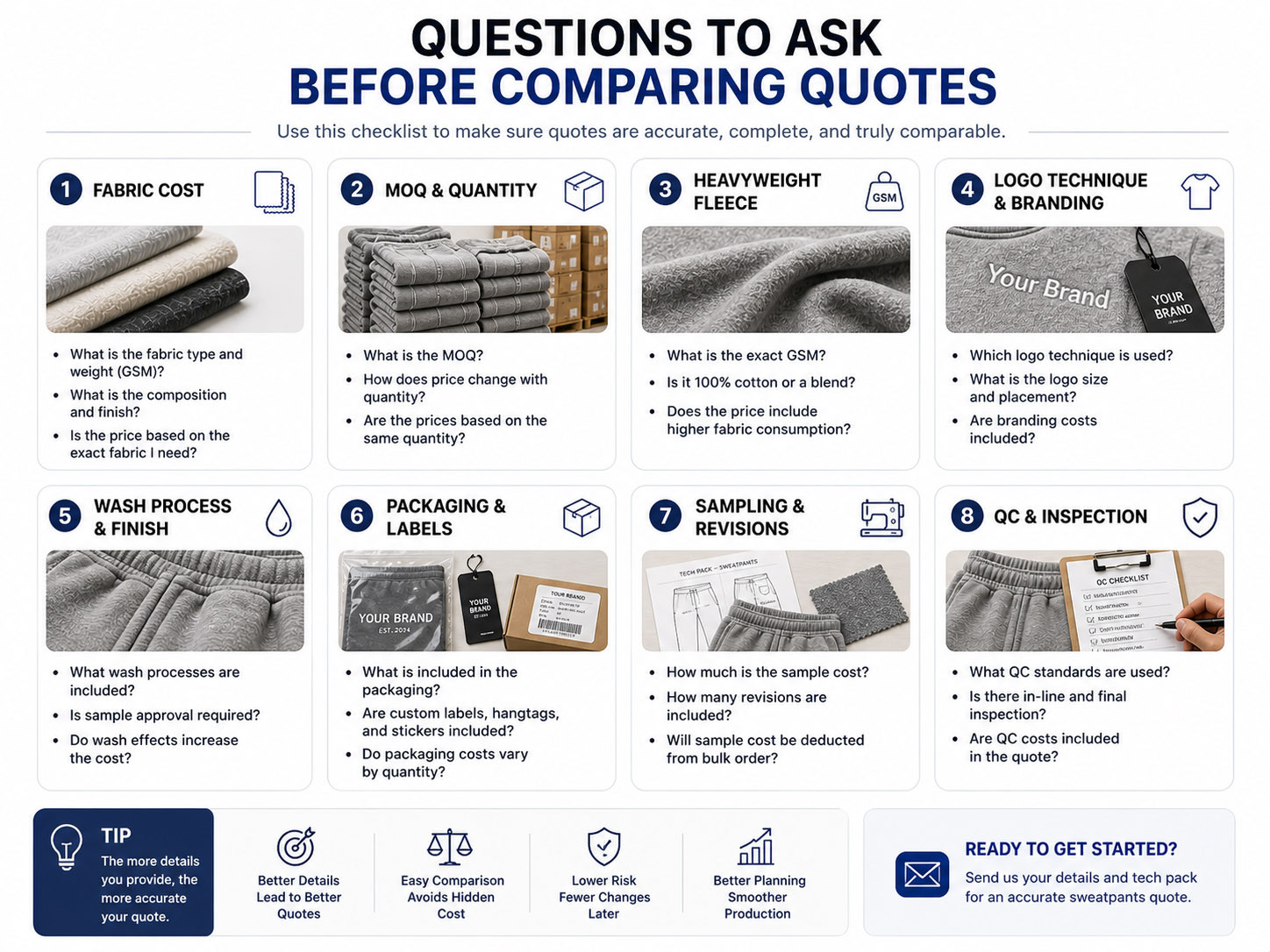
When comparing suppliers, ask each one to quote based on the same fabric, quantity, logo method, packaging, and QC requirements. This makes the comparison more meaningful.
Next Steps Before Requesting a Custom Sweatpants Quote
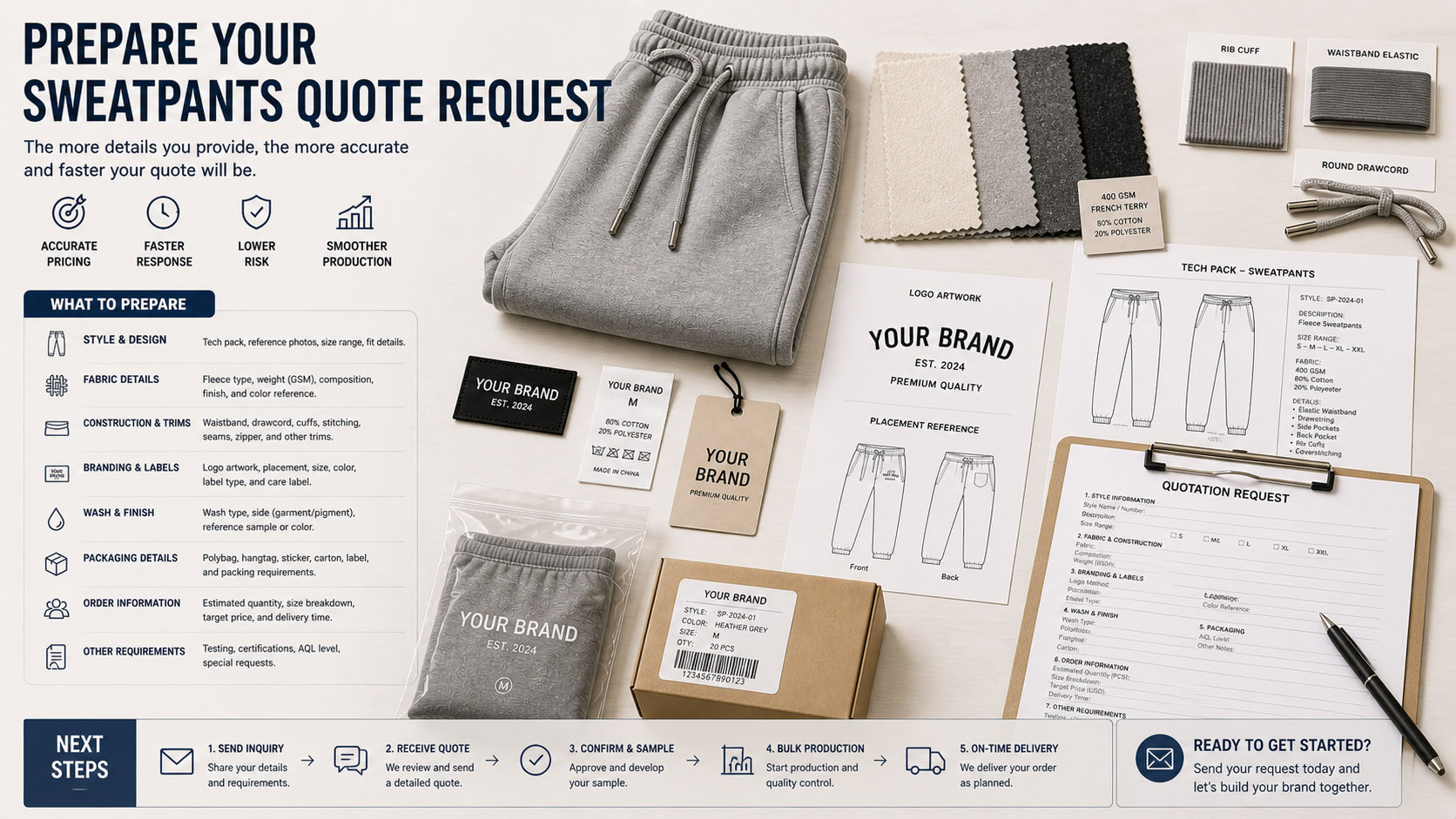
Before requesting a quote, brands should define the relationship between product goal and production requirements. The goal is not to choose the cheapest option. The goal is to understand which fabric, fit, branding, quantity, and QC standard match the brand's target market.
Prepare These Details First
Product type
Target silhouette
Fabric direction
Approximate fabric weight
Waistband and cuff requirements
Logo method
Wash or dye requirement
Label and packaging needs
Target order quantity
Timeline expectation
QC concerns
Vanrd supports private label and streetwear buyers with fabric selection, custom sampling, trim coordination, logo technique support, bulk production, and quality control. Buyers preparing a sweatpants project can also review Vanrd's factory strength before starting development.
FAQ
How much do custom sweatpants cost to manufacture?
Custom sweatpants cost depends on fabric, weight, fit, construction, trims, branding, wash, quantity, packaging, and QC requirements. A manufacturer needs clear specifications before giving a meaningful quote.
Why are heavyweight sweatpants more expensive?
Heavyweight sweatpants can cost more because they may use more expensive fabric, more material, stronger rib or elastic, more careful sewing, and more attention to shrinkage, seams, packing, and QC.
Does MOQ change the price of custom sweatpants?
Yes. MOQ affects fabric sourcing, cutting efficiency, trim ordering, production planning, packaging, and unit cost. Smaller orders may have a higher per-piece cost because setup work is spread across fewer units.
What files should I send to get an accurate sweatpants quote?
Send reference images, tech pack if available, size chart, fabric direction, fabric weight preference, target fit, waistband and cuff details, logo artwork, wash requirement, label and packaging needs, target quantity, and QC expectations.
Are washed sweatpants more expensive than regular sweatpants?
Washed sweatpants can cost more because garment dye, pigment wash, acid wash, enzyme wash, or vintage finishing may require additional testing, processing, shrinkage control, and shade approval.
How can private label brands reduce sweatpants production cost?
Brands can reduce unnecessary cost by preparing clear files, choosing fabric and trims that match the target price, avoiding late changes, confirming logo methods early, and approving samples before bulk production.
Why do different sweatpants manufacturers quote different prices?
Different manufacturers may assume different fabric weights, trims, construction standards, logo methods, packaging requirements, MOQ, QC processes, and sample support. Buyers should compare the specifications behind each quote, not only the unit price.
Final CTA
The cost of custom sweatpants depends on the full production specification, not only the garment type. Fabric, fit, waistband, cuffs, trims, branding, wash, MOQ, packaging, and QC should all be discussed before comparing quotes.
If your brand is developing baggy sweatpants, heavyweight fleece sweatpants, washed sweatpants, joggers, graphic sweatpants, or private label fleece bottoms, send your project brief, tech pack, reference images, and target quantity to Vanrd. Our team can review your requirements and help you plan a clearer quotation and sampling process.
Contact Vanrd through the custom apparel inquiry page to discuss your custom sweatpants cost, sampling, and production requirements.