Sustainable Manufacturing for Streetwear Brands: A Buyer Guide for Material Sourcing, Certifications, Cost, and Lead Time
How established streetwear brands evaluate fabric choices, verify environmental and social claims, manage cost and lead time, and reduce production waste without compromising fit or commercial viability.
TL;DR: Sustainable Manufacturing for Streetwear Brands
- Set requirements first. Decide which materials, certifications, and minimum order quantities (MOQs) your program needs before sampling. Retrofitting sustainability after production is much more expensive.
- Match material to product. Recycled polyester for fleece, recycled nylon for shells, organic cotton for heavyweight pieces, TENCEL for premium drape, hemp blends for workwear-style streetwear.
- Verify claims, do not assume them. Ask for OEKO-TEX, GOTS, GRS/RCS, BSCI, or WRAP documentation with certificate numbers you can check.
- Understand scope vs. transaction certificates. Scope certificates cover the facility, transaction certificates cover the specific shipment.
- Plan for cost, MOQ, and lead time. Sustainable materials typically add 10-20 percent cost and require higher MOQs. Allow 2-4 weeks of additional lead time for certified goods.
- Standard MOQ at VANRD: 100 pcs per color per style for most custom programs.
What Sustainable Apparel Manufacturing Actually Means
Before you evaluate any supplier, it helps to be specific about what "sustainable" means in the apparel context. The term covers a wide range of practices, and not all of them are equally important for streetwear.
In practical terms, sustainable apparel manufacturing usually refers to one or more of the following:
- Material choice. Using recycled, organic, or lower-impact fibers instead of virgin synthetic or conventional cotton.
- Process choice. Lower-impact dyeing, water recycling, and reduced chemical use during fabric finishing.
- Social compliance. Audited working conditions, fair wages, and reasonable hours at the cut-and-sew facility.
- Waste reduction. Marker optimization, remnant reuse, and made-to-order production models.
- Packaging and logistics. Recycled cardboard, biodegradable polybags, and consolidated shipping.
For streetwear brands, the order of priority usually looks like this: material first, certification second, process third, packaging fourth. The reason is simple. Material choices show up on the product label and in your marketing. Certifications give buyers something verifiable to point to. Process improvements are real but rarely visible to the end consumer. Packaging is the easiest win to add later.
There is no universal standard. A brand running a 200-piece micro-drop has very different needs from a brand shipping 20,000 units a season. The right program depends on your customer, your price point, and your distribution channels.
How to Set Sustainability Requirements Before Sampling
Sustainability works best when it is built into the tech pack, not added after the first sample arrives. Once a sample is approved in a non-sustainable fabric, switching mid-stream usually means re-dyeing, re-cutting, and re-testing. The cost adds up quickly.
Here is the sequence that established streetwear brands tend to follow:
- Define the claim. Decide what you actually want to say on the product page and hangtag. "Made with recycled materials" is a different claim from "100 percent organic cotton" or "GOTS-certified."
- Identify the fabric category. Recycled polyester, organic cotton, recycled nylon, TENCEL, or hemp blend. Each has different cost, lead time, and minimum order implications.
- Identify the certification scope. Do you need chemical safety (OEKO-TEX), organic chain-of-custody (GOTS), recycled content verification (GRS/RCS), or social compliance (BSCI, WRAP)? These are separate, not interchangeable.
- Set the cost ceiling. Sustainable materials usually add 10-20 percent to fabric cost. If your retail margin cannot absorb that, the program will not survive.
- Set the MOQ. Standard MOQ at VANRD is 100 pcs per color per style. Some certified fabrics require higher minimums because of mill minimum dye lot sizes.
- Lock the lead time expectation. Certified fabric sourcing typically adds 2-4 weeks versus non-certified equivalents.
If you complete this list before sampling, your sales conversation becomes much simpler. You can ask suppliers specific questions and compare apples to apples.
Sustainable Materials for Different Streetwear Products
Not every sustainable fabric suits every streetwear product. Here is how the main options break down.
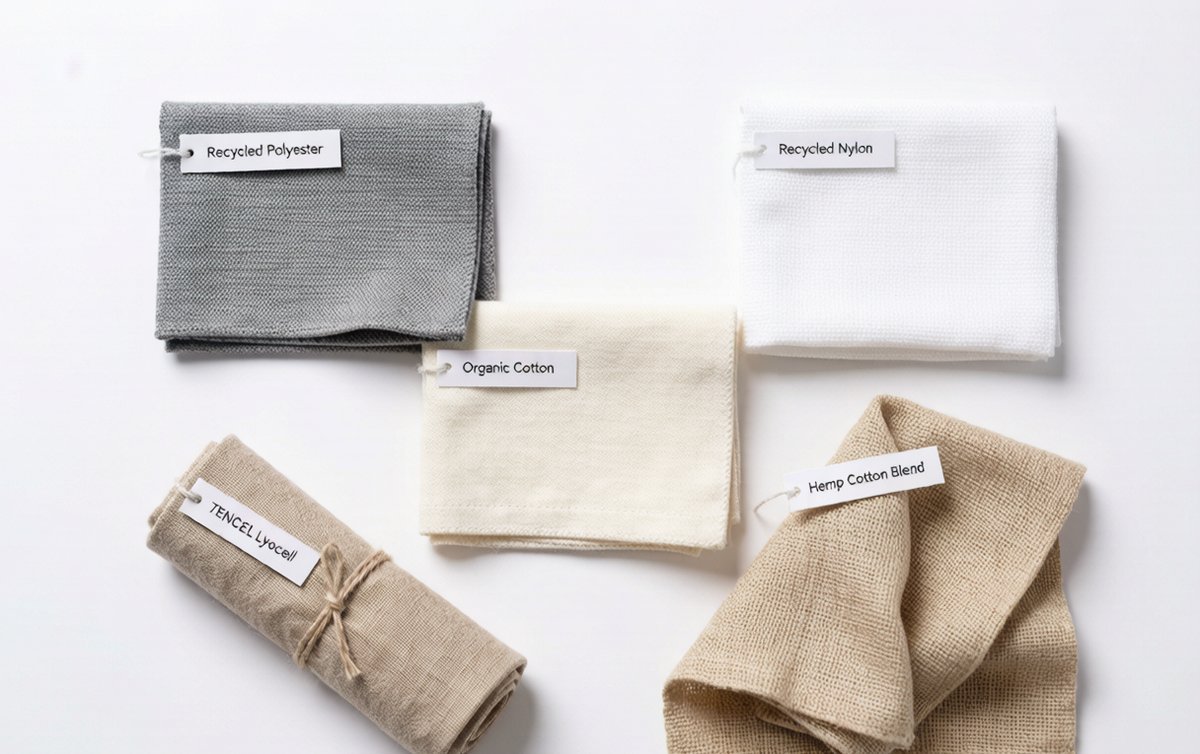
Five common sustainable streetwear fabrics, side by side: recycled polyester, recycled nylon, organic cotton, TENCEL Lyocell, and hemp blend
Recycled Polyester (rPET)
Recycled polyester is made from post-consumer plastic bottles or post-industrial polyester waste. It performs similarly to virgin polyester in terms of strength, color retention, and washability, and is the most widely available sustainable option for fleece tracksuits, performance hoodies, lightweight wind shells, and lining fabrics. Recycled polyester usually carries GRS (Global Recycled Standard) or RCS (Recycled Claim Standard) certification, which verifies the recycled content claim.
Cost impact: typically 10-20 percent over virgin polyester. Lead time: usually similar to virgin polyester for stocked variants, but may add 1-2 weeks for custom colors.
Recycled Nylon
Recycled nylon (often ECONYL from fishing nets and carpet waste, or pre-consumer industrial scrap) is the nylon equivalent of rPET. It works well for technical outerwear, wind shells, and any streetwear piece where nylon is part of the construction. Like rPET, recycled nylon usually carries GRS or RCS certification.
Cost impact: higher than recycled polyester, often 20-30 percent over virgin nylon. Lead time: variable, depending on whether the supplier stocks the variant or has to mill to order.
Organic Cotton
Organic cotton is grown without synthetic pesticides or GMO seeds. For streetwear, it is the right choice for heavyweight hoodies, oversized tees, sweatpants, and any product where the hand feel is part of the brand story. GOTS (Global Organic Textile Standard) certification verifies the organic chain of custody from farm to finished fabric.
Cost impact: typically 20-40 percent over conventional cotton. Lead time: usually 2-3 weeks longer for GOTS-certified sourcing. MOQ: VANRD offers GOTS-certified organic cotton at our standard MOQ of 100 pcs per color per style, with upstream mill minimums managed through our established supply chain.
TENCEL Lyocell
TENCEL Lyocell is a regenerated cellulose fiber made from sustainably sourced wood pulp, manufactured in a closed-loop solvent process. It is soft, drapes well, and wicks moisture, which makes it a good fit for premium streetwear pieces where you want a refined hand feel without resorting to synthetic performance fibers.
Cost impact: noticeably higher than cotton or polyester, often in line with premium cotton price points. Lead time: similar to cotton. Availability: less common than rPET or organic cotton, so plan ahead.
Hemp and Cotton Blends
Hemp blends (typically hemp-cotton or hemp-polyester) are durable, breathable, and soften with wear. The aesthetic suits workwear-inspired streetwear, chore coats, cargo pants, and utility vests. Hemp is also a low-input crop, which makes the raw material story straightforward.
Cost impact: variable, often similar to organic cotton depending on blend ratio. Lead time: usually 2-3 weeks longer. Availability: fewer mill options, so color and weight selection is more limited than mainstream fibers.
Material Comparison Table
Here is a side-by-side summary to support sourcing decisions. Cost and lead time figures are general ranges based on our experience, not contractual numbers, and will vary by supplier, region, and order volume.
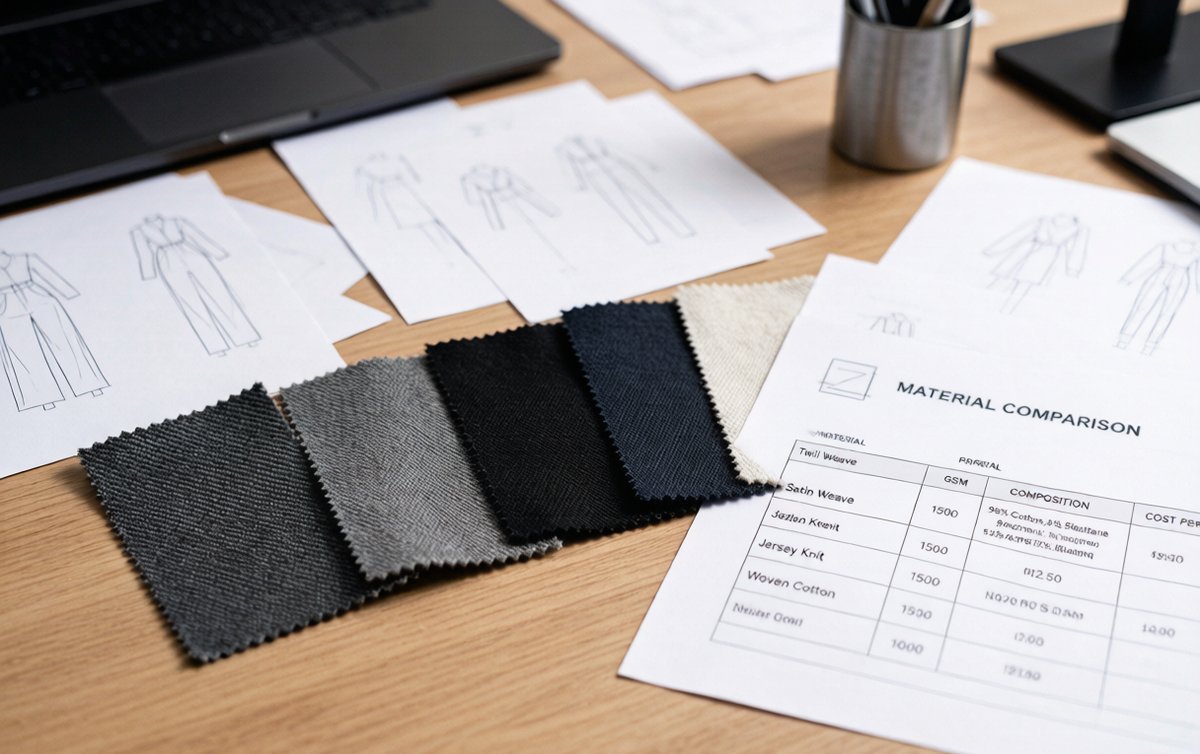
Material comparison worksheet with GSM, composition, and cost reference
| Material | Best For | Typical Cost vs. Virgin | Lead Time Impact | Key Certification |
|---|---|---|---|---|
| Recycled Polyester (rPET) | Fleece, hoodies, linings, light shells | +10-20% | Similar to virgin | GRS / RCS |
| Recycled Nylon | Technical outerwear, shells | +20-30% | +1-3 weeks | GRS / RCS |
| Organic Cotton | Heavyweight hoodies, tees, sweatpants | +20-40% | +3-4 weeks | GOTS |
| TENCEL Lyocell | Premium drapey pieces, lightweight | Higher than cotton | Similar to cotton | FSC (wood sourcing) |
| Hemp / Cotton Blends | Workwear, cargo pants, chore coats | Variable | +2-3 weeks | Limited options |
The table is a starting point. Actual pricing depends on order volume, fabric mill, country of origin, and current market conditions. Always request a written quote for your specific program.
Dyeing, Washing, and Finishing Options
Fabric choice gets most of the marketing attention, but dyeing and finishing are where the heaviest water and chemical use happens. Here is a quick rundown of what to ask your supplier about.
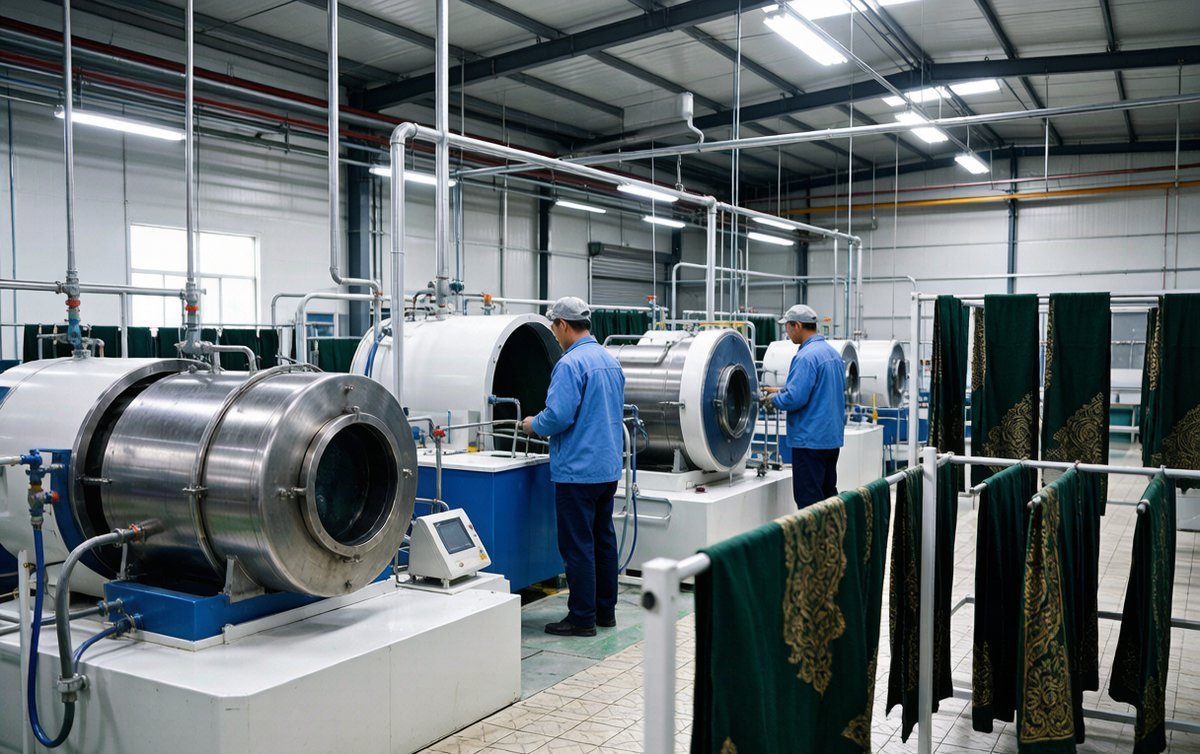
Textile dyeing workshop with low-impact dye equipment and water treatment system
Low-Impact Dyes
Low-impact dyes are formulated to have a higher absorption rate, which means less dye is flushed out in the wastewater. They are a meaningful step up from conventional reactive dyes and are widely available in Asia at modest cost premium.
Waterless and Low-Water Dyeing
Waterless dyeing systems (such as supercritical CO2) exist and are commercially available, but adoption is still limited. Most facilities in our network use advanced wastewater treatment combined with conventional or low-impact dyeing, rather than fully waterless systems. If a supplier claims waterless dyeing, ask which technology they use and at what scale.
Ozone Washing and Enzyme Finishing
For denim and vintage-wash pieces, ozone washing replaces chlorine-based bleaches, and enzyme finishing replaces pumice stones. Both reduce water and chemical use without sacrificing the distressed look. These are mature technologies and widely available.
Wastewater Treatment
Any supplier doing wet processing should have a wastewater treatment system in place, either on-site or through a licensed partner. Ask to see the treatment flow and the most recent discharge compliance records. A good factory will provide this without hesitation.
How to Verify Environmental and Social Claims
This is the part that separates a real sustainable program from a marketing one. Certifications are verifiable documents, not adjectives on a product page. The list below covers the certifications you will encounter most often, what each one actually verifies, and what to ask for when you want to confirm a claim.
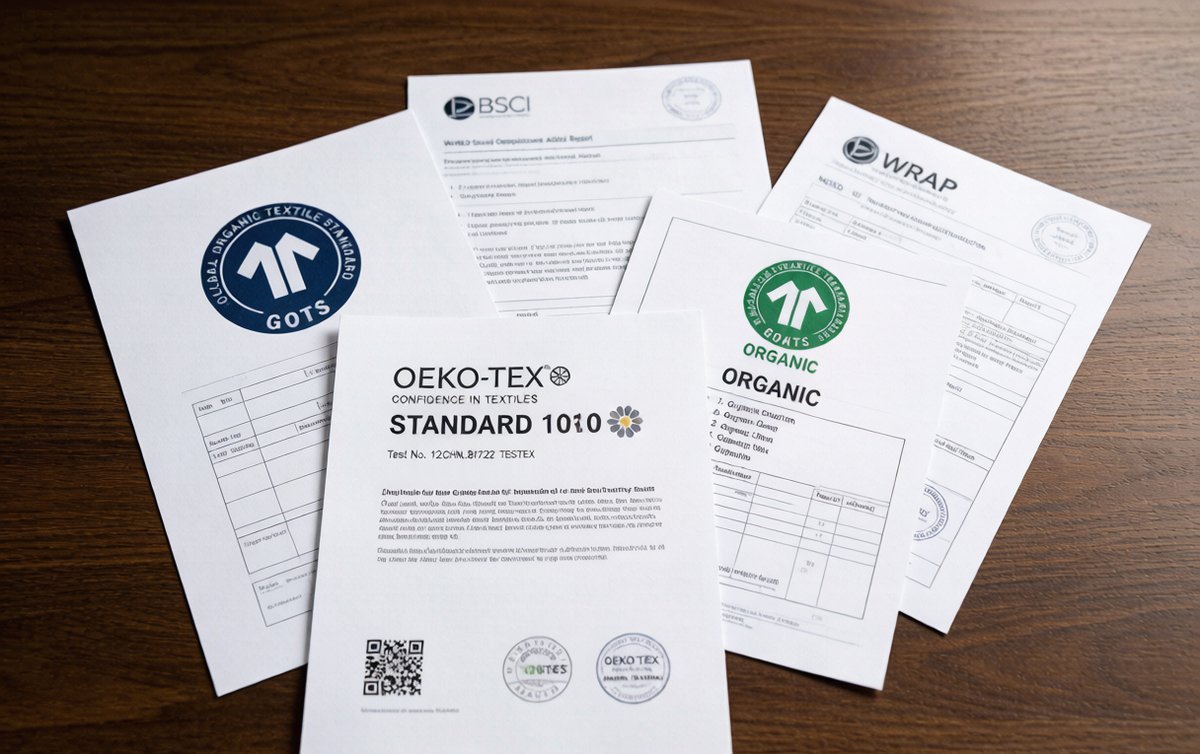
Textile certification documents and audit reports, including OEKO-TEX, GOTS, GRS, BSCI, and WRAP
OEKO-TEX Standard 100
OEKO-TEX Standard 100 certifies that every component of a fabric (the fiber, the yarn, the dyes, the trims) has been tested against a list of harmful substances. It is a chemical safety standard, not an environmental or social standard. If a brand tells you its fabric is OEKO-TEX certified, it means the fabric has been tested for substances that could harm the wearer. It does not, on its own, say anything about whether the fabric is organic or recycled.
What to ask for: the OEKO-TEX certificate number, the issuing institute, and the certificate expiry date. You can verify the certificate on the OEKO-TEX website.
GOTS (Global Organic Textile Standard)
GOTS covers the entire organic chain of custody, from the cotton farm to the finished fabric, and includes both environmental and social criteria. A GOTS-certified fabric is verified organic at every step. Without GOTS, an "organic cotton" claim is essentially self-declared.
What to ask for: the GOTS scope certificate for the supplier, plus a transaction certificate for your specific order. The transaction certificate is what links your shipment to the certified supply chain.
GRS (Global Recycled Standard) and RCS (Recycled Claim Standard)
GRS and RCS verify recycled content claims. GRS is the more comprehensive standard, covering recycled content, chain of custody, social and environmental practices, and chemical restrictions. RCS is the lighter version, focused only on recycled content verification. For rPET and recycled nylon claims, GRS or RCS is the relevant standard. Recycled content percentage must be at least 20 percent for RCS and 50 percent for GRS, with GRS requiring additional criteria beyond content.
What to ask for: the GRS or RCS scope certificate, plus a transaction certificate showing the recycled content percentage for your specific order.
BSCI (Business Social Compliance Initiative)
BSCI is a social compliance audit framework. It is not a certification, and BSCI does not certify individual factories. Instead, BSCI audits evaluate working conditions against a set of labor and human rights criteria. A factory that has passed a BSCI audit has demonstrated, on the date of the audit, that it meets those criteria. The amfori BSCI monitoring cycle generally runs for two years. Facilities rated A or B typically undergo a new full audit within two years, while facilities rated C, D, or E may require a follow-up audit within two to twelve months.
What to ask for: the most recent BSCI audit report (or summary) for the facility. Look for the audit date, the rating, and any non-conformities raised.
WRAP (Worldwide Responsible Accredited Production)
WRAP is a facility-level certification focused on ethical manufacturing, covering labor practices, workplace safety, and environmental compliance. WRAP-certified facilities have passed an independent audit and are subject to ongoing monitoring. WRAP certification is more rigorous than a single BSCI audit because it requires ongoing compliance, not just a one-time pass.
What to ask for: the WRAP certificate number, the certificate expiry date, and the certified facility address.
Scope Certificates, Transaction Certificates, and Product Certificates
If you are new to certified supply chains, the differences between these certificate types matter. Conflating them is one of the most common mistakes buyers make when verifying sustainability claims.
Scope certificate. Scope certificates and transaction certificates are commonly used in chain-of-custody systems such as GOTS, GRS, and RCS. A scope certificate is issued to a facility (the mill, the dyeing house, the garment factory). It confirms that the facility is approved to process certified material under that standard. A scope certificate does not prove that your specific order is certified, only that the facility is in the certification system.
Transaction certificate. A transaction certificate is issued for a specific shipment or order. It confirms that the material in that shipment is genuinely certified and meets the standard's requirements. A transaction certificate is the document that links your product to the certification claim.
Product certificate (OEKO-TEX example). Standards like OEKO-TEX STANDARD 100 use a different model. They issue a product certificate tied to a specific article or product scope, along with a certificate number. Buyers can verify the certificate through the official Label Check system on the OEKO-TEX website. The focus is on whether the specific textile article has been tested for harmful substances, rather than chain-of-custody tracking.
When a buyer says "our fabric is GOTS-certified," you should ask: do you have the scope certificate for the mill, and do you have a transaction certificate for this specific order? Both. If they only have a scope certificate, the fabric might be GOTS-eligible, but your particular shipment is not verified.
For OEKO-TEX claims, the verification path is different. Ask for the certificate number and look it up on the OEKO-TEX Label Check. The product certificate will show what was tested and whether the article is still within the validity period.
Knowing which certificate type applies to which standard is what separates a real sustainable program from marketing claims. The good news is that reputable suppliers will provide the right documents on request.
Waste Reduction During Pattern Making and Cutting
Material cost and lead time get most of the attention, but waste reduction is where many brands find unexpected savings. Two stages matter most: marker layout during pattern making, and remnant handling during cutting.
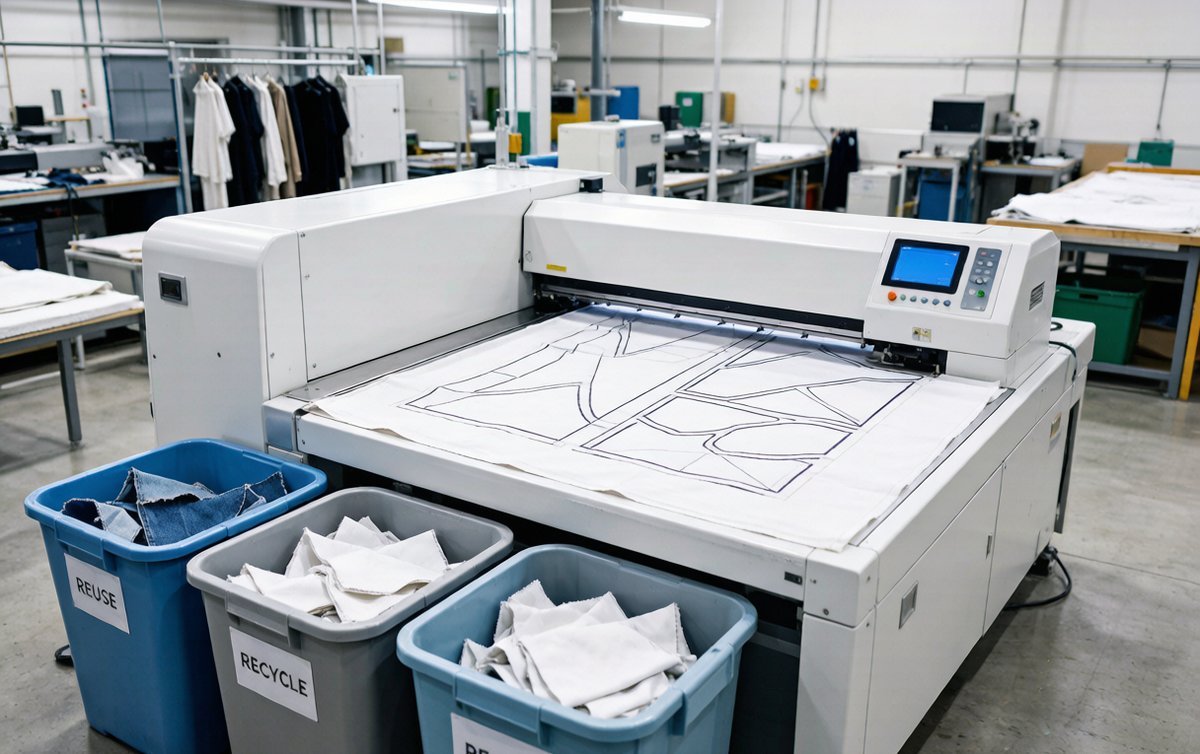
Cutting department with digital cutting machine and fabric remnants organized for reuse
Marker Optimization
Marker optimization is the process of arranging pattern pieces on the fabric to minimize waste. Done by an experienced marker maker, the difference between a good and a bad layout can be several percentage points of fabric. Done with software, the result is more consistent and the layout is documented, which helps for repeat orders.
Digital Cutting
Automated cutting machines are more precise than manual cutting. Less precision means more cut tolerance, which means more fabric used per garment. For high-volume programs, the savings from digital cutting can be material.
Remnant Reuse
Even with optimized markers, there will always be fabric remnants. The question is what happens to them. Better factories sort remnants by material, color, and weight, then reuse them for smaller products, internal samples, or accessory lines. Ask your supplier what their remnant handling process looks like. If the answer is "we throw them away," that is a signal they have not thought through the waste side of the operation.
Made-to-Order Production
Made-to-order (MTO) is the most powerful waste reduction strategy available to streetwear brands. Producing only what customers have already ordered eliminates deadstock entirely. It also fits streetwear culture well, because scarcity is part of the brand appeal. The practical requirement is a manufacturer that supports low MOQs and fast turnaround. At VANRD, the standard MOQ is 100 pcs per color per style, which is workable for MTO and limited drop models.
Sustainable Packaging Options
Packaging is a small but visible part of the sustainability story. For most streetwear brands, packaging is a smaller environmental impact than fabric or dyeing, but it is the easiest to communicate to customers and the easiest to implement.
Common sustainable packaging options include:
- Recycled cardboard hangtags. Standard option, modest cost premium.
- Recycled kraft paper shipping cartons. Standard option, available from most packaging suppliers in China.
- Biodegradable polybags. Cornstarch-based, compostable. Note: these may not protect garments as well as conventional PE polybags during long international transit, so test before committing.
- Recycled PE polybags. A practical middle ground if compostable polybags do not meet your durability needs.
- Soy-based or water-based inks for printed materials. Lower VOC emissions than conventional petroleum-based inks.
Talk to your packaging supplier about which options are available at your order volume. Most sustainable packaging upgrades are incremental, and you can phase them in over multiple seasons.
Cost, MOQ, and Lead-Time Considerations
Three numbers drive most sustainability decisions: cost, minimum order quantity, and lead time. None of these are deal-breakers, but they need to be planned for.
Cost
Sustainable materials usually add 10-20 percent to fabric cost versus their conventional equivalents. Higher-end options like GOTS-certified organic cotton or TENCEL can add 20-40 percent. The question is not whether you can afford the premium, it is whether your retail margin can absorb it. If your margin is thin, start with one sustainable SKU in the highest-volume style, rather than converting the entire line at once.
MOQ
Certified fabrics can require higher mill minimums depending on the material and supplier. VANRD manages GOTS-certified organic cotton through our established supply chain, and our garment-level MOQ remains 100 pcs per color per style for most sustainable programs. Discuss your target volume with us early, so we can confirm what color and weight options are available within your MOQ.
Lead Time
Sustainable fabric sourcing typically adds 2-4 weeks to the lead time, depending on the material. Recycled polyester and recycled nylon are usually close to virgin material lead times. GOTS organic cotton, TENCEL, and hemp blends often take longer. Build the additional lead time into your production calendar from the start.
How VANRD Supports Sustainable Apparel Projects
Here is what we do in our own facility, and what we coordinate through partner suppliers. We separate the two because sustainable programs often involve multiple parties, and it helps to be clear about who is doing what.
What we do in-house at VANRD
- Pattern making and marker optimization. Done by our in-house pattern and sample team.
- Cutting and sewing. Core pattern making, sample development, cutting, sewing, and quality control are managed by VANRD. Some specialist processes (knitwear, hats, embroidery-heavy items) are coordinated through approved production partners when required.
- Quality control. Inline and final inspection at our facility.
- Production planning and timeline management. Coordinated by our project managers.
What we coordinate through partner suppliers
- Fabric sourcing. Mainland China and select overseas mills, including rPET, organic cotton, hemp blends, TENCEL, and recycled nylon variants.
- Dyeing and finishing. Partner dye houses with OEKO-TEX certification and wastewater treatment systems in place.
- Printing and embroidery. Partner facilities with certification options available on request.
- Packaging. Recycled cardboard, kraft paper, and biodegradable polybag options sourced from packaging suppliers.
GOTS-certified organic cotton available as standard
GOTS-certified organic cotton options can be sourced through qualified upstream mills. Certification availability, chain-of-custody documentation, and transaction certificate requirements are confirmed on a project-by-project basis. We will tell you at the quoting stage whether the GOTS scope certificate for the mill and a transaction certificate for your specific order are available for the fabric variant and color you have selected.
In addition to GOTS, OEKO-TEX STANDARD 100-certified fabric and trim options are available upon request, subject to the selected material, supplier, color, finishing process, and certification scope. GRS/RCS certification is available for recycled content verification, and BSCI or WRAP social compliance documentation can be provided for our facility. Each certification is separate, and your program may need one, some, or all of them depending on your market and buyer requirements.
Standard MOQ at VANRD is 100 pcs per color per style. The 30-45 day lead time we quote refers to production time from approved sample to bulk shipment handover at our facility, not including international air or sea freight to your destination. Transit time depends on your chosen shipping method and final destination, and should be added separately to your production calendar.
Buyer Checklist
Use this list before you commit to a sustainable manufacturing program.
- Have I defined the exact sustainability claim I want to make on the product page?
- Have I matched the material to the product (rPET for fleece, organic cotton for heavyweight, etc.)?
- Have I asked for the scope certificate for the mill and the transaction certificate for my specific order?
- Have I confirmed GRS/RCS recycled content percentage for rPET or recycled nylon?
- Have I confirmed GOTS certification status for any organic cotton claim?
- Have I confirmed OEKO-TEX certification for fabric and trims?
- Have I asked for the most recent BSCI or WRAP audit report for the cut-and-sew facility?
- Have I confirmed the dye house wastewater treatment setup?
- Have I planned for 10-20 percent cost premium and 2-4 weeks of additional lead time?
- Have I confirmed MOQ at both the mill level and the garment level?
- Have I asked about the supplier's remnant handling and waste reduction process?
- Have I budgeted for sustainable packaging upgrades?
If you can answer yes to most of these, you are in a good position to start a sustainable program. If you cannot, you have a clear list of follow-up questions for your supplier.
Frequently Asked Questions
OEKO-TEX Standard 100 certifies that a fabric has been tested for harmful chemical substances. It is a chemical safety standard. GOTS certifies that a fiber (usually cotton) has been grown and processed organically, with chain-of-custody verification from farm to finished fabric. OEKO-TEX is about what is not in the fabric. GOTS is about how the fiber was produced. They are complementary, not interchangeable.
Both verify recycled content. GRS (Global Recycled Standard) is the more comprehensive standard, requiring at least 50 percent recycled content plus social, environmental, and chemical criteria. RCS (Recycled Claim Standard) is the lighter version, requiring at least 20 percent recycled content and focused only on content verification. If you want a full sustainability claim, GRS is the stronger standard. If you only need to verify the recycled content percentage, RCS is sufficient.
Not exactly. BSCI is a social compliance audit framework. Audited factories are evaluated against labor and human rights criteria, but BSCI does not issue facility-level certifications. A factory that has passed a BSCI audit has demonstrated, on the audit date, that it meets those criteria. The amfori BSCI monitoring cycle generally runs for two years, with follow-up timing depending on the audit rating. If you need an actual certification rather than an audit, WRAP is the more common option for facility-level social compliance certification.
GOTS-certified means the cotton (or other organic fiber) has been grown organically, processed without harmful chemicals, and tracked through every step of the supply chain from farm to finished fabric. Both the mill and your specific shipment must be GOTS-certified. The scope certificate covers the facility. The transaction certificate covers your specific order. Without the transaction certificate, you cannot claim GOTS certification on your product.
Standard garment MOQ is 100 pcs per color per style. For sustainable fabric programs, upstream mill minimums may apply (typically 500-1000 kg per dye lot for certified organic cotton). We can work with you on phased programs if you want to test a sustainable material in one style before committing to a full line.
As a general range, recycled polyester runs 10-20 percent over virgin polyester. Recycled nylon runs 20-30 percent over virgin nylon. GOTS-certified organic cotton runs 20-40 percent over conventional cotton. TENCEL pricing varies but is usually above mid-range cotton. These are industry ranges, not VANRD-specific quotes. Get a written quote for your specific program.
Standard fabric lead time is 2-4 weeks longer than non-certified equivalents, depending on material. Recycled polyester and recycled nylon are usually close to virgin lead times. GOTS organic cotton, TENCEL, and hemp blends typically take longer. The 30-45 days we quote for VANRD production covers the time from approved sample to bulk shipment handover at our facility. International air or sea freight to your destination is not included and should be added separately to your production calendar.
Planning a sustainable streetwear program? VANRD is a custom clothing manufacturer with pattern making, cutting, sewing, and quality control in-house, and a vetted network of fabric mills, dye houses, and packaging suppliers. Tell us about your program and we will send back a fabric, certification, and lead-time breakdown specific to your project.
Request a Sustainable Sourcing Brief