Jacquard vs Intarsia Sweaters: Which Knit Pattern Fits Your Design?
Jacquard vs Intarsia Sweaters: Which Knit Pattern Fits Your Design?
When developing a custom knitted sweater, choosing the right pattern technique involves more than deciding how the design should look. The way different yarns are knitted together affects the front appearance, reverse-side construction, fabric weight and overall production requirements. Jacquard and intarsia are two common approaches, but they create patterns in very different ways. Understanding these differences can help you choose a suitable construction before moving into sample development.
Jacquard and intarsia are two different knitting techniques used to create multicolored sweater designs. Jacquard uses programmed stitch selection to form patterns, while intarsia creates separate color fields using individual yarn carriers. The right choice depends on the artwork, pattern layout, reverse-side requirements, yarn, gauge and intended fabric performance.
1. Jacquard vs Intarsia: How Are the Patterns Actually Knitted?
Jacquard and intarsia both create patterns directly within knitted fabric, but they use different approaches to manage yarn and form color areas. The difference becomes clearer when you look beyond the finished design and examine how each stitch is produced.
What Is Jacquard Knitting?
Jacquard knitting is a patterning technique in which a programmed knitting system controls which needles form stitches with particular yarn colors.
Instead of changing the color of an already finished garment, the machine builds the design directly into the knitted structure.
For example, imagine a sweater with a repeating diamond pattern in navy, cream and burgundy. The knitting program determines where each color appears across the fabric, allowing the motif to repeat throughout the garment.
Depending on the design and machine setup, jacquard can be developed using different knitting constructions.
- Single-knit float jacquard: Unused yarns travel across the reverse side as floats until they are needed again.
- Double-knit jacquard: Additional yarns are knitted into a backing structure, which may create a different thickness, weight and reverse-side appearance.
This distinction matters because two sweaters described as jacquard can have noticeably different fabric structures.
Jacquard is therefore not one fixed fabric construction. The actual result depends on the stitch arrangement, machine setup and backing method.
What Is Intarsia Knitting?
Intarsia creates a knitted pattern by assigning separate yarn supplies to individual color areas.
Each yarn is knitted within its designated section. When two colors meet, their knitted areas are connected at the boundary through the appropriate joining technique.
Think of a sweater with a large cream-colored mountain graphic on a dark green body. The cream yarn is used in the mountain area, while the green yarn forms the surrounding fabric.
Unlike traditional float jacquard, the unused color does not need to travel across long sections of the reverse side behind the graphic.
This makes intarsia useful for designs with clearly separated color blocks, large placement graphics and bold shapes.
However, the connection between color areas still requires careful control. Poorly developed joins can create holes, uneven tension or weak-looking boundaries.
Jacquard vs Intarsia: A Technical Comparison
| Comparison Factor | Jacquard | Intarsia |
|---|---|---|
| Pattern formation | Programmed needle and yarn selection | Separate yarn supplies for individual color fields |
| Yarn management | Unused yarn may float or form a backing | Yarn is knitted within its assigned color area |
| Typical design | Repeating and distributed patterns | Large, isolated color blocks |
| Reverse structure | Floats or knitted backing, depending on construction | Color joins and yarn transitions |
| Pattern placement | Often suitable for all-over repeats | Often suitable for specific placement graphics |
| Main development focus | Repeat, color distribution and backing | Color boundaries, joins and motif shape |
| Yarn consumption | Depends on the selected jacquard structure | Depends on the number and layout of color fields |
Neither technique is automatically better. The more useful question is which structure can reproduce your artwork while meeting the desired fabric weight, stretch and appearance.
2. What Does Each Technique Look Like on the Front and Back?
The reverse side is one of the most useful places to compare jacquard and intarsia. It reveals how the yarns are managed and can help explain differences in fabric weight, flexibility and construction.
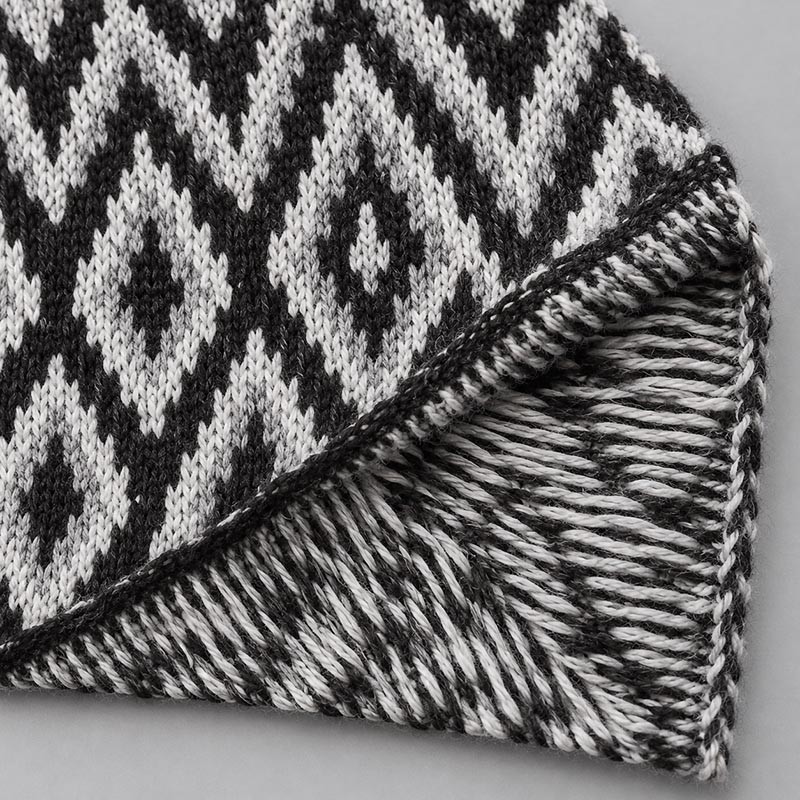
The Front and Reverse of Jacquard
On the front, jacquard can produce repeated motifs, geometric patterns, multicolored graphics and continuous color arrangements.
The reverse depends on the selected structure.
With float jacquard, yarns that are not forming visible stitches in a particular area are carried across the back. These floats connect one section of a color pattern to another.
If the floats are too long or poorly controlled, they may catch on objects, restrict fabric movement or affect the reverse-side appearance.
Double-knit jacquard works differently. Instead of leaving all unused yarns floating, the machine can knit them into a backing structure.
Common backing arrangements include:
- Stripe back
- Twill back
- Ladder back
These constructions affect the thickness, weight and internal appearance of the finished knit.
This is why looking at the front alone is not enough when evaluating jacquard.
The Front and Reverse of Intarsia
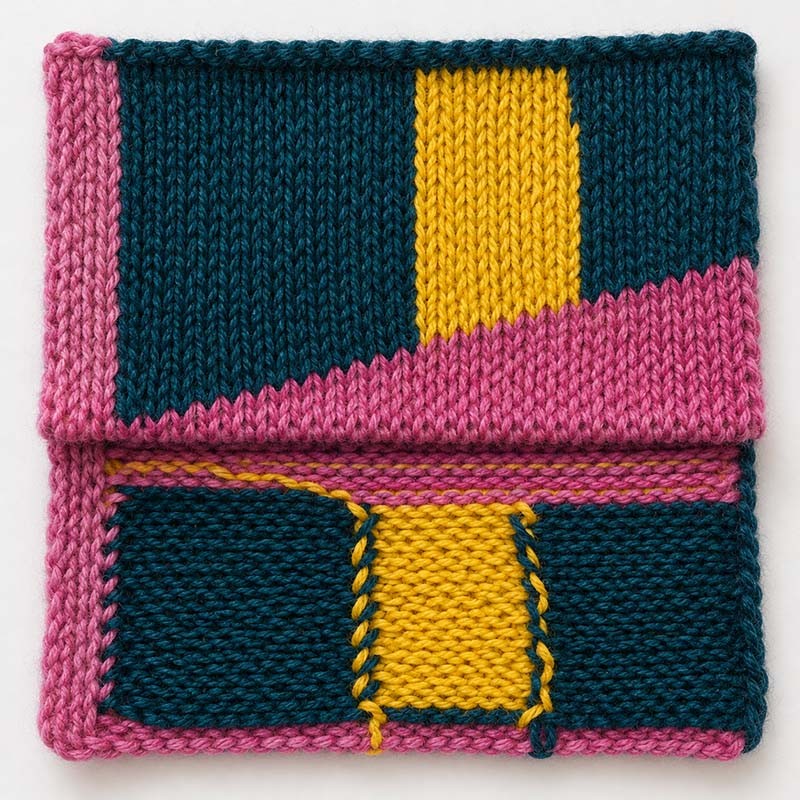
On the front, intarsia is known for its clearly separated color fields.
A large graphic can be incorporated into the knitted fabric without carrying its unused background yarn across the entire back of the motif.
However, the reverse is not necessarily completely smooth or identical to the front.
You may still see yarn transitions, connection points and changes where individual color areas meet.
For brands developing intarsia sweaters, these joining areas deserve particular attention.
- The color boundaries are securely connected.
- Small holes do not appear between adjacent color areas.
- The yarn tension remains consistent around the motif.
- The graphic remains balanced after finishing.
- The reverse-side construction matches the intended garment requirements.
Why the Reverse-Side Comparison Matters
Consider two sweaters with a similar graphic on the front. One uses float jacquard, while the other uses intarsia.
They may look quite similar when photographed from the front. However, their reverse-side structures can be very different.
The difference may influence:
- Fabric thickness and weight.
- How the fabric stretches.
- How the reverse feels against the wearer.
- The possibility of yarn snagging.
- The finishing requirements.
For this reason, a proper development review should include photographs or physical swatches showing both sides of the fabric.
When comparing samples, make sure you know the actual jacquard backing construction. A float-back sample and a double-knit jacquard sample should not be treated as the same structure.
3. Which Sweater Designs Work Better With Each Technique?
The best starting point is the artwork itself. Look at where the colors appear, whether the design repeats and how the different color areas connect.
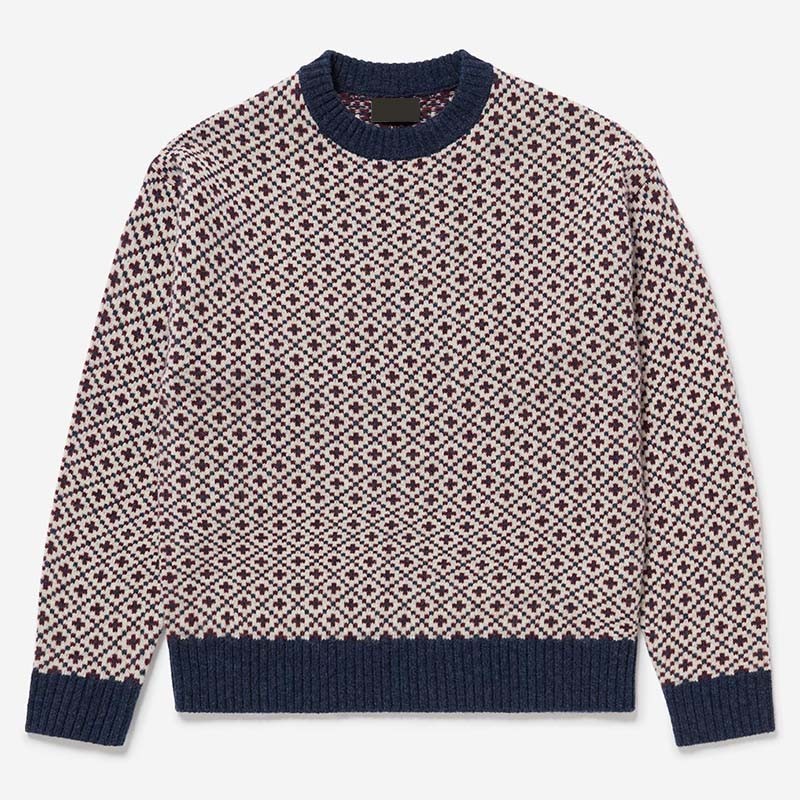
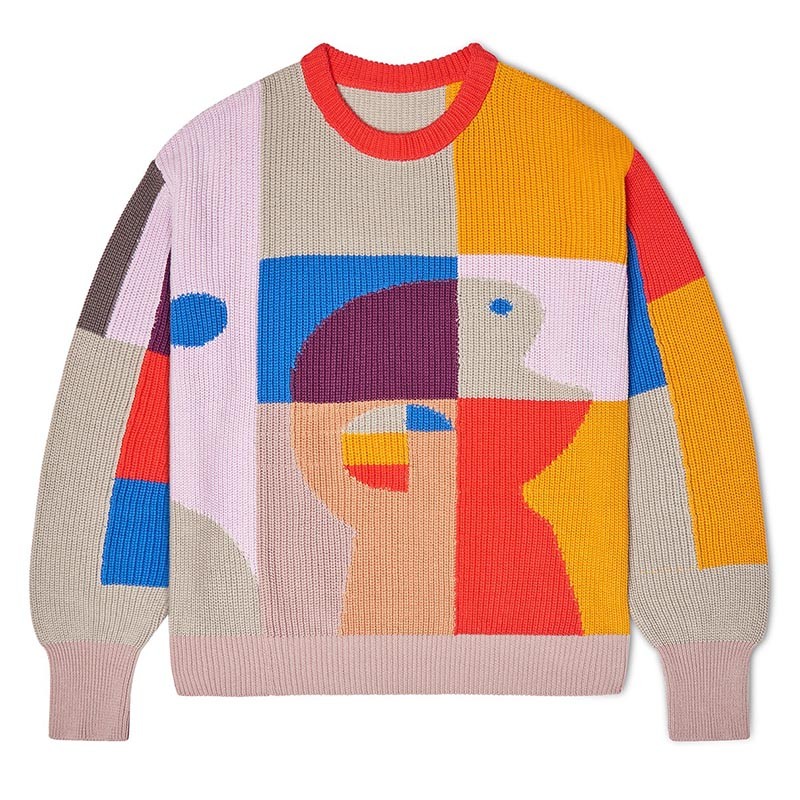
These are visual design references. The exact knitting construction of a finished garment should be confirmed through its technical specification or manufacturer.
Repeating Geometric Patterns
Jacquard is often the first technique to evaluate for repeating patterns.
Examples include:
- Diamond patterns
- Argyle-inspired motifs
- Repeating geometric shapes
- Checkerboard patterns
- All-over decorative graphics
These designs distribute colors across a larger knitted area.
A jacquard program can organize the pattern across the fabric, making it suitable for designs that need consistent repetition.
However, the repeat size, number of colors within each course and selected backing structure still need to be checked.
Large Placement Graphics
Intarsia is often worth evaluating first for large, isolated graphics.
Examples include:
- Large front or back illustrations
- Animal and character graphics
- Large abstract shapes
- Color-blocked designs
- Oversized graphic motifs
Because the colors are knitted in their designated areas, intarsia can avoid carrying unused background yarn across large sections of the reverse.
This can be useful when the design contains a large graphic surrounded by a relatively simple base color.
Lettering and Brand Logos
Letters and logos need more careful consideration.
A large block-style logo with clear outlines may be suitable for intarsia. A repeating logo pattern across the sweater may point toward jacquard.
But not every logo is easy to translate into knitted stitches.
For example, a design containing very thin lines, small lettering or narrow spaces between letters may lose definition when converted into a stitch grid.
Before choosing a technique, review:
- Letter height and width.
- Thickness of each line.
- Spacing between letters.
- Small enclosed spaces.
- Color contrast against the background.
If necessary, the artwork can be simplified to preserve its overall appearance in the knitted version.
Mixed Pattern and Graphic Designs
Some sweater designs combine a repeating pattern with a large central graphic.
For example, a sweater might have a geometric pattern around the body and a large brand illustration across the chest.
In this situation, choosing only one technique may not be the most practical solution.
Depending on the machine and garment construction, different techniques may be combined or the artwork may be adjusted to achieve a more consistent result.
The important thing is to review the entire design rather than making a decision based on one individual graphic.
4. How Do Gauge, Yarn and Stitch Structure Affect the Result?
Even when a design looks clear on a computer screen, the knitted result may look different.
Gauge, yarn thickness, fiber characteristics and stitch construction all affect how much detail can be reproduced.
Gauge and Pattern Definition
In flat knitting, gauge generally describes the number of needles per inch on a needle bed.
It influences the stitch grid available for building a pattern.
A finer gauge provides more potential stitch positions within a given area, while a coarser gauge produces larger stitches.
This affects:
- The sharpness of graphic edges.
- The appearance of small lettering.
- The spacing between color blocks.
- The proportions of geometric patterns.
However, a finer gauge does not automatically make every design better.
The yarn, machine capabilities and intended fabric construction must also work together.
Yarn Thickness and Surface Texture
Yarn affects both the appearance and physical feel of a patterned sweater.
A thicker yarn creates larger stitches, which can make small details harder to reproduce.
A hairy or fuzzy yarn may soften the edges between different colors. Smooth yarns can make color boundaries appear more defined, depending on the stitch structure and tension.
Fiber composition also matters.
For example, wool blends, cotton yarns and synthetic yarns can behave differently during knitting and finishing.
Before confirming a design, the selected yarn should be evaluated alongside the intended gauge and pattern.
Fabric Weight, Stretch and Hand Feel
Jacquard backing structures can add additional knitted material to the reverse, potentially changing the weight and thickness of the fabric.
Intarsia avoids some of the yarn consumption associated with a double-knit jacquard backing, but that does not mean every intarsia sweater will be lighter.
The final result also depends on:
- Yarn thickness and composition.
- Stitch density.
- Base knit structure.
- Number and arrangement of color areas.
- Finishing and washing.
If your brand has a specific target weight or hand feel, communicate it before sampling rather than judging the result from the artwork alone.
For more information about material and construction options, see our Fabrics & Techniques page.
5. What Affects Knitting Complexity, Cost and Sampling?
There is no universal rule that jacquard is more expensive than intarsia, or that intarsia always requires more production time.
The cost depends on how the actual design is translated into a knitted structure.
Color Count Is Not the Only Factor
A sweater might use six colors across the entire design, but only two or three may appear in a particular knitting course.
Another design might use fewer colors overall but require frequent color changes and many separate color areas.
These two designs can have very different production requirements.
The factory needs to examine:
- Number of colors used in each course.
- Number of separate color areas.
- Frequency of color changes.
- Pattern repeat and dimensions.
- Yarn carrier and machine requirements.
- Complexity of the reverse-side construction.
The distribution of colors can be just as important as the total color count.
Yarn Consumption and Backing Construction
Yarn consumption depends on the knitted structure.
For example, double-knit jacquard can use additional yarn to create its backing, while intarsia can avoid carrying unused colors across large sections.
However, the total material requirement still depends on the size and layout of the artwork, the selected yarn and the construction of the garment.
It is not reliable to estimate cost using only the name of the knitting technique.
Programming and Sample Development
Before bulk production, the artwork needs to be translated into a knitting program.
This may involve adjusting the motif, mapping colors to stitches, confirming the gauge and reviewing the machine setup.
The first sample may also reveal details that were not obvious in the original artwork.
For example, a small gap between letters might become too narrow at the selected gauge, or a color boundary might need adjustment to improve its appearance.
These changes are part of normal product development.
The sampling schedule depends on design complexity, yarn availability, technical adjustments and approval speed.
For a clearer overview of how development moves toward bulk production, visit our Service Process page.
6. Factory Reality: What Should You Check on a Knitwear Sample?
A sweater sample should be evaluated as a finished garment, not just as a successful reproduction of the front artwork.
The following checkpoints can help brands review the result before approving production.
Check the Front Pattern
First, compare the knitted motif with the approved artwork.
- Overall graphic proportions.
- Color placement and contrast.
- Pattern alignment.
- Lettering and small details.
- Position relative to the neckline, shoulders and garment measurements.
For repeating jacquard patterns, also check whether the motif remains consistent across the body and sleeves.
Inspect the Reverse Construction
Turn the garment inside out.
For jacquard, identify whether the sample uses float backing or a knitted backing structure.
Check the float length, yarn security and overall thickness.
For intarsia, inspect the connection points between color areas. Look for holes, loose joins and uneven tension.
Do not approve an intarsia sample simply because its front graphic looks clean.
Check Measurements and Fabric Behavior
Pattern development can influence the finished garment dimensions.
Measure the sweater after finishing and compare it with the approved specification.
- Chest width.
- Body length.
- Shoulder width.
- Sleeve length.
- Cuff and hem measurements.
Also evaluate stretch recovery, fabric hand feel and how the garment behaves after the intended washing process.
A pattern that looks correct before finishing may need further adjustment if the finished dimensions or proportions change.
Compare the Approved Sample With Bulk Requirements
Before production begins, document the approved yarn, gauge, pattern version, color references and construction details.
The factory and buyer should work from the same approved reference.
This reduces the risk of differences between the sample and bulk garments.
For more information about production inspection and quality checkpoints, see our Quality Control System.
7. Common Mistakes When Choosing Jacquard or Intarsia
Some development problems start before the first sample is knitted. Here are four mistakes worth avoiding.
Choosing a Technique Based Only on the Front Design
A graphic may look suitable for intarsia or jacquard on screen, but its reverse-side construction may not meet the garment requirements.
Review both sides before confirming the technique.
Assuming More Colors Always Mean More Complexity
The number of colors is only one factor.
How those colors are distributed across each knitting course, how often they change and how many separate color fields are required can make a significant difference.
Ignoring Small Graphic Details
Fine lines, narrow gaps and small lettering may not translate accurately into the selected stitch grid.
Review the artwork at the intended knitting gauge and adjust details where necessary.
Approving the Sample Without Checking Its Finished Condition
A sample should be checked after the required finishing process, not only immediately after knitting.
Dimensions, tension, fabric feel and pattern appearance should all be reviewed before bulk approval.
8. How to Prepare Your Sweater Artwork for Production
If you are developing a custom jacquard or intarsia sweater, preparing the right information early can make the technical review much easier.
Here is what to share with your manufacturer.
1. Artwork and Pattern Placement
Provide the original design file or a clear reference image.
Indicate whether the graphic should appear on the front, back, sleeves or throughout the garment.
If the design repeats, include the intended repeat dimensions where available.
2. Color References
Identify each color used in the artwork.
Color references or physical yarn swatches can help the development team evaluate the intended appearance more accurately.
3. Yarn and Gauge Preferences
If you already have a preferred fiber composition, yarn thickness or gauge, include that information.
If not, explain the target fabric weight, softness and overall appearance so the manufacturer can discuss suitable options.
4. Garment Specifications
Provide the size chart, garment measurements and expected size range.
This is particularly important when the graphic needs to maintain its proportions across different sweater sizes.
5. Production Requirements
Include your estimated order quantity, target development schedule and any special requirements for the reverse side.
If you have a reference sweater or physical sample, share it as well.
At VANRD, we review custom apparel requirements from the perspective of product development, material selection and production feasibility. Our OEM & ODM Services provide further information about how we support brand development.
Frequently Asked Questions
Is jacquard always thicker than intarsia?
No. Fabric thickness depends on the specific jacquard construction, yarn and gauge. Double-knit jacquard may be thicker because of its additional backing, but single-knit float jacquard can have a different weight and feel. Intarsia also varies according to its base knit structure and yarn selection.
Does intarsia always have a completely clean reverse side?
No. Intarsia generally avoids long floats across separate color fields, but its reverse can still show yarn transitions and joining points. The actual appearance depends on the construction and finishing.
Can a small sweater logo be made using intarsia?
It may be possible, but the design needs to be evaluated against the selected gauge and stitch resolution. Very small letters, thin outlines and narrow spaces may require artwork adjustments.
Can jacquard be used for a large front graphic?
Yes. Jacquard can create large graphic areas, but the yarn management and reverse-side construction need to be considered. For a large isolated motif, intarsia may also be worth evaluating.
How long does it take to develop a custom jacquard or intarsia sweater sample?
The development time depends on the artwork, yarn sourcing, knitting program, machine setup and number of sample revisions. A clear tech pack and approved color references can help reduce unnecessary adjustments.
What should I send a manufacturer before developing a jacquard sweater?
Provide the artwork, color references, intended pattern placement, garment measurements, yarn preferences and target quantity. If you have a reference sample, include clear photographs of both the front and reverse sides.
Conclusion: Choose the Knit Structure That Works for Your Design
Jacquard and intarsia offer different ways to build color and graphics into knitted sweaters. Jacquard is often a practical starting point for repeating patterns and broader color arrangements, while intarsia is frequently considered for large, separate graphic areas and bold color blocks.
But the final decision should go beyond the appearance of the artwork. Yarn management, reverse-side construction, gauge, stitch definition, fabric weight and production feasibility all influence the finished sweater.
The most reliable way to choose is to review the design alongside the intended yarn and knitting structure, then evaluate the actual sample from both sides.
Develop Your Custom Sweater With VANRD
Have a sweater design in mind? Share your artwork and reference requirements with VANRD. Our team can help review the development requirements and discuss a suitable manufacturing approach for your collection.