Baggy Sweatpants vs Joggers: Which Fit Works Better for Streetwear Brands?
Baggy sweatpants and joggers use different fit logic in custom manufacturing. Baggy sweatpants focus on volume, drape, rise, thigh width, and leg opening, while joggers focus on taper, cuff recovery, leg shape, and a cleaner athletic-to-streetwear silhouette. The better choice depends on brand positioning, fabric weight, target customer, styling direction, logo placement, and production control.
Quick Answers
What is the main difference between baggy sweatpants and joggers?
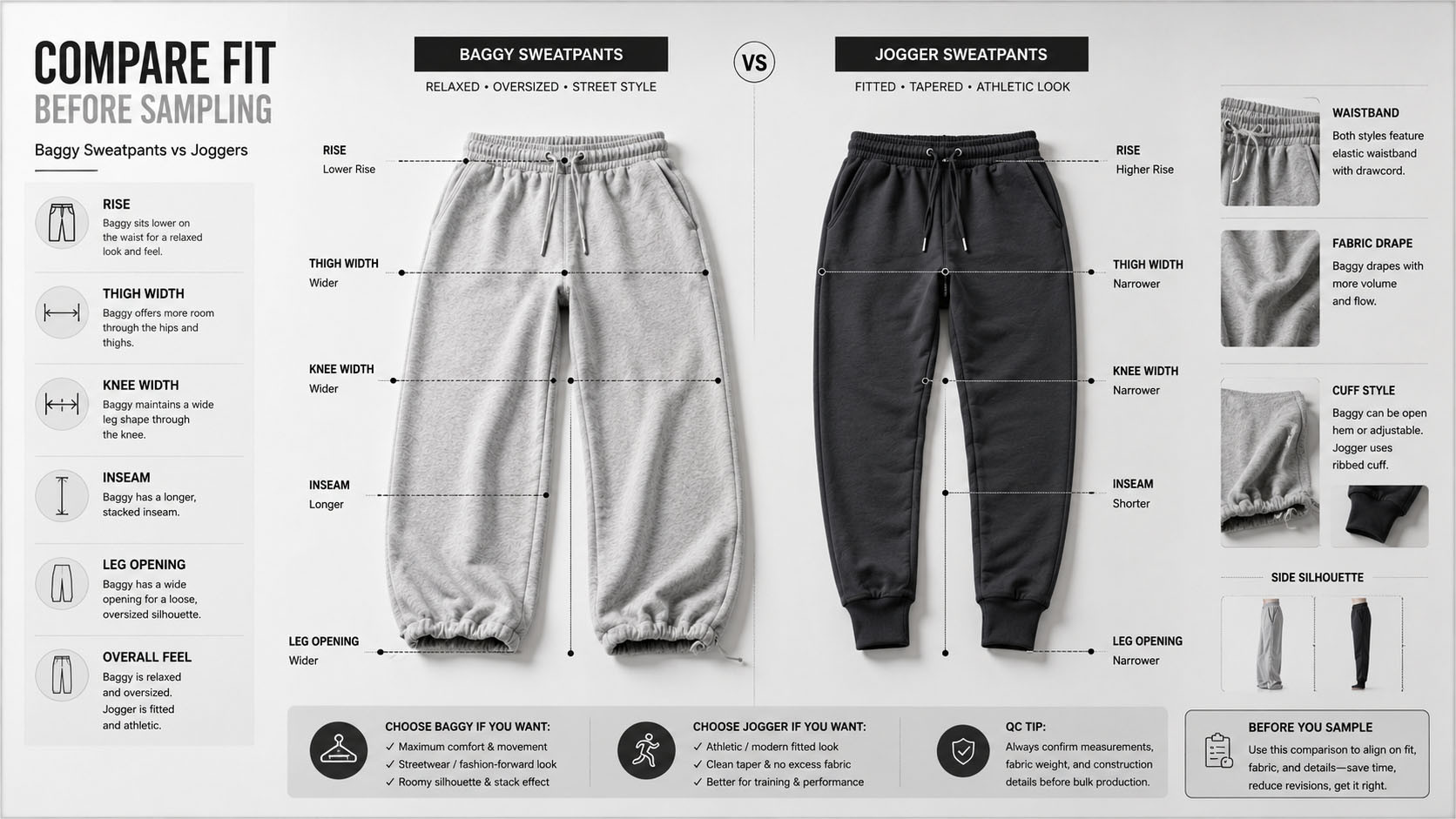
Baggy sweatpants usually have more volume through the rise, thigh, knee, and leg opening. Joggers are usually more tapered, with a narrower lower leg and a more controlled cuff. The difference is not only style. It changes pattern, fabric behavior, cuff construction, and QC focus.
Are baggy sweatpants better for streetwear brands?
Baggy sweatpants can work well for streetwear brands that want a relaxed, oversized, vintage, skate, or heavyweight fleece look. They are especially useful when the brand wants stronger silhouette identity. However, they need careful fit control to avoid looking too loose or unbalanced.
Are joggers still good for streetwear collections?
Joggers can still work for streetwear collections when the brand wants a cleaner, sporty, tapered, or everyday fit. They are often easier to style across broader customers, but they may feel less distinctive if the fabric, cuff, and branding details are too basic.
Which fit is easier to manufacture?
Joggers may be easier when the brand uses a standard tapered pattern and simple fleece. Baggy sweatpants can require more pattern development because rise, thigh volume, inseam, leg opening, and drape must be balanced. However, both fits need clear measurements before sampling.
What fabric works better for baggy sweatpants?
Baggy sweatpants often need midweight to heavyweight fleece with enough structure to hold volume. The best choice depends on the intended drape, stacking, season, wash process, and target price. Fabric should be tested on a real sample before bulk production.
What fabric works better for joggers?
Joggers can use midweight fleece, French terry, loopback fleece, or lighter fleece depending on the product goal. The key is to match fabric weight with taper, cuff recovery, waistband comfort, and movement.
What should brands confirm before choosing between baggy sweatpants and joggers?
Brands should confirm target customer, fit direction, fabric weight, waistband structure, cuff design, inseam, leg opening, logo placement, wash requirement, target quantity, and QC standards before sampling.
Baggy Sweatpants vs Joggers: Direct Comparison
Baggy sweatpants and joggers are both fleece bottoms, but they are not developed with the same production logic. Baggy sweatpants are usually built around volume and drape. Joggers are usually built around taper and cuff control.
| Comparison Point | Baggy Sweatpants | Joggers |
| Main silhouette | Loose, relaxed, wide, or stacked | Tapered, cuffed, cleaner lower leg |
Fit focus | Rise, thigh, knee, inseam, leg opening | Taper, cuff opening, knee shape, waistband |
Fabric direction | Often midweight to heavyweight fleece | Midweight fleece, French terry, loopback, or lighter fleece |
Cuff role | Optional, sometimes open hem or loose cuff | Usually important for silhouette control |
Streetwear effect | Stronger oversized or vintage identity | Cleaner sporty or everyday streetwear look |
| Production risk | Unbalanced volume, too much fabric, poor drape | Weak cuff recovery, tight lower leg, poor taper |
| Best for | Baggy, skate, vintage, heavy fleece, wide-leg styles | Jogger sets, athleisure, tapered streetwear, everyday bottoms |
The better option depends on what the brand wants the product to communicate. If the brand wants a bold streetwear silhouette, baggy sweatpants may be stronger. If the brand wants a cleaner and more wearable product, joggers may be more suitable.
1. Start With Brand Positioning Before Choosing the Fit
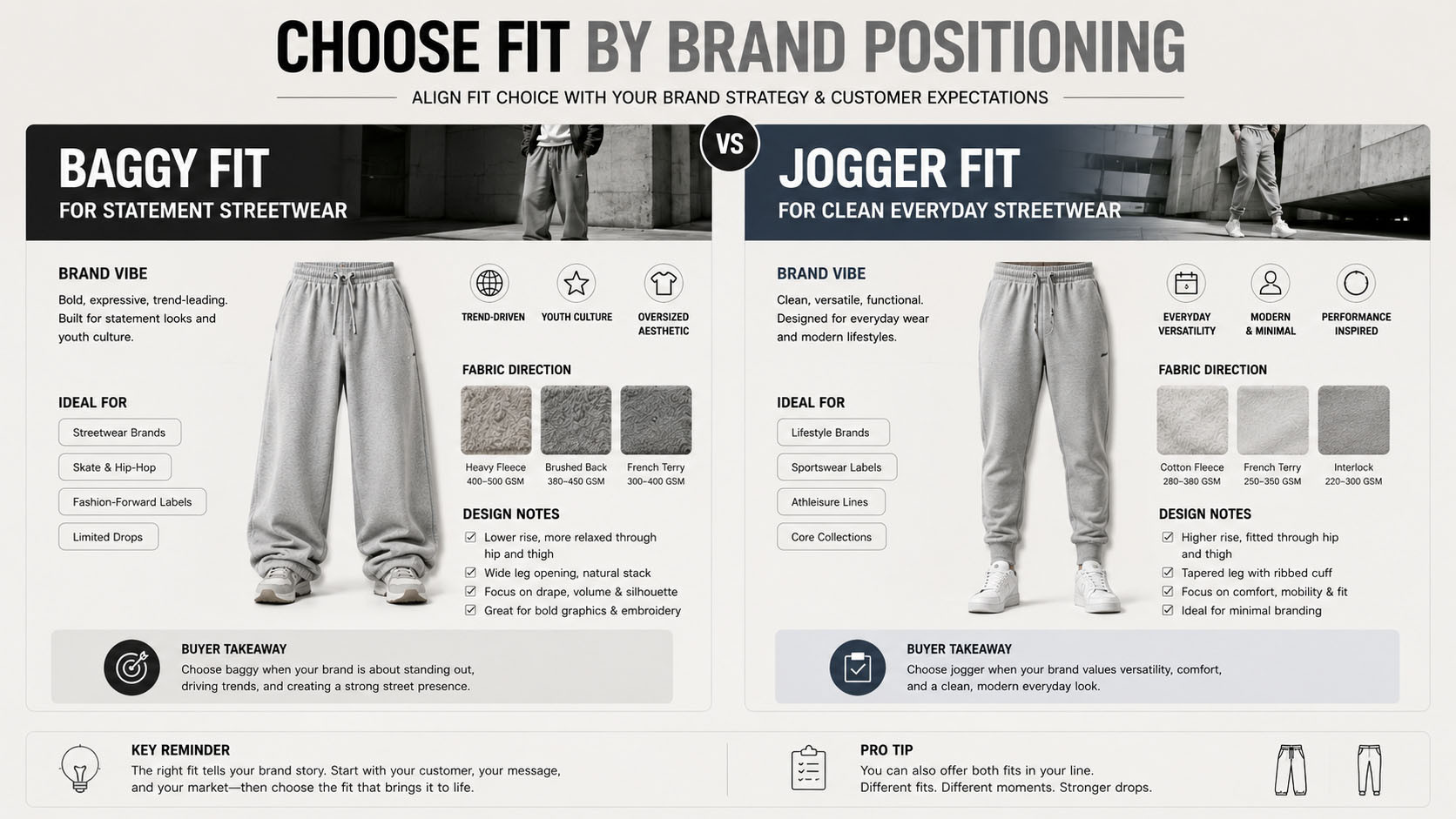
Fit direction should come from brand positioning, not only trend preference. A private label brand should ask what type of customer, product story, and price level the sweatpants need to support.
When Baggy Sweatpants Make More Sense
Baggy sweatpants may be more suitable when the brand wants:
Oversized streetwear identity
Skate or vintage-inspired styling
Heavyweight fleece programs
Wide-leg or stacked bottoms
Relaxed fit collections
Statement silhouettes
Larger logo placements on the leg
Baggy sweatpants can help a brand create a stronger product identity, but the pattern must be controlled carefully. Too much volume can make the garment look oversized by accident rather than intentionally designed.
When Joggers Make More Sense
Joggers may be more suitable when the brand wants:
Cleaner everyday sweatpants
Athletic-to-streetwear bottoms
Tapered fleece pants
Coordinated hoodie and jogger sets
More controlled lower-leg shape
Broader customer wearability
Cuffed ankle styling
Joggers can be easier for customers to understand, but they may need stronger fabric, cuff, and logo detail to avoid looking generic.
Brands developing a full private label streetwear program can review Vanrd's OEM/ODM apparel manufacturing services to understand how fit direction, sampling, and production can be organized.
2. Compare Pattern Logic: Volume vs Taper
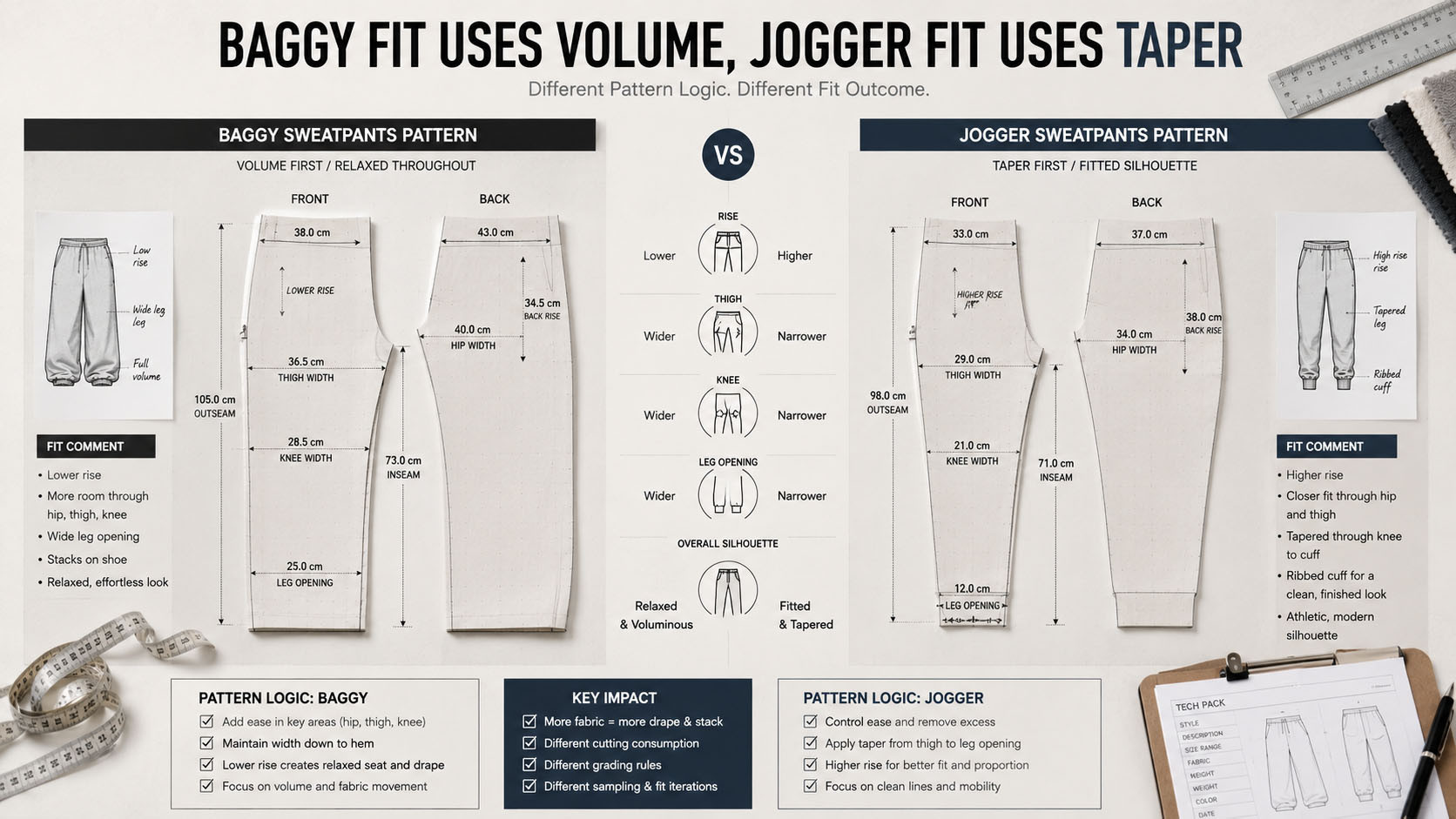
Pattern logic is the biggest production difference between baggy sweatpants and joggers. A factory should not create baggy sweatpants by simply enlarging a jogger pattern.
Baggy Sweatpants Pattern Logic
Baggy sweatpants need controlled volume across the full garment. Important pattern points include:
Waist balance
Rise depth
Hip width
Thigh volume
Knee width
Inseam
Outseam
Leg opening
Hem or cuff decision
Stacking effect if required
The main risk is poor proportion. If the rise is too long, the pants may look heavy around the crotch. If the thigh is too wide without leg balance, the garment may look shapeless. If the inseam is too long without controlled fabric structure, the stacking may look messy.
Jogger Pattern Logic
Joggers need controlled taper from thigh to cuff. Important pattern points include:
Waist comfort
Rise
Hip width
Thigh width
Knee width
Calf shape
Cuff opening
Cuff height
Inseam
Side seam balance
The main risk is over-tapering. If the lower leg is too narrow, the jogger may feel tight or distort when worn. If the cuff is too loose, the silhouette may lose the clean jogger shape.
3. Match Fabric Weight to the Fit Direction
Fabric weight affects both baggy sweatpants and joggers, but in different ways. The same fleece may perform well in one fit and poorly in another.
Fabric for Baggy Sweatpants
Baggy sweatpants often need enough structure to hold volume. Midweight to heavyweight fleece may help create a stronger streetwear silhouette, especially for wide-leg, stacked, or relaxed bottoms.
Check:
Fabric weight direction
Drape
Shrinkage
Inside hand feel
Stacking behavior
Seam thickness
Wash effect
Packing volume
Heavy fabric can support structure, but it can also create bulk. The brand should review fabric weight on an actual sample, not only through a swatch.
Fabric for Joggers
Joggers can work with midweight fleece, French terry, loopback fleece, or lighter fleece depending on the intended market. Because joggers are more tapered, fabric should not make the lower leg or cuff area feel too bulky.
Check:
Drape
Stretch or stability
Cuff compatibility
Knee recovery
Comfort when moving
Hand feel
Seasonality
Shrinkage
Common Confusion: Heavyweight Does Not Automatically Mean Better
Heavyweight fleece can be useful, but it is not always the best choice. If the product is a clean jogger for year-round wear, a very heavy fabric may feel too bulky. If the product is a baggy streetwear sweatpant, a fabric that is too light may not hold the intended shape.
For fleece, French terry, wash, decoration, and trim options, buyers can review Vanrd's fabric and technique customization support.
4. Waistband and Cuff Construction Are Not the Same
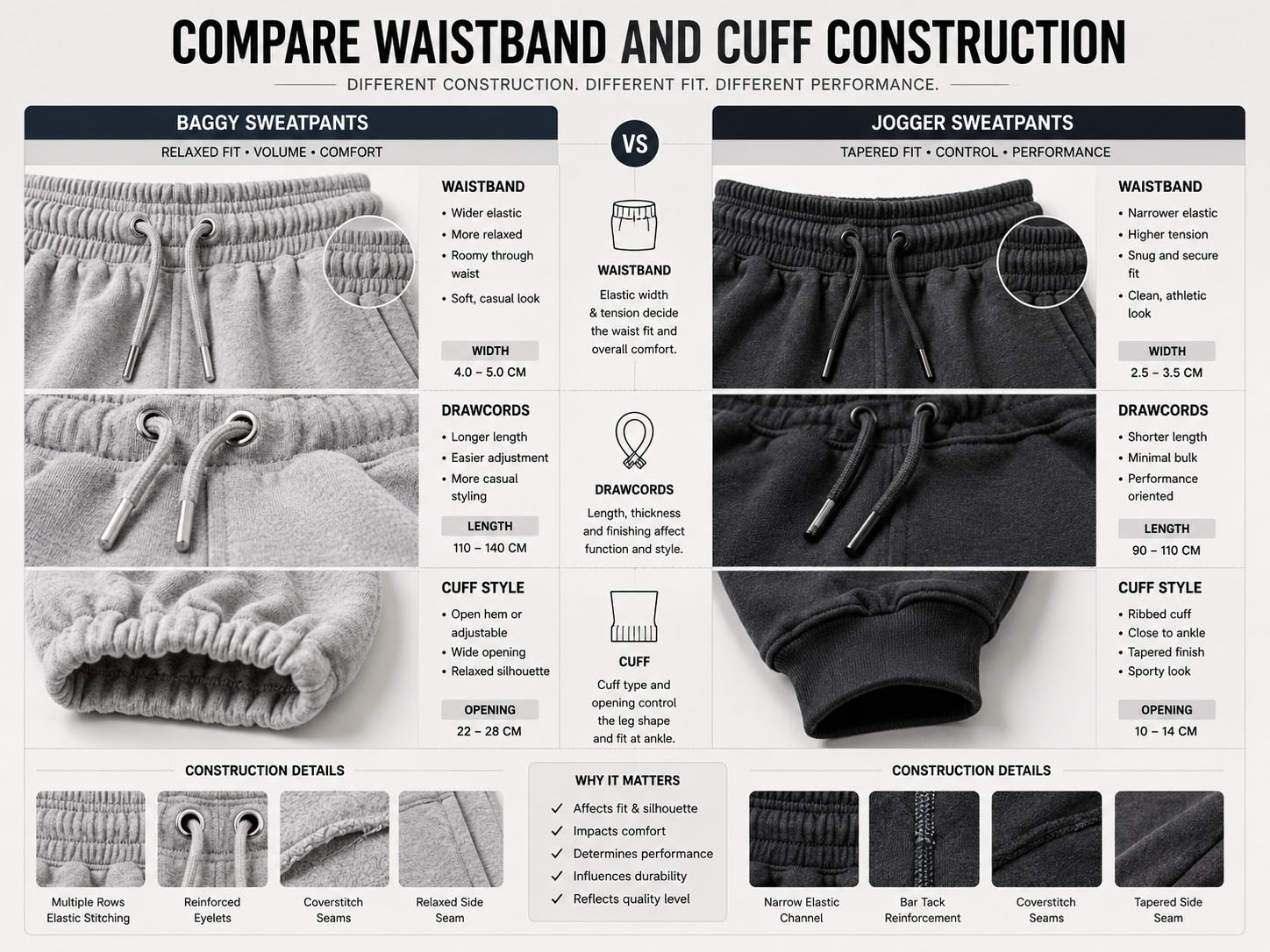
Waistband and cuff decisions affect both comfort and silhouette. Baggy sweatpants and joggers may use similar materials, but they usually need different construction emphasis.
Waistband for Baggy Sweatpants
Baggy sweatpants may need a waistband that can support more fabric volume. The waistband should feel secure without creating too much tightness.
Confirm:
Elastic width
Elastic strength
Waistband height
Drawcord type
Drawcord placement
Inside finish
Topstitching method
Waist-to-hip balance
If the waistband is too weak, the extra fabric volume may feel unstable. If it is too tight, the garment may lose comfort.
Waistband for Joggers
Joggers usually need a waistband that supports movement and daily wear. The construction may be simpler, but it still needs to match the fabric weight and fit.
Confirm:
Elastic recovery
Drawcord function
Waistband height
Topstitching
Comfort after stretching
Consistency across sizes
Cuffs for Baggy Sweatpants
Baggy sweatpants may use open hems, loose cuffs, gathered cuffs, or wider cuff openings. The cuff choice changes the entire lower-leg look.
Cuffs for Joggers
Joggers usually rely heavily on cuff quality. A weak cuff can destroy the jogger silhouette. A cuff that is too tight can make the pants uncomfortable.
Confirm:
Cuff rib quality
Cuff height
Cuff opening
Rib recovery
Attachment method
Lower-leg balance
5. Compare Branding and Logo Placement
Logo placement should be planned differently for baggy sweatpants and joggers. The available surface area, leg shape, pocket placement, and movement pattern are different.
Branding on Baggy Sweatpants
Baggy sweatpants can support larger graphics or more visible branding because the leg has more surface area. This can work well for streetwear capsules, embroidery, side-leg print, puff print, applique, or patch placements.
Possible placements:
Left thigh
Right thigh
Side leg
Back pocket area
Near knee
Lower leg
Waistband label
Cuff label
The risk is alignment. Large graphics on loose legs can look uneven if placement is not tested on the real pattern.
Branding on Joggers
Joggers usually have less flat visual space because the leg tapers. Smaller logos, thigh placements, pocket-area branding, or cuff labels may work better.
Possible placements:
Left thigh
Pocket area
Small side logo
Lower leg print
Cuff label
Back pocket logo
Woven label
The risk is distortion. A logo placed too low on a tapered leg may curve or look compressed when worn.
Decoration Method Considerations
Both fits may use screen print, puff print, embroidery, applique, heat transfer, woven patch, rubber patch, or reflective details. The method should match fabric, wash process, and placement.
6. Sampling Checklist for Baggy Sweatpants and Joggers
Sampling is where the fit decision becomes visible. A swatch can show fabric hand feel, but only a sample can show how the fabric, fit, waistband, cuffs, and logo placement work together.
Baggy Sweatpants Sample Review
Check:
Rise depth
Thigh volume
Knee width
Leg opening
Stacking effect
Fabric drape
Waistband support
Pocket position
Logo placement
Overall proportion
Jogger Sample Review
Check:
Taper from thigh to cuff
Knee shape
Cuff opening
Cuff recovery
Waistband comfort
Pocket position
Inseam
Lower-leg movement
Logo placement
Overall clean silhouette
What Buyers Should Prepare Before Sampling
Prepare:
Reference images
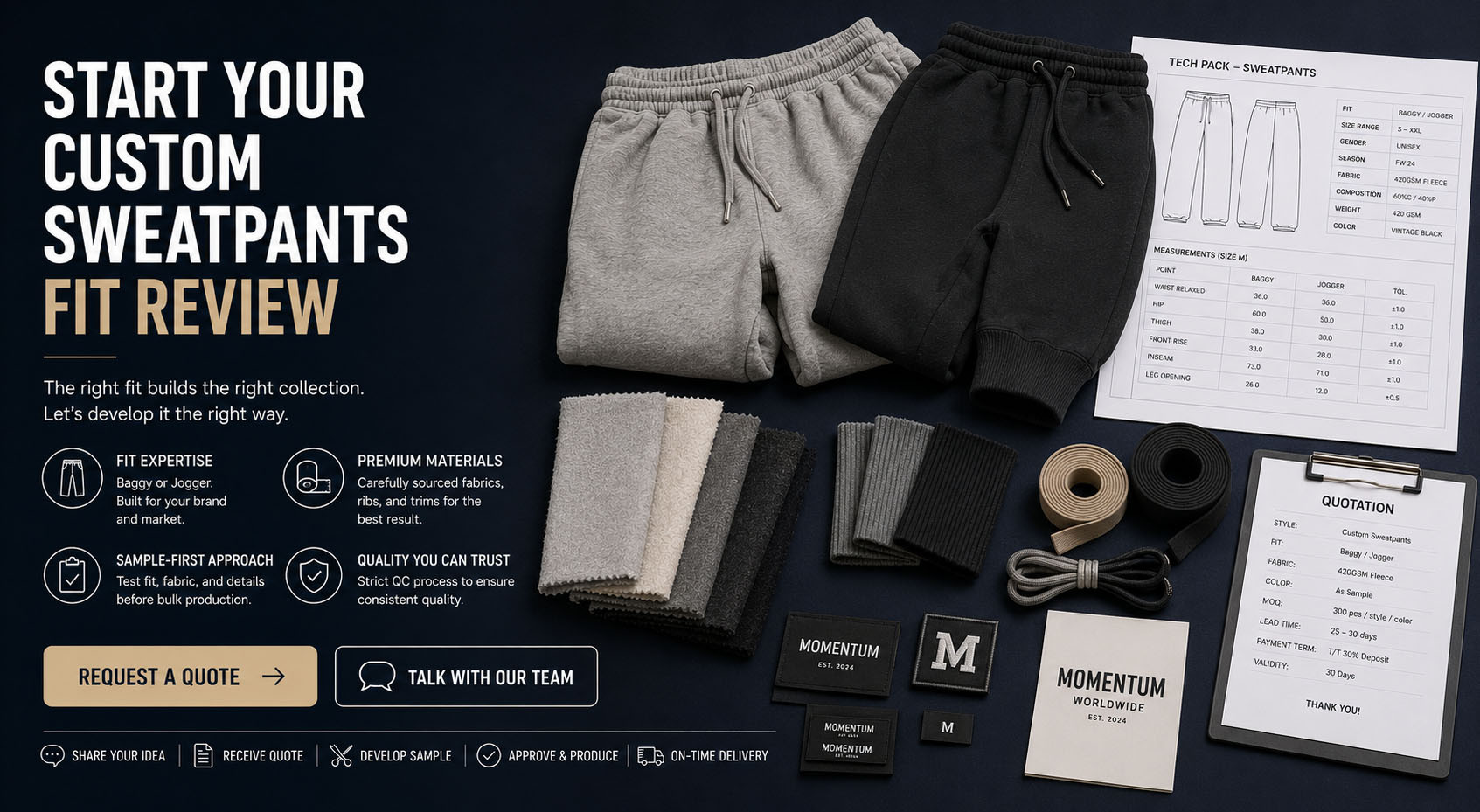
Tech pack if available
Size chart
Target fit direction
Fabric direction
Waistband requirement
Cuff requirement
Pocket layout
Logo artwork
Wash or decoration requirement
Target quantity
QC expectations
Vanrd's custom apparel service process explains how sampling, review, revision, and bulk production communication can be structured for custom apparel projects.
7. QC Points: What Changes Between Baggy Sweatpants and Joggers
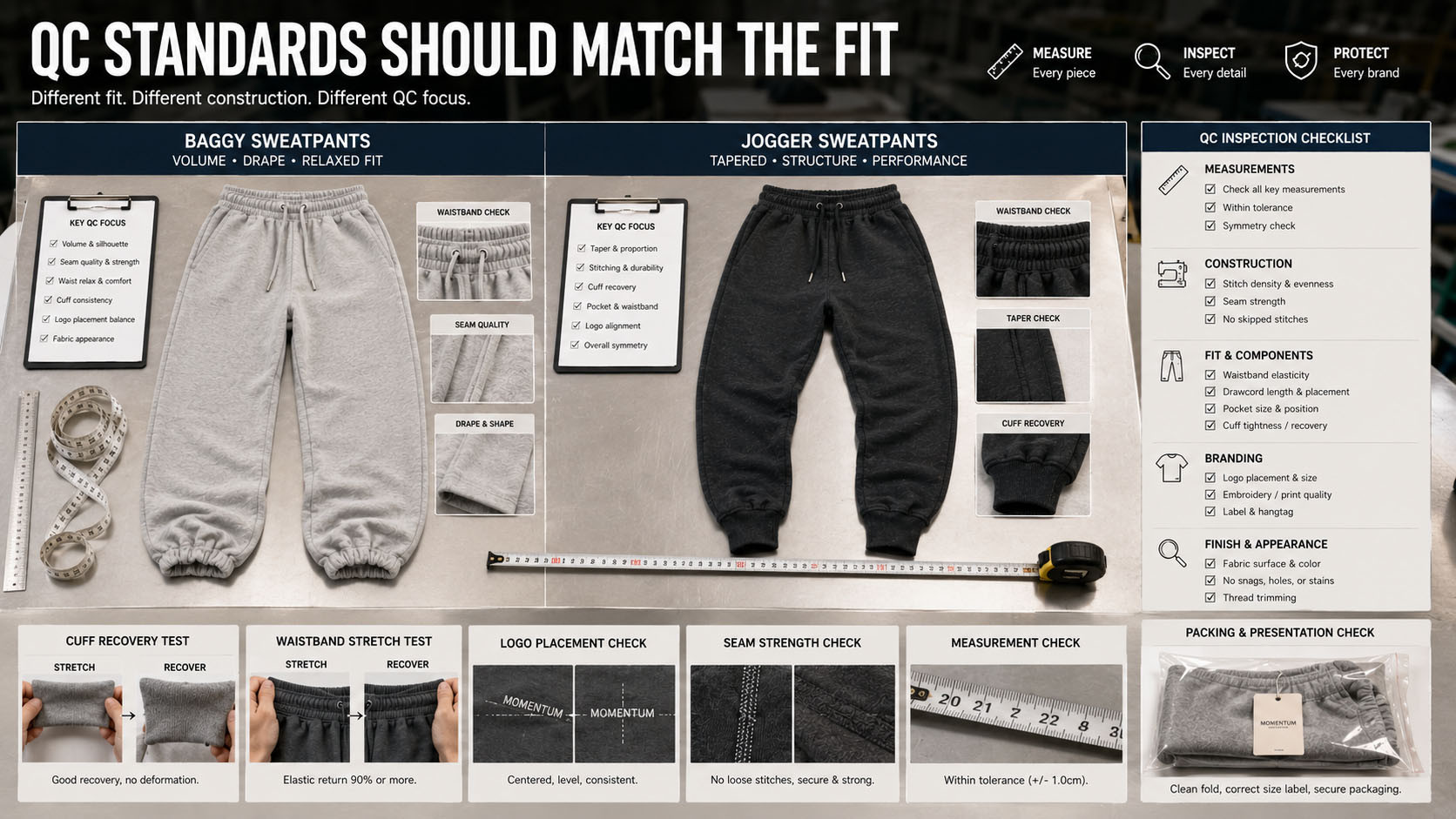
QC standards should match the fit type. A baggy sweatpant and a jogger may share some inspection points, but the emphasis is different.
QC for Baggy Sweatpants
Important points include:
Waist measurement
Rise
Hip width
Thigh width
Knee width
Inseam
Leg opening
Left and right balance
Fabric drape
Pocket symmetry
Logo placement
Shrinkage after wash if relevant
Baggy sweatpants need careful symmetry and measurement control because extra volume can make uneven areas more visible.
QC for Joggers
Important points include:
Waist measurement
Rise
Thigh width
Knee shape
Calf shape
Inseam
Cuff opening
Cuff recovery
Taper balance
Pocket placement
Logo placement
Stitching and loose threads
Joggers need stronger attention to cuff recovery and taper consistency. If the cuff or lower leg varies too much, the product may look inconsistent across sizes.
For inspection planning and quality standards, buyers can review Vanrd's quality control and inspection standards.
8. Factory Reality: Why Fit Choice Affects Cost, Timeline, and Risk
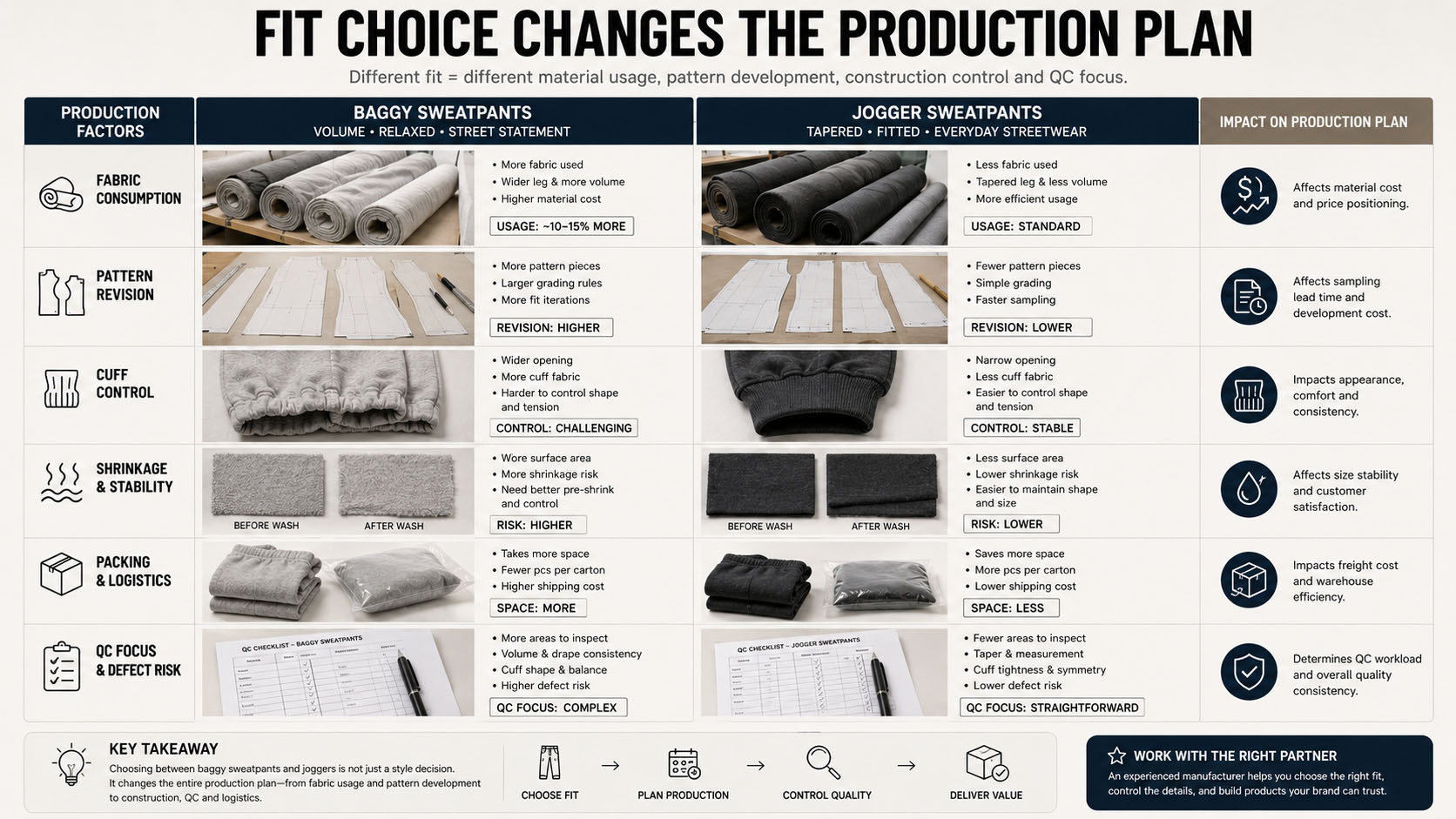
In real production, choosing between baggy sweatpants and joggers affects more than appearance. It can influence pattern work, fabric consumption, sample revisions, trims, sewing process, shrinkage control, and QC.
Baggy Sweatpants May Use More Fabric
Baggy sweatpants often use more material because they require more volume through the leg and body. This can affect quotation, cutting efficiency, and packing volume.
Joggers May Require More Cuff Control
Joggers may use less fabric than some baggy styles, but they rely more heavily on cuff quality, lower-leg taper, and rib recovery. A poor cuff can make the garment look weak.
Fit Revisions Can Change the Whole Pattern
Changing rise, thigh, knee, or leg opening can affect the full garment balance. Revisions should be specific and measurable, not vague.
Fabric Changes Can Require New Fit Testing
A fit approved in midweight fleece may not behave the same in heavyweight fleece or French terry. If the fabric changes, the brand may need to review fit again.
Bulk Production Needs Clear Approval Standards
A strong sample is not enough. The factory needs approved measurements, tolerance, fabric, trims, logo placement, packaging, and QC standards before bulk production.
9. Common Mistakes When Choosing Between Baggy Sweatpants and Joggers
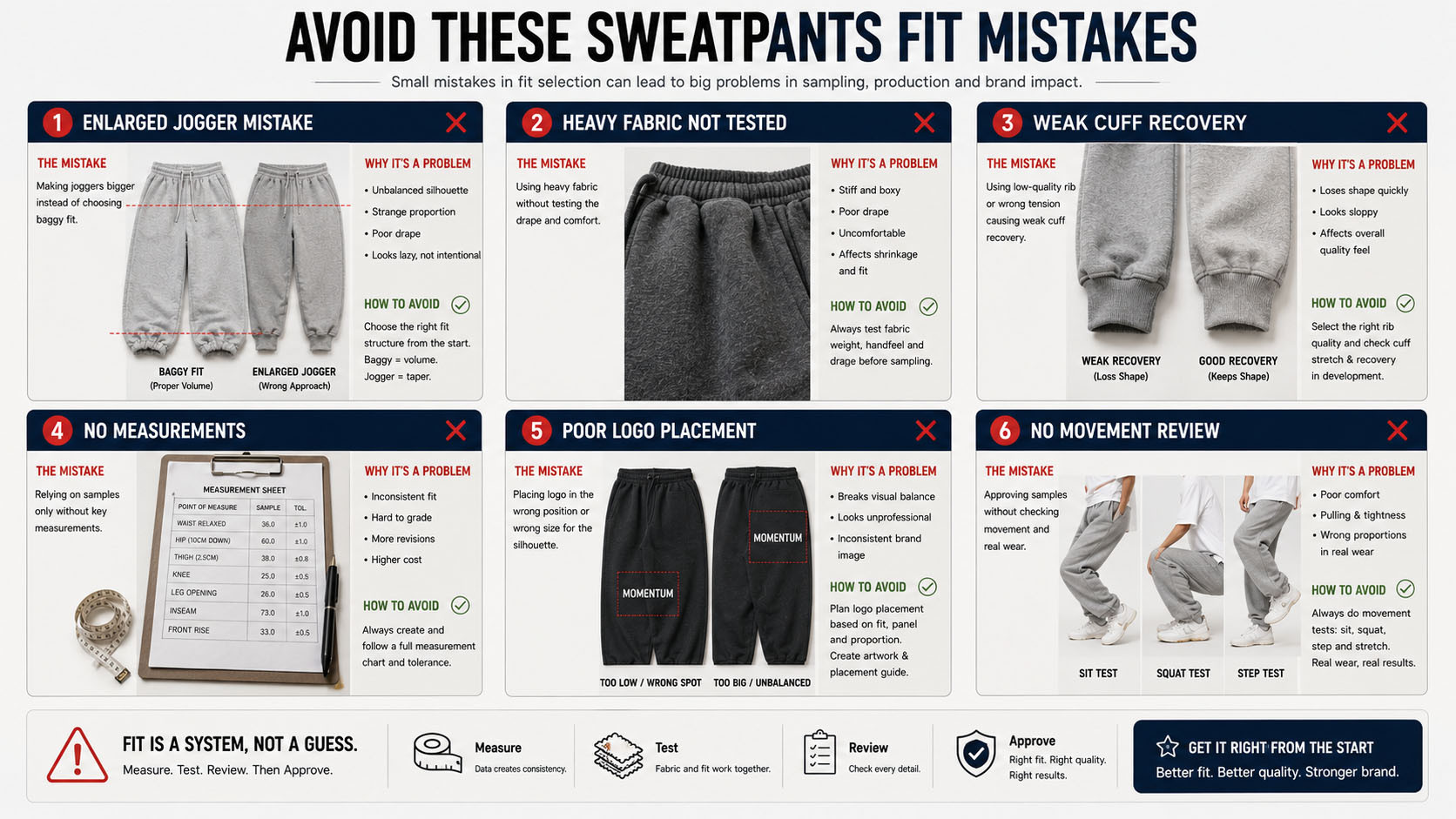
Most fit selection mistakes happen when brands choose based on trend images without checking production details.
Mistake 1: Making Joggers Bigger and Calling Them Baggy Sweatpants
Baggy sweatpants need their own pattern logic. Simply enlarging a jogger can create poor rise, awkward leg shape, and unbalanced proportions.
Mistake 2: Choosing Heavy Fabric Without Testing Fit
Heavy fabric may look premium, but it can feel bulky if the fit and construction are not planned correctly.
Mistake 3: Ignoring Cuff Recovery on Joggers
Joggers depend on cuff shape. Weak cuff recovery can make the whole garment look lower quality.
Mistake 4: Using Generic Fit Words Without Measurements
Words like baggy, relaxed, tapered, and oversized are not enough. The factory needs measurements and fit references.
Mistake 5: Placing Logos Without Checking the Real Pattern
Logo placement should be tested on the actual sample. Baggy and tapered legs change how graphics look when worn.
Mistake 6: Approving the Sample Without Movement Review
Sweatpants should be checked for comfort and movement, especially around rise, thigh, knee, waistband, and cuff.
10. Decision Checklist: Baggy Sweatpants or Joggers?
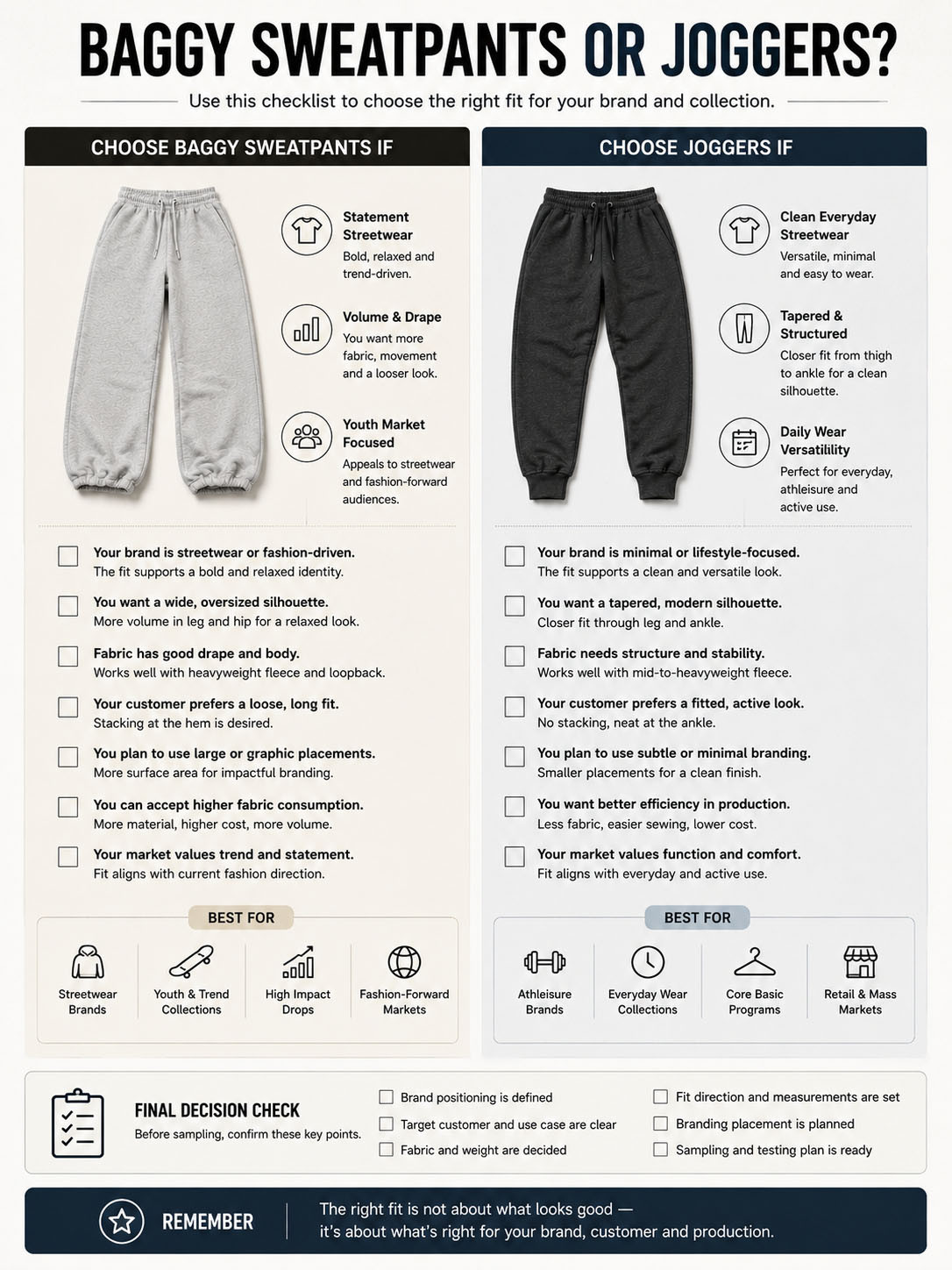
Use this checklist before choosing the fit direction for custom sweatpants sampling.
Choose Baggy Sweatpants If
Your brand wants a stronger streetwear silhouette
The target customer prefers oversized or relaxed fits
The design needs more leg volume
The product uses midweight or heavyweight fleece
You want visible drape or stacking
Logo placement needs more leg surface area
The product is part of a statement streetwear drop
Choose Joggers If
Your brand wants a cleaner everyday fit
The target customer prefers tapered bottoms
The product needs cuffed ankle control
The design is more athletic-to-streetwear
You want easier broad-market wearability
The fabric is midweight, French terry, or loopback
Logo placement is smaller or more minimal
Confirm Before Final Decision
Target fit
Fabric weight
Rise
Thigh width
Inseam
Leg opening
Cuff decision
Waistband construction
Logo placement
Wash or decoration method
Target quantity
QC tolerance
11. How to Communicate Fit Requirements to a Manufacturer
Fit requirements should be communicated with both words and measurements. A buyer should avoid saying only "make it baggy" or "make it tapered" without more detail.
Better Ways to Describe Baggy Sweatpants
Use clear descriptions such as:
"We want a relaxed rise with more thigh volume and a wider leg opening."
"We want a stacked effect, but not too much fabric bunching around the ankle."
"We want a baggy streetwear fit with a secure waistband."
"We want a wide-leg sweatpant without a tight jogger cuff."
Better Ways to Describe Joggers
Use clear descriptions such as:
"We want a tapered leg from thigh to cuff."
"We want a clean cuffed jogger shape for daily streetwear."
"We want the cuff to hold shape without feeling too tight."
"We want a relaxed upper leg but controlled lower leg."
What to Send With the Request
Send:
Reference images
Tech pack if available
Size chart
Target fit notes
Fabric direction
Waistband requirement
Cuff requirement
Logo artwork
Wash or decoration requirement
Target quantity
QC concerns
If some details are not final, clearly mark them as open for factory recommendation. This helps the manufacturer understand which decisions need support.
Next Steps Before Starting a Custom Sweatpants Sample
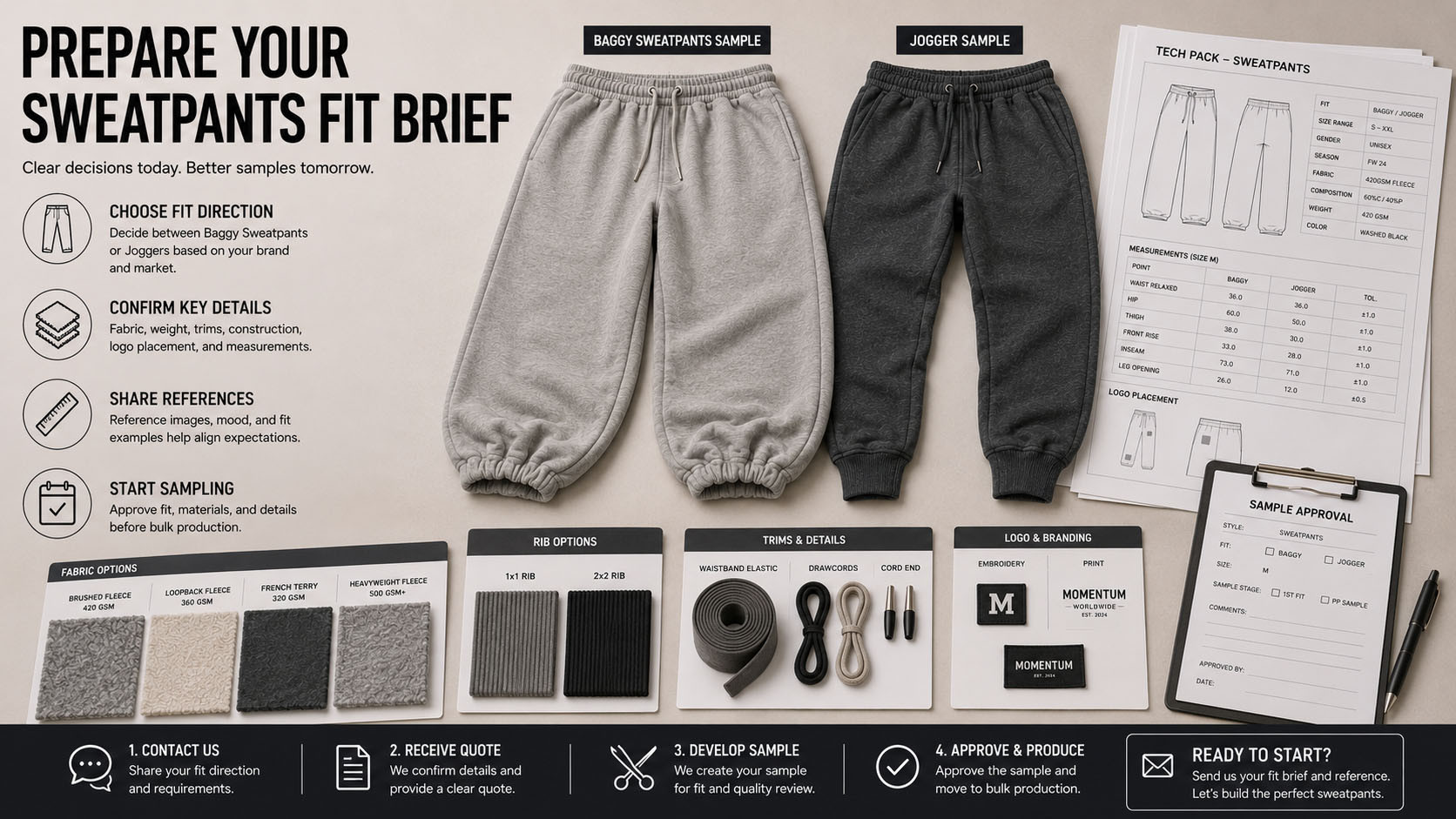
Before starting a custom sweatpants sample, brands should decide whether the product needs a bold baggy silhouette or a cleaner jogger fit. The choice should be based on brand positioning, target customer, fabric weight, construction, logo placement, and QC needs.
Prepare These Details First
Baggy or jogger direction
Target silhouette
Reference images
Size chart
Fabric structure preference
Approximate fabric weight
Waistband requirement
Cuff requirement
Logo placement
Wash or decoration method
Target quantity
QC concerns
Vanrd supports private label and streetwear buyers with custom sweatpants sampling, fit development, fabric selection, trim coordination, bulk production, and quality control. Buyers preparing a custom sweatpants project can also review Vanrd's factory strength before starting development.
FAQ
Are Baggy Sweatpants And Joggers The Same Thing?
No. Baggy sweatpants usually have more volume through the rise, thigh, knee, and leg opening. Joggers usually have a tapered leg and cuffed ankle. They require different pattern, fabric, and QC logic in custom manufacturing.
Which fit is better for a streetwear brand?
Baggy sweatpants are often better for brands that want a stronger oversized or vintage streetwear silhouette. Joggers are often better for brands that want a cleaner, tapered, everyday fit. The better choice depends on target customer and product positioning.
What fabric should I use for baggy sweatpants?
Baggy sweatpants often work better with midweight to heavyweight fleece that can hold volume and drape properly. However, the final fabric should be selected based on fit, season, wash process, comfort, cost, and production requirements.
What fabric should I use for joggers?
Joggers can use midweight fleece, French terry, loopback fleece, or lighter fleece depending on the intended hand feel and season. The fabric should work with the taper, cuff opening, and waistband structure.
How long does it take to sample baggy sweatpants or joggers?
Sampling time depends on fabric availability, pattern complexity, logo technique, wash requirement, trim sourcing, and buyer feedback speed. Baggy sweatpants with custom fit or washed effects may require more development review than basic joggers.
What files should I send before sampling?
Send reference images, tech pack if available, size chart, target fit notes, fabric direction, waistband and cuff requirements, logo artwork, wash or decoration requirements, target quantity, and QC expectations.
What should be approved before bulk production?
Before bulk production, buyers should approve fabric, color, fit, measurements, waistband, cuff, logo placement, decoration method, labels, packaging, and QC standards.
Final CTA
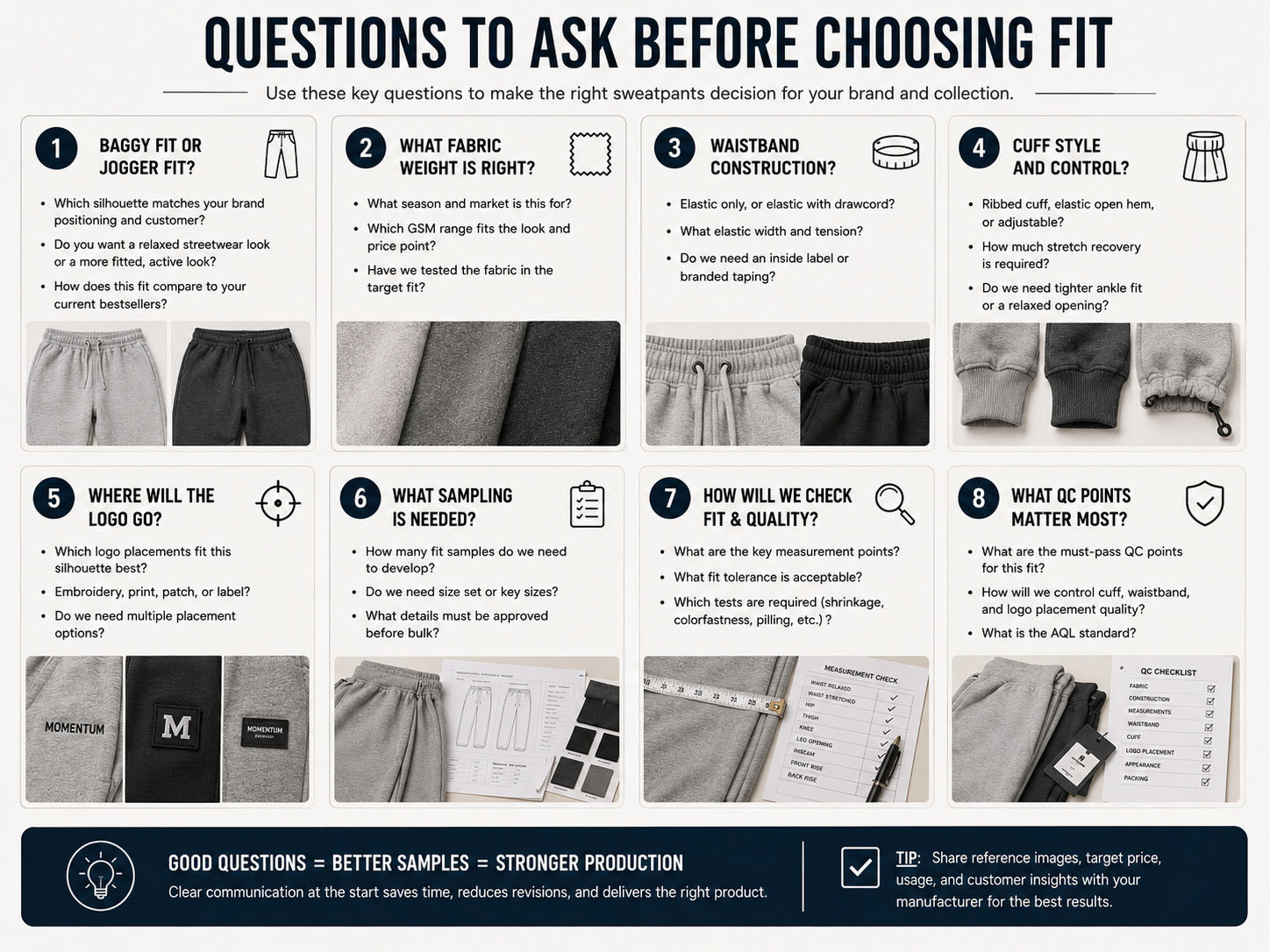
Choosing between baggy sweatpants and joggers should be based on brand positioning, target fit, fabric weight, waistband structure, cuff design, logo placement, sampling needs, and QC standards. A clear fit direction can make sampling more accurate and bulk production easier to control.
If your brand is developing baggy sweatpants, joggers, heavyweight fleece bottoms, washed sweatpants, or private label fleece pants, send your fit direction, reference images, tech pack, and target quantity to Vanrd. Our team can review your project requirements and help you plan the next step for sampling and production.
Contact Vanrd through the custom apparel inquiry page to discuss your custom sweatpants and jogger manufacturing requirements.